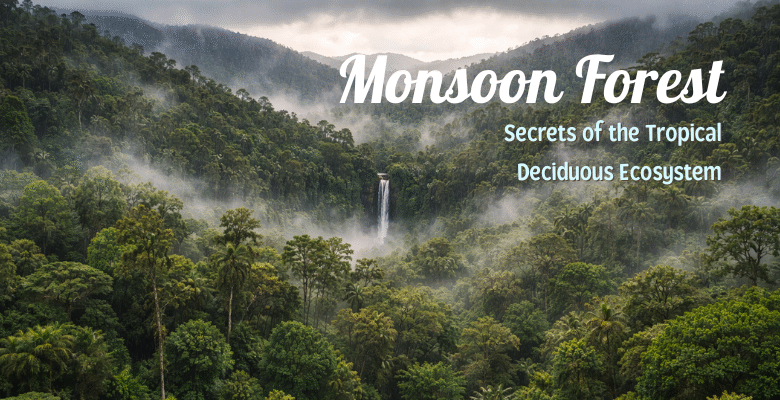
The world of tropical greenery is often pictured as a place of constant rain and unchanging humidity, but there is a specific type of woodland that lives by the beat of a seasonal drum. This is the monsoon forest, a resilient and dynamic ecosystem that undergoes a dramatic transformation twice every year. Unlike the famous evergreen rainforests that stay lush year-round, these forests are the ultimate survivalists of the natural world.
The term monsoon forest refers to tropical regions that experience distinct wet and dry seasons, forcing the vegetation to adapt to periods of extreme thirst followed by torrential downpours. These forests act as a vital bridge between the arid savannas and the dense rainforests, providing a home to some of the planet’s most iconic wildlife and valuable timber. Understanding how these forests breathe and change is essential for anyone interested in the delicate balance of our global climate.
Defining the Monsoon Forest: Nature’s Seasonal Shape-Shifters
Scientific Classification: The Tropical Deciduous Forest
In the world of ecology, the monsoon forest is scientifically known as a Tropical Deciduous Forest. The word “deciduous” comes from a Latin term meaning “to fall off,” which perfectly describes the primary characteristic of the trees in this region. These forests are strategically located in tropical areas that receive high annual rainfall but endure a long, harsh dry season.
Because the rain does not fall consistently throughout the year, the trees have developed a rhythmic life cycle. During the wet months, the canopy is a thick, vibrant green that rivals any rainforest in density. However, as the moisture disappears from the soil, the forest takes on a completely different appearance, often looking brown and skeletal until the rains return.
The Mechanism of “Leaf Drop” as a Survival Tactic
The most striking feature of the monsoon forest is the synchronized shedding of leaves. When the dry season begins, trees stop sending water to their leaves to prevent moisture loss through a process called transpiration. By dropping their leaves, the trees enter a state of dormancy, effectively “shutting down” to conserve every drop of water stored in their trunks and roots.
This survival tactic is what allows the monsoon forest to thrive in areas where other tropical plants would wither and die. This period of leaflessness also allows sunlight to reach the forest floor, which is a rare occurrence in dense rainforests. This sunlight triggers a brief but intense growth of grasses and shrubs before the canopy closes up again during the monsoon rains.
Key Differences Between Monsoon Forests and Rainforests
While both are tropical, the monsoon forest and the tropical rainforest are distinct in their structure and behavior. The primary differentiator is the distribution of rainfall rather than the total amount received. Rainforests have a “per-humid” climate with no true dry season, whereas the monsoon variety is defined by its seasonality.
| Feature | Monsoon Forest | Tropical Rainforest |
| Leaves | Deciduous (Shed seasonally) | Evergreen (Year-round) |
| Canopy Layers | Fewer layers, more open | Multiple, very dense layers |
| Rainfall | Seasonal (Wet/Dry cycle) | Consistent (Year-round) |
| Undergrowth | Thick and bushy | Sparse due to low light |
Global Distribution: Where These Green Giants Grow
The Heart of South and Southeast Asia
The most expansive and famous examples of the monsoon forest are found across South and Southeast Asia. Countries like India, Myanmar, Thailand, and Vietnam are home to massive stretches of these woodlands. These regions are dominated by the rhythmic shift of the Indian Ocean monsoons, which dictate the planting cycles for millions of people and the life cycles of the local wildlife.
In India, these forests cover a significant portion of the peninsula, particularly in the foothills of the Himalayas and the Western Ghats. These areas are not just biological hotspots; they are also the source of the region’s most famous hardwoods. The dense Asian monsoon forest remains one of the most productive and economically significant ecosystems in the Eastern Hemisphere.
Pockets of Life in Northern Australia and Central America
Beyond Asia, the monsoon forest appears in Northern Australia, where it is often referred to as “dry vine thickets.” These patches of forest are critical refuges for birds and mammals during the intense heat of the Australian dry season. They often grow around rocky outcrops or watercourses where a small amount of moisture lingers in the soil.
Central and South America also host significant areas of this ecosystem, particularly in regions like the Yucatan Peninsula and parts of Brazil. In these areas, the forest provides a buffer between the Amazonian rainforest and the drier scrublands. Each of these global pockets plays a specific role in maintaining regional biodiversity and protecting the soil from erosion.
Mapping the Impact of the ITCZ (Intertropical Convergence Zone)
The existence of the monsoon forest is largely driven by a global weather phenomenon known as the Intertropical Convergence Zone (ITCZ). This is a belt of low pressure that circles the Earth near the equator, where the trade winds of the Northern and Southern Hemispheres meet. As the ITCZ shifts north and south with the seasons, it brings the “rain belt” with it.
When the ITCZ moves over a region, it brings the heavy rains of the wet season. When it moves away, the region is left under the influence of dry, high-pressure air. This seasonal migration of the ITCZ is the physical engine that powers the monsoon forest, creating the distinct periods of growth and dormancy that define this habitat.
A Unique Ecosystem: Specialized Flora and Fauna
Dominant Tree Species: Teak, Sal, and Bamboo
The flora of the monsoon forest is dominated by species that are both fire-resistant and drought-tolerant. Teak (Tectona grandis) is perhaps the most famous resident, prized globally for its durable, water-resistant wood. Another essential species is the Sal tree, which forms vast, tall stands across the Indian subcontinent and is central to the local economy and culture.
Bamboo is also a staple of the monsoon forest, growing in thick, fast-spreading clumps that provide food and shelter for countless animals. These species have evolved thick bark to survive the occasional ground fires that occur during the peak of the dry season. The combination of these hardwoods and fast-growing grasses creates a varied and resilient landscape.
Wildlife Adaptations to the Dry and Wet Cycles
Animals living in the monsoon forest must be as adaptable as the plants they rely on. Many species have developed migratory patterns, moving toward permanent rivers or higher elevations when the forest turns dry and brown. Large herbivores like the Asian Elephant and the Indian Rhino are frequent inhabitants, moving through the underspread as the seasons change.
Predators like the Bengal Tiger and the Indochinese Leopard also thrive here, using the changing density of the forest to their advantage during hunts. Many smaller animals, including various species of monkeys and deer, time their breeding cycles so that young are born at the start of the wet season. This ensures that there is an abundance of fresh, green foliage available for the growing offspring.
The Role of Epiphytes and Undergrowth in the Monsoon Canopy
Because the canopy of a monsoon forest is less dense than a rainforest, more sunlight reaches the lower levels. This leads to a much richer and more developed undergrowth of shrubs, grasses, and young trees. During the wet season, this floor becomes a tangled web of greenery that provides perfect camouflage for ground-dwelling species.
Epiphytes, such as orchids and ferns, also cling to the branches of the larger trees. While they are not as numerous as they are in rainforests, they have adapted to store water in fleshy leaves or thick roots. These plants add a layer of complexity to the ecosystem, creating micro-habitats for insects and amphibians high above the ground.
Understanding the Dry Season vs Wet Season Cycle
The life blood of the monsoon forest is the transition between its two extreme seasons. The dry season can last anywhere from four to nine months, during which the landscape appears almost desert-like. The heat can be intense, and the lack of moisture tests the limits of every living thing in the forest.
When the monsoon finally arrives, the transformation is nearly instantaneous. Within days of the first heavy rains, the brown landscape turns into a lush emerald paradise. This “burst” of the monsoon triggers a frantic period of growth, flowering, and reproduction, as every species rushes to make the most of the available water.
Annual Rainfall Thresholds and Temperature Profiles
For a region to support a monsoon forest, it typically requires an annual rainfall between 700mm and 2,000mm. While this is a lot of water, the fact that it all falls within a few months is what creates the deciduous nature of the trees. Temperatures remain high throughout the year, usually averaging between 24°C and 30°C.
| Climate Variable | Typical Range in Monsoon Forest |
| Annual Rainfall | 700mm – 2,000mm |
| Dry Season Duration | 4 – 9 Months |
| Average Temperature | 24°C – 30°C (75°F – 86°F) |
| Humidity | High (Wet Season) / Low (Dry Season) |
How Monsoon Forests Regulate Local Water Tables
These forests play a critical role in the hydrological cycle of their regions. During the heavy rains, the complex root systems of the monsoon forest act like a sponge, slowing down the runoff and allowing water to seep deep into the ground. This recharges the local water tables, which are vital for human agriculture and drinking water during the dry months.
Without the forest cover, the heavy monsoon rains would simply wash away the topsoil in massive floods, leaving the land barren and dry shortly after the rain stops. The forest acts as a natural regulator, ensuring that the water provided by the monsoon is stored and released slowly. This makes the preservation of these forests a matter of life and death for the communities that surround them.
Conservation and the Future of Monsoon Forests
Despite their importance, the monsoon forest is one of the most threatened ecosystems on Earth. Because the soil in these regions is often very fertile, large tracts of forest are cleared every year to make room for farms, particularly for crops like rice, sugarcane, and palm oil. This habitat loss is devastating for the wildlife that depends on the seasonal cycles.
As the forests are fragmented, animals like elephants find it harder to migrate between their seasonal feeding grounds. This leads to increased human-wildlife conflict as animals wander into farms in search of food. Protecting the remaining corridors of monsoon forest is essential for maintaining the peace between nature and human civilization, making it more important than ever to save the wildlife by preserving the natural pathways they have used for generations.
The Economic Value of Monsoon Timber and Resources
The economic pressure on these forests is immense because they contain some of the world’s most valuable timber. Teak and Sal are in high demand for luxury furniture and construction, leading to both legal and illegal logging operations. While timber can be a sustainable resource, over-harvesting can destroy the forest’s ability to regenerate.
Beyond wood, these forests provide non-timber products like medicinal plants, resins, and honey. Many indigenous communities rely entirely on the monsoon forest for their livelihoods and spiritual practices. Balancing the global demand for resources with the local need for a healthy ecosystem is one of the greatest challenges of modern conservation.
Strategies for Preserving These Essential Carbon Sinks
As the world grapples with climate change, the role of the monsoon forest as a carbon sink has become a major focus. These forests absorb massive amounts of carbon dioxide during their rapid growth phases in the wet season. Protecting them is a cost-effective way to mitigate the impacts of global warming while preserving biodiversity.
Current conservation strategies include the creation of national parks, the implementation of sustainable logging practices, and reforestation projects. By educating local communities and providing economic alternatives to deforestation, we can ensure that the monsoon forest continues to thrive. The future of the World’s Happiest Animal (the quokka) might be in Australia, but the future of our tropical climate depends heavily on these seasonal giants.
The monsoon forest is a testament to the resilience of nature. It teaches us that life can find a way to flourish even in the face of extreme seasonal change. By protecting these forests, we are not just saving trees; we are securing the water, the weather, and the wildlife that make our planet a vibrant and livable home.