Endangered Species Guide 2026: Meaning, List & Conservation
The Ultimate 2026 Roadmap to India's Wildlife & Global Conservation.

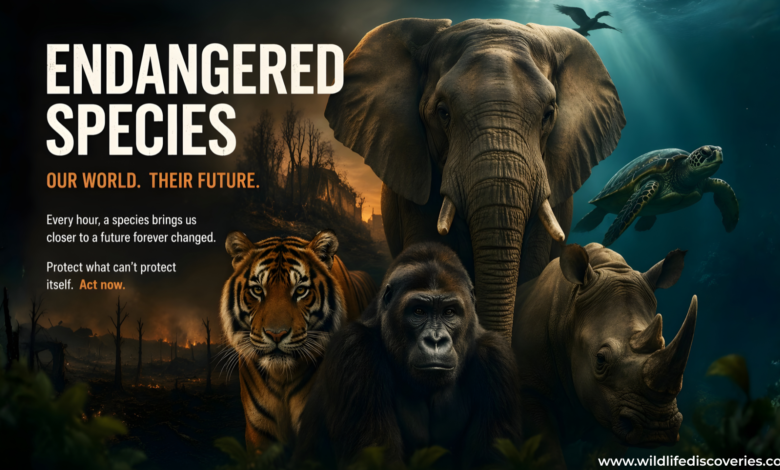
The year 2026 marks a pivotal moment in our relationship with the natural world. As we navigate the mid-point of a decade dedicated to ecosystem restoration, the term endangered species has moved from the pages of textbooks to the forefront of global policy and daily conversation. Our planet’s biodiversity is the silent engine that keeps our air clean, our water pure, and our food systems stable. Yet, that engine is stuttering.
In this ultimate guide, we will dive deep into what it means for a species to be “endangered,” look at the latest 2026 data, explore the most at-risk animals in India and across the globe, and discuss how modern technology from AI to drones—is giving us a fighting chance to save them.
What is an Endangered Species?
At its simplest, an endangered species is a type of organism (animal, plant, or fungus) that is at a very high risk of becoming extinct in the wild. But “endangered” isn’t just a general word; it’s a specific scientific classification used by the International Union for Conservation of Nature (IUCN).
The IUCN maintains the “Red List of Threatened Species,” often called the “Barometer of Life.” This list categorizes species based on their population size, rate of decline, and geographic range.
The IUCN Categories
To understand the gravity of the situation, it helps to see where “endangered” sits on the scale:
Least Concern: Population is stable and widespread.
Near Threatened: Likely to become threatened in the near future.
Vulnerable: High risk of extinction in the wild.
Endangered: Very high risk of extinction in the wild.
Critically Endangered: Extremely high risk of extinction in the wild (the final stop before extinction).
Extinct in the Wild: Only survive in captivity (zoos or labs).
Extinct: No living individuals remain anywhere.
Latest Data: The 2026 State of Wildlife
As of April 2026, the data paints a complex picture. On one hand, we have seen incredible recoveries thanks to intensive wildlife conservation efforts; on the other, the “Triple Threat” of climate change, habitat fragmentation, and illegal trade is accelerating.
Global Overview: There are now over 172,600 species on the IUCN Red List. Out of these, more than 48,600 are threatened with extinction.
The Breakdown: * 44% of reef-building corals are currently threatened (a sharp rise due to 2025’s record ocean temperatures).
41% of amphibians are at risk.
26% of mammals and 11.5% of birds are on the brink.
The 2026 Census Trends: Modern tracking has revealed that while some large mammals like the Asiatic Lion are seeing slight population bumps, smaller, less “charismatic” species—like the European eel and various tropical spiders—are disappearing at record rates.
The Endangered Species List: Global & India
The endangered species list is a living document. Every year, species are added or moved between categories based on new field data.
Global Endangered Species 2026
European Eel: Once a common sight, its population has plummeted by 95% in the last few decades.
Cao-vit Gibbon: The world’s second-rarest primate. Only about 74 individuals remain in the wild.
Saker Falcon: Highly prized in falconry, their wild numbers have dropped below 30,000.
Clouded Leopard: Targeted for their striking pelts and teeth, these elusive cats are facing a crisis in Southeast Asia.
Tropical ecosystems are the planet’s primary biodiversity hubs, yet they face the most aggressive deforestation rates globally. Understanding the specific threats to these regions requires a closer look at the Endangered Animals of Rainforest that are currently fighting for survival amidst shrinking canopies. Protecting these specialized habitats is the first critical step in reversing the trend of global species loss.
Endangered Animals in India
India is a megadiverse country, but that diversity is under heavy pressure. In 2026, the Zoological Survey of India (ZSI) identified over 300 species in the country as “Endangered” or “Critically Endangered.”
Bengal Tiger: While Project Tiger (now merged with Project Elephant) has stabilized numbers, habitat fragmentation remains a major hurdle.
Asiatic Lion: Found only in the Gir landscape of Gujarat. While the 2025 census reported 891 individuals, experts are worried about “hyper-endemism”—if a disease hits Gir, the entire species could vanish.
Gangetic River Dolphin: India’s National Aquatic Animal. Current estimates suggest around 6,300 remain, but they face constant threats from river pollution and fishing nets.
Snow Leopard: The rugged terrain of the Indian Himalayas is home to a predator so elusive it is rarely spotted by even the most seasoned mountain patrols. Gaining insight into the Snow Leopards: Secrets of the Himalayan Ghost Cat is vital for understanding how these animals survive in extreme high-altitude environments where few other species can exist. Their presence remains a key biological indicator for the health and security of our northern borders’ unique biodiversity.
Indian Rainbow Tarantula: A strikingly iridescent spider found in the Western Ghats, currently being decimated by the illegal exotic pet trade.
India’s commitment to wildlife is best exemplified by its rigorous management of apex predators within dedicated protected zones. For defense aspirants and conservationists alike, staying updated on the Tiger Reserves in India 2025: Latest Update State-Wise List is essential to understanding how strategic land management helps stabilize populations. These reserves serve as the backbone of India’s ecological security and biodiversity monitoring efforts.
Critically Endangered Species: The Brink of Extinction
A critically endangered species is one that is facing an “extremely high” risk of extinction. These are the species that could disappear within our lifetime if we don’t act now.
The Vaquita: This tiny porpoise in the Gulf of California is the world’s most endangered marine mammal, with likely fewer than 10 individuals left in 2026.
The Great Indian Bustard (GIB): Perhaps India’s most at-risk bird. With fewer than 140 left, they are struggling against high-voltage power lines that crisscross their grassland homes in Rajasthan.
Javan Rhino: Surviving only in one national park in Indonesia, their population is extremely vulnerable to natural disasters.
Malabar Large-Spotted Civet: One of the world’s rarest mammals, endemic to India’s Western Ghats. It hasn’t been reliably sighted in years, leading some to fear it may already be gone.
Major Causes of Species Becoming Endangered
Why are so many animals and plants struggling? It is rarely just one thing. Usually, it’s a “cocktail” of human-driven factors.
1. Habitat Loss and Fragmentation
This remains the #1 cause. Whether it’s for palm oil plantations, urban sprawl, or mining, we are destroying the homes of wildlife.
Fragmentation: Even if we leave some forest behind, cutting it into small pieces with roads and railways makes it hard for animals to find mates or food. In India, “linear infrastructure” like highways now cuts through 70% of wildlife corridors.
2. The Illegal Wildlife Trade (Poaching)
Poaching isn’t just about ivory and rhino horns. In 2026, the trade includes rare orchids, colorful spiders, and exotic birds. The “dark web” has unfortunately made it easier for poachers to find buyers for these critically endangered species.
3. Invasive Species
When we introduce a non-native species (like rats on islands or lantana bushes in Indian forests), they often outcompete or eat the local wildlife, who have no natural defenses against them.
4. Pollution
From plastic in the deepest trenches of the ocean to pesticides in our soil, chemical pollution disrupts the reproductive systems of many endangered species, leading to a slow population collapse.
Endangered Species Act and Laws
To fight back, governments have enacted powerful laws. The most famous is the Endangered Species Act (ESA) of the United States, which has saved species like the Bald Eagle from extinction.
In India, the Wildlife Protection Act (1972) serves a similar purpose.
The 2025-2026 Overhaul: Recently, India merged Project Tiger and Project Elephant into a single unified division. This “landscape approach” aims to protect entire ecosystems rather than just one animal.
International Laws: CITES (Convention on International Trade in Endangered Species) is the global treaty that regulates the trade of over 38,000 species to ensure their survival is not threatened.
Importance of Wildlife Conservation: Why Should We Care?
You might wonder, “Why does it matter if a small spider or a specific bird goes extinct?”
1. The Domino Effect: Every species is a thread in a web. If you pull out enough threads, the whole thing collapses. For example, if we lose bees (many of which are endangered), our ability to grow food is severely compromised.
2. Medical Breakthroughs: Many of our medicines, from heart medication to cancer treatments, come from plants and animals. We might be losing the cure for a future pandemic before we’ve even discovered the species that holds it.
3. Climate Regulation: Healthy forests and oceans (maintained by the animals that live in them) are our best defense against global warming.
Global conservation strategies often rely on international recognition to provide a legal and protective shield for vulnerable ecosystems. Exploring the 10 UNESCO Sites with Hidden Wildlife reveals how these heritage locations act as vital sanctuaries for rare species that might otherwise be overlooked. By preserving these world-renowned landscapes, we ensure that both cultural heritage and biological diversity are safeguarded for future generations.
Methods of Conservation: Old vs. New
Wildlife conservation has evolved. While traditional “boots-on-the-ground” patrolling is still vital, 2026 has seen a surge in tech-driven solutions.
Traditional Methods
Protected Areas: National parks and wildlife sanctuaries.
Ex-situ Conservation: Captive breeding in zoos and seed banks (like the successful Great Indian Bustard breeding center in Jaisalmer).
The 2026 Tech Revolution
AI and Drones: In 2026, the “Global Conservation Tech Forum” highlighted how autonomous drones now use thermal imaging to spot poachers at night.
eDNA (Environmental DNA): Scientists can now take a sample of water from a river and tell you every species that has swam through it in the last 48 hours just by analyzing the DNA left behind.
Smart Corridors: AI-driven sensors like India’s “Gajraj” system are being installed on railway tracks to alert train drivers when elephants are nearby, preventing tragic collisions.
Climate Change Impact on Endangered Species
Climate change is no longer a future threat; it is a current reality.
Thermal Stress: Animals like the Snow Leopard are being forced into “climate migration,” moving higher into the mountains as the lower slopes become too warm.
Altered Cycles: Plants are blooming earlier, and birds are migrating sooner. Often, these cycles get “out of sync”—a bird might arrive at its destination before the insects it needs to eat have hatched.
Ocean Acidification: As the sea absorbs $CO_2$, it becomes more acidic, dissolving the shells of sea creatures and killing coral reefs.
Endangered vs. Extinct: What’s the Difference?
It is easy to confuse these terms, but there is a massive difference in terms of hope.
| Feature | Endangered Species | Extinct Species |
| Definition | At high risk of vanishing soon. | No individuals left alive. |
| Status | Can still be saved with action. | Gone forever (no “undo” button). |
| Example | Bengal Tiger, Blue Whale. | Dodo, Passenger Pigeon. |
| IUCN Category | Endangered or Critically Endangered. | Extinct (EX). |
| Human Action | Requires intensive conservation. | Focus shifts to preventing others. |
Conclusion: A Call to Action
Protecting endangered species is not just the job of scientists and governments. In 2026, every choice we make from the products we buy to the policies we support—ripples through the natural world. Whether it’s reducing our carbon footprint or supporting organizations like the IUCN or local wildlife trusts, our collective effort is the only thing standing between a species’ survival and its permanent disappearance.
The list of endangered animals in India and across the globe is a warning, but it’s also a roadmap. It shows us exactly where we need to focus our energy. If we can save the Tiger, the Lion, and the Great Indian Bustard, we aren’t just saving animals—we are saving the very systems that sustain human life.