The world is rich with history, marked by the stone monuments and ancient ruins of past civilizations. Equally, the planet teems with life, from the smallest insect to the largest mammal. Rarely, however, do these two magnificent aspects—cultural heritage and wild biodiversity—meet and thrive in the same location. This intersection is precisely what the United Nations Educational, Scientific and Cultural Organization (UNESCO) seeks to protect through its World Heritage Sites program.
These sites offer a unique dual mandate: preserving irreplaceable human history while safeguarding critical natural ecosystems. They represent a living laboratory where the past meets the present, and where the incredible drama of evolution continues to unfold. This exploration highlights 10 UNESCO Sites with Hidden Wildlife that offer far more than just historical sightseeing. These are places where you can witness the incredible power of conservation protecting both monuments and the animals that now call them home.
The concept of a sanctuary for both human history and the natural world is a powerful one. It reminds us that our story is inseparable from the health of the planet around us. By touring these protected areas, one gains an appreciation not only for ancient achievements but also for the critical role of these 10 UNESCO Sites with Hidden Wildlife in global biodiversity efforts.
Where Ruins Roam: Wildlife Among Ancient Civilizations
The first group of sites focuses on places recognized primarily for their cultural and historical significance, yet which now serve as vital habitats for extraordinary animal life. Nature has reclaimed the edges of these ancient settlements, creating an ecological haven.
(a) Machu Picchu, Peru
This Incan citadel, perched high in the Andes mountains, is one of the world’s most recognized archaeological wonders. Yet, its location within the rugged cloud forest of the Historic Sanctuary of Machu Picchu makes it a crucial biodiversity hotspot. Visitors often focus on the stonework, missing the vibrant wildlife thriving just beyond the main terraces.
The Andean Condor, one of the largest flying birds in the world, soars on thermal currents high above the peaks. More elusive is the Spectacled Bear (or Andean Bear), South America’s only bear species, which navigates the humid, dense forest slopes in search of fruit and plants. While you are guaranteed to see the domesticated Llamas and Alpacas grazing the lawns, keep an eye out for the small, rabbit-like Vizcacha darting among the rocks. This stunning combination of architectural genius and unique animal life truly defines this as one of the essential 10 UNESCO Sites with Hidden Wildlife.
(b) Tikal National Park, Guatemala
The monumental ruins of the ancient Mayan city of Tikal are surrounded by a vast, protected rainforest in the heart of the Petén Basin. Tikal is one of the few sites inscribed on the UNESCO list for both cultural and natural criteria, underscoring its dual importance. The massive stone temples rise high above the jungle canopy, offering incredible vantage points for wildlife viewing.
The park is home to five species of wild cats, including the stealthy Jaguar and the Puma, though sightings are rare. Much more common are the Spider Monkeys and Howler Monkeys, whose loud calls echo throughout the park from the treetops. Over 300 species of birds can be found here, making it a birdwatcher’s paradise, with colorful toucans and the rare Ocellated Turkey commonly seen near the ancient plazas. Protecting this forest is paramount to the survival of the Jaguar and is why this is a prime example of 10 UNESCO Sites with Hidden Wildlife.
(c) Sigiriya, Sri Lanka
Often called the Lion Rock, Sigiriya is a dramatic rock fortress that served as the capital during the reign of King Kashyapa in the 5th century. The cultural site includes intricate frescoes, mirror walls, and a spectacular water garden complex. However, the surrounding dry zone forest and wetlands are part of a crucial migratory path for one of Asia’s great megafauna.
The site is known for supporting a significant population of Sri Lankan Elephants. These magnificent animals, the largest of the Asian elephant subspecies, frequently move through the surrounding protected areas. Furthermore, the area is home to nocturnal and secretive small cats, including the Fishing Cat and the rare Rusty-Spotted Cat. The forested environment is also vital for the Toque Macaque and a high number of endemic bird species, highlighting its important place among 10 UNESCO Sites with Hidden Wildlife.
(d) Komodo National Park, Indonesia
This location gained its World Heritage status specifically because of its most famous resident: the Komodo Dragon, the world’s largest lizard. While the islands of Komodo, Rinca, and Padar are of volcanic origin and have striking savannah landscapes, the UNESCO designation protects both the unique reptile and the marine environment that surrounds it. The site’s unique blend of white and pink sand beaches, like the one in the photograph, combined with rugged hillsides, create a spectacular setting.
The dragons are the apex predator, preying on other species found in the park, such as the Timor Deer and Wild Boar. The rich coral reefs and strong currents surrounding the islands place this site within the Coral Triangle, making it a critical marine biodiversity hub. Giant Manta Rays, various species of whales, and Dugongs (sea cows) frequent the protected waters, proving that 10 UNESCO Sites with Hidden Wildlife often protect the water as much as the land.
(e) Ngorongoro Conservation Area, Tanzania
This area is unique because it protects a vast, unbroken landscape that contains archaeological sites charting human evolution, such as Olduvai Gorge, alongside one of the greatest concentrations of large mammals on Earth. The spectacular Ngorongoro Crater, a massive, intact volcanic caldera, acts as a natural enclosure for wildlife.
The crater floor supports approximately 25,000 large animals, including the highest density of lions anywhere in the world. The entire “Big Five” (Lion, Leopard, Elephant, Rhino, and Buffalo) can be found here. Most importantly, the conservation area is a critical sanctuary for the severely endangered Black Rhinoceros, with a carefully monitored population thriving within the crater. The annual Great Migration of Wildebeest also passes through the wider conservation area, reinforcing this location’s status as one of the ultimate 10 UNESCO Sites with Hidden Wildlife.
The Planet’s Wildest Masterpieces: Natural Heritage Hotspots
The following section shifts focus to sites primarily recognized for their exceptional natural value and biodiversity. These are the planet’s biological treasures, where protection efforts center on maintaining delicate ecological balances.
(f) Sichuan Giant Panda Sanctuaries, China
This vast sanctuary, spanning multiple reserves across the Qionglai and Jiajin Mountains, is dedicated to the survival of the world’s most recognizable and endangered bear. The UNESCO inscription protects the largest remaining contiguous area of habitat for the Giant Panda, which relies almost exclusively on the bamboo forests here. This site holds over 30% of the world’s total wild population.
The region’s value extends far beyond the pandas. The temperate forests here are some of the botanically richest outside of tropical rainforests. This rich flora supports other globally threatened species, including the charming Red Panda, the elusive Snow Leopard, and the Clouded Leopard. The immense effort required to protect this shy, specialized bear highlights why conserving habitat for species like the Giant Panda is a key focus among the 10 UNESCO Sites with Hidden Wildlife.
(g) Sundarbans, India & Bangladesh
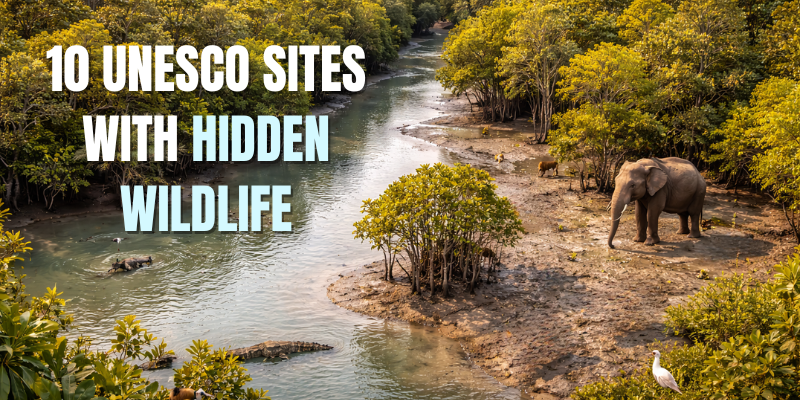
The Sundarbans, meaning “beautiful forest,” is the largest single block of tidal halophytic mangrove forest in the world, spanning the border between India and Bangladesh. It is a dynamic, shifting delta formed by the confluence of the Ganges, Brahmaputra, and Meghna rivers, a unique ecosystem that thrives in saltwater conditions.
This is the only mangrove forest in the world that is home to the Bengal Tiger. These tigers are famous for their unique, semi-aquatic lifestyle, swimming across the many rivers and channels in search of prey like Chital Deer and Wild Boar. The vast waterways also support the endangered Irrawaddy Dolphin and the Saltwater Crocodile. The fragile balance of the ecosystem and the specialized nature of its apex predator define the significance of this location among the 10 UNESCO Sites with Hidden Wildlife.
(h) Bwindi Impenetrable National Park, Uganda
Bwindi is a true rainforest jewel, a vast and ancient Afromontane forest that represents a vital intersection of biological zones. The park’s altitude range and position at the edge of the Albertine Rift Valley have made it a refugium for countless species, giving it one of the highest diversities of trees and ferns in East Africa.
The park is most famous for being home to almost half of the world’s population of the critically endangered Mountain Gorilla. The gorilla-trekking tourism industry is carefully managed to fund conservation efforts that protect these magnificent great apes. The forest also hosts Chimpanzees, L’Hoest’s Monkeys, and a high number of endemic bird species, making it an essential stronghold for primate conservation and a significant location among 10 UNESCO Sites with Hidden Wildlife.
(i) Kakadu National Park, Australia
Kakadu is one of the few sites globally that meets all four of the criteria for Natural Heritage and three of the criteria for Cultural Heritage, making its universal value exceptional. It encompasses a diverse landscape from tidal flats and floodplains to low-lying stone country, and it holds a 40,000-year history of Aboriginal habitation, documented through ancient rock art.
Its wetlands are of international importance, providing a refuge for over 280 species of birds, including the iconic Magpie Goose. The park’s waters are ruled by the massive Saltwater Crocodile, a prehistoric survivor that is an apex predator throughout the ecosystem. The dry woodlands and stone country are also home to the elusive Black Wallaroo and Dingoes. The protection of both the world’s longest-living cultural history and this incredible landscape is the core mission of this crucial location among the 10 UNESCO Sites with Hidden Wildlife.
(j) Yellowstone National Park, USA
As the world’s first national park, Yellowstone set the standard for protected lands globally and was one of the earliest sites inscribed on the UNESCO list. It is a natural wonder, sitting atop a gigantic volcanic caldera, famous for its geothermal features like the Old Faithful geyser. It is the core of one of the last remaining intact large ecosystems in the northern temperate zone.
Yellowstone is synonymous with North American wildlife conservation. Its most notable success story is the reintroduction of the Gray Wolf, a process that restored balance to the entire ecosystem, controlling Elk populations and allowing the regeneration of willow and aspen trees. The park is home to the largest, continuously free-ranging herd of American Bison and healthy populations of Grizzly Bears, making it a powerful symbol of wilderness and a leading example of the 10 UNESCO Sites with Hidden Wildlife.
A Global Sanctuary: Comparing Heritage and Habitat
The sites chosen for this list represent a cross-section of global conservation priorities. It shows that whether a site is culturally or naturally inscribed, the result is often the same: a safe haven for vulnerable species.
| UNESCO Site Category | Site Example | Iconic Wildlife Protected | Key Heritage Feature |
| Cultural/Mixed | Machu Picchu, Peru | Spectacled Bear, Andean Condor | Incan Citadel |
| Cultural/Mixed | Ngorongoro, Tanzania | Black Rhino, Lion, Wildebeest | Olduvai Gorge (Archaeology) |
| Natural | Sundarbans, India/BD | Bengal Tiger, Irrawaddy Dolphin | World’s Largest Mangrove Forest |
| Natural | Bwindi, Uganda | Mountain Gorilla, Chimpanzee | Afromontane Impenetrable Forest |
| Mixed | Kakadu, Australia | Saltwater Crocodile, Magpie Goose | 40,000 years of Aboriginal Rock Art |
| Natural | Yellowstone, USA | Gray Wolf, Grizzly Bear, Bison | Geothermal Features (Geysers) |
This comparison highlights the diversity of challenges and successes. In sites like Ngorongoro and Kakadu, the presence of ancient human history and artifacts is inextricably linked to the landscape that supports the wildlife. The designation ensures that both are managed cohesively.
Conservation in Action: The Impact of Heritage Status
The inscription of a site on the World Heritage list provides more than just prestige; it provides a framework for global conservation. Being recognized as one of the 10 UNESCO Sites with Hidden Wildlife often brings international funding, expertise, and political attention necessary to combat localized threats.
This increased scrutiny helps to fund anti-poaching units, ecological research, and sustainable tourism programs. These programs are often the only things separating an endangered species from extinction. The economic boost from tourism, carefully controlled, provides local communities with a tangible reason to save the wildlife and cultural treasures on their doorstep, transforming former poachers into conservation partners and guides. The success of species like the Giant Panda and the Mountain Gorilla is a direct reflection of this international cooperation.
Protecting these areas is an acknowledgment that a rich culture and a thriving ecosystem are mutually dependent. Without the healthy forest of Tikal, the Mayan ruins would quickly be overcome and damaged. Without the dedicated protection of the Sichuan reserves, the Giant Panda would likely vanish. The 10 UNESCO Sites with Hidden Wildlife serve as a powerful reminder that preservation is a continuous, integrated effort.