9100-Meter Mystery Mollusc: New Deep-Sea Discovery
How an Extraordinary Deep-Sea Creature is Redefining Biological Limits

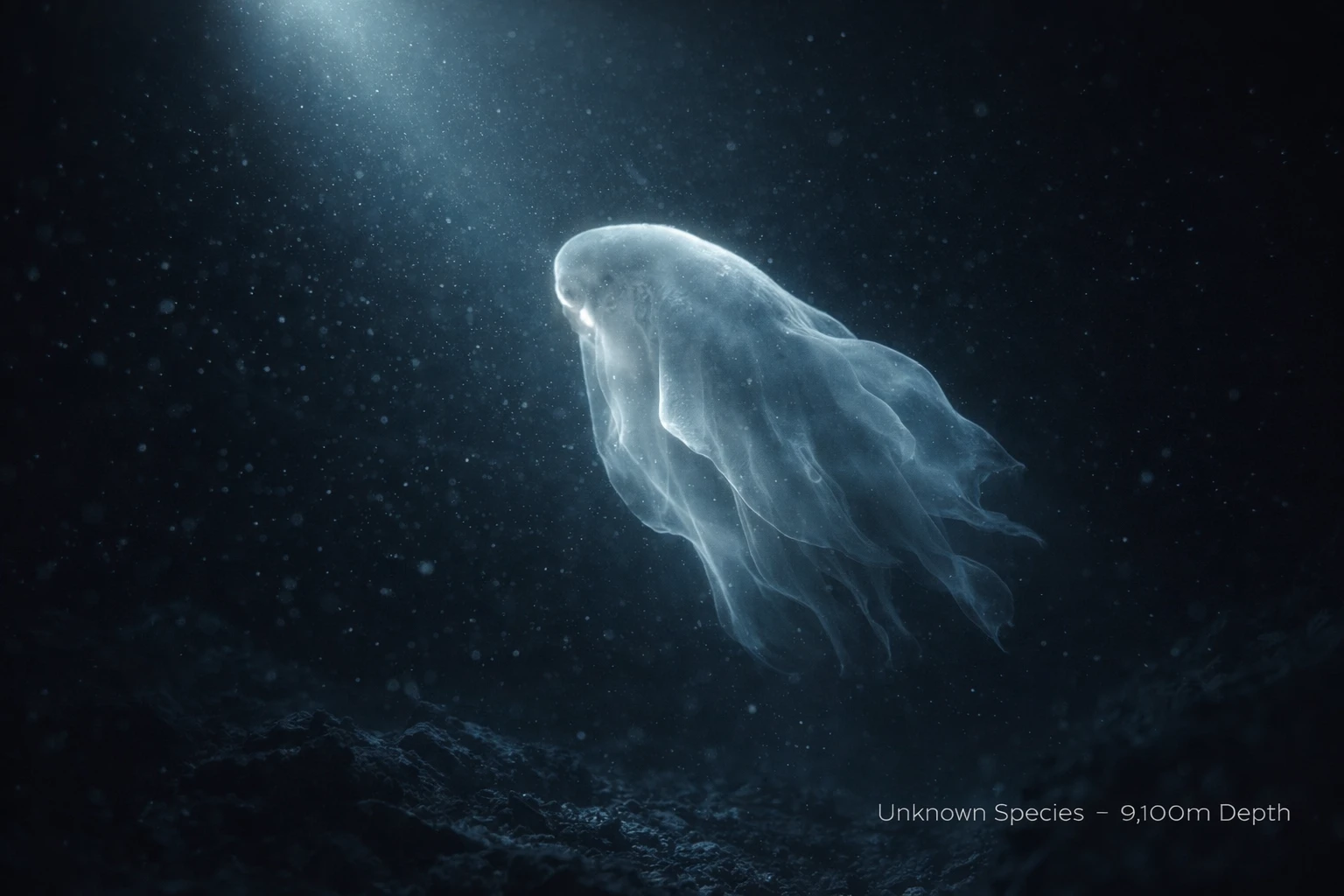
Scientists are currently grappling with an unprecedented deep-sea enigma: the 9100-Meter Mystery Mollusc. Living at staggering abyssal depths formerly deemed uninhabitable by such complex life, this puzzling creature, subjected to pressure over 900 times surface level, has completely baffled experts globally. Its unique physiology and molecular structures defy conventional biological understanding, with cellular membranes and protein structures fundamentally different from anything previously recorded. Is this baffling mollusc a relic from a lost evolutionary branch or evidence of life’s boundless resilience? Either way, it forces a critical rewrite of biological limits and redefines the catalog of life on Earth, proving that the ocean’s darkest reaches still hold transformative secrets.
Quick Facts at a Glance
| Common Name | 9100-Meter Mystery Mollusc |
| Scientific Designation | Animalia incerta sedis (unclassified) |
| Discovery Location | Japan, Ryukyu & Izu-Ogasawara Trenches, NW Pacific |
| Depth Filmed | Up to 9,137 metres (29,977 ft) |
| Expedition Vessel | DSSV Pressure Drop |
| Expedition Year | 2022 (findings published April 2026) |
| Research Institutions | Minderoo-UWA Deep-Sea Research Centre; Tokyo University of Marine Science and Technology |
| Published In | Biodiversity Data Journal (2026) |
| Lead Researcher | Prof. Alan Jamieson, University of Western Australia |
| Classification Status | Unresolved — no known species, genus, or family match |
What Is the 9100-Meter Mystery Mollusc?
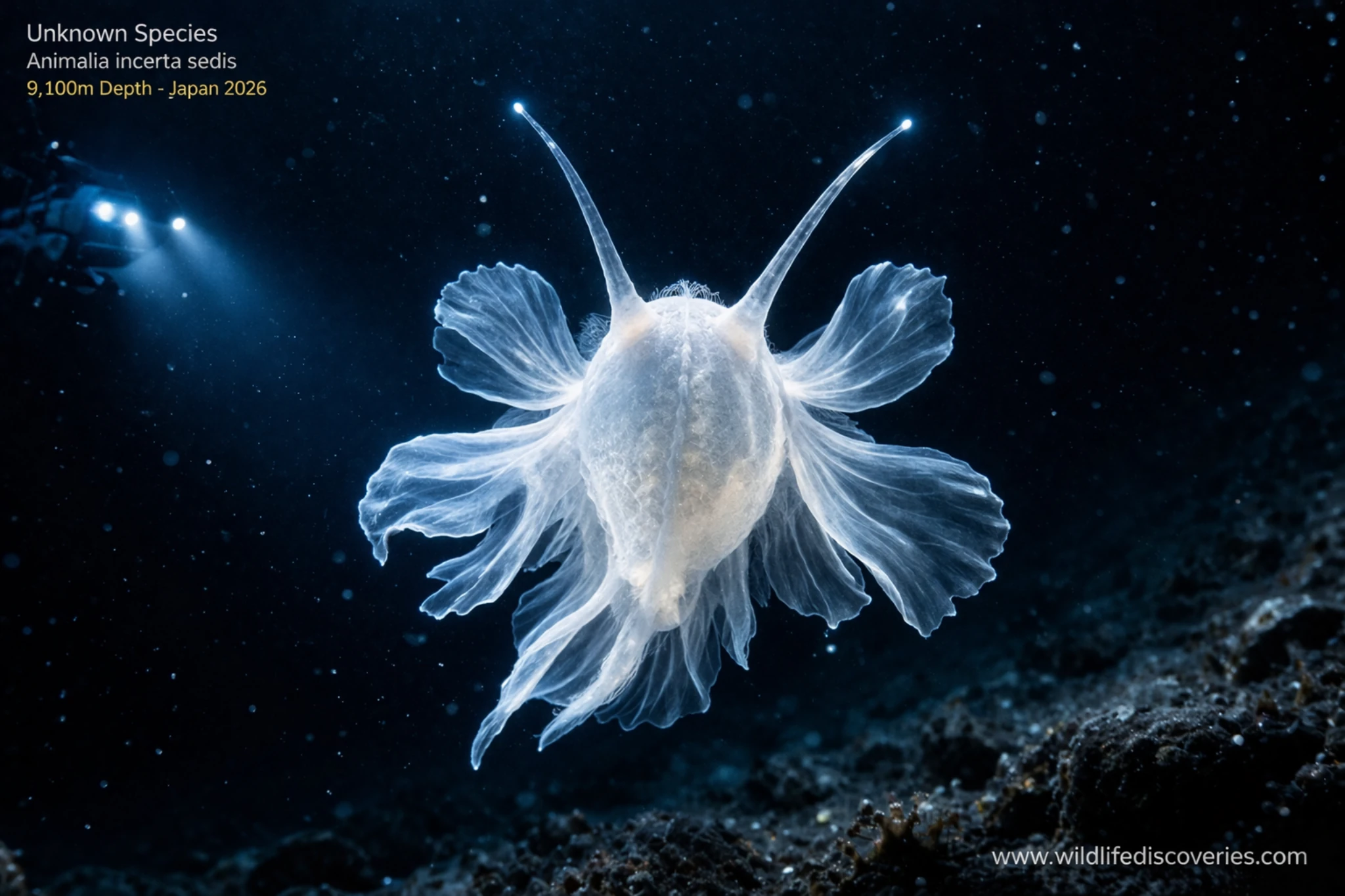
At a depth where the pressure reaches approximately 900 times that of the surface atmosphere, where sunlight has never once penetrated, and where the water temperature hovers close to freezing — something was drifting through the darkness. It was slow. It was pale. And when the research team reviewed the footage, no one knew what it was.
The creature, now formally designated Animalia incerta sedis — a Latin scientific placeholder meaning “animal of uncertain placement” — was captured on camera twice during a two-month scientific expedition aboard the vessel DSSV Pressure Drop. The mission surveyed the Japan, Ryukyu, and Izu-Ogasawara trenches of the northwestern Pacific Ocean, probing depths between 4,534 and 9,775 metres. Its findings, published in the peer-reviewed Biodiversity Data Journal in April 2026, represent the most comprehensive visual survey of these hadal ecosystems ever conducted.
Among the 108 distinct organism groups catalogued during the expedition, one stood apart from all others. The mystery mollusc was not just a new species — it was something so unfamiliar that even the world’s most experienced taxonomists, when shown the footage, could not fit it into any recognised category of animal life.
“This combination enabled us to build the most comprehensive visual baseline yet for abyssal and hadal megafauna in the Northwest Pacific to date.” — Research team statement, Biodiversity Data Journal, 2026
Where Exactly Was It Found? Understanding the Hadal Zone
To appreciate just how extraordinary this discovery is, it helps to understand where it was found — and why reaching that location is itself a scientific achievement.
The creature was filmed in the hadal zone, the deepest layer of the ocean, found exclusively within submarine trenches. The hadal zone is defined as depths below 6,000 metres. At such depths, organisms face extreme pressure, total darkness, near-freezing temperatures, and limited food availability. Despite these conditions — or perhaps because of the millions of years of isolation they create — the hadal zone harbours life found nowhere else on Earth.
The specific trenches surveyed were:
- The Japan Trench — formed by the subduction of the Pacific Plate beneath the Okhotsk Plate off northeastern Japan, reaching depths of around 9,000 metres.
- The Ryukyu Trench — a curved trench southwest of Japan, formed at the junction of the Eurasian and Philippine Sea Plates.
- The Izu-Ogasawara Trench — one of the deepest trenches in the western Pacific, where the mystery mollusc and the deepest-ever carnivorous sponges were documented.
The mystery mollusc was specifically filmed at depths of up to 9,137 metres — a depth that places it among the deepest known observations of any soft-bodied organism on record. For context, the deepest known nudibranch (sea slug) before this discovery was recorded at around 4,000 metres — making this creature’s habitat twice as deep.
Depth Comparison — How Deep Is 9,100 Metres?
What Does the Mystery Mollusc Look Like?
The official scientific photograph released with the study shows a pale, translucent organism drifting just above the seafloor sediment in near-total darkness, illuminated only by the submersible’s lights. It appears softly structured — neither rigid nor spiny — and moves with a slow, gliding motion rather than the rapid escape behaviour of many deep-sea creatures startled by artificial light.
Beyond these visual observations, precise morphological details remain limited by the nature of the footage. The team did not collect a physical specimen, meaning no tissue sample is available for genetic analysis — the primary reason its classification remains unresolved. Deep-sea taxonomy at the most extreme depths depends heavily on physical collection, and the research methodology of this particular expedition deliberately prioritised non-invasive observation to preserve fragile organisms in their natural habitat.
What scientists can confirm is that the creature does not match the body plan of any currently described animal family. Its movement, structure, and appearance place it outside the reference database of known species — which is precisely why the designation Animalia incerta sedis was applied. This is not a provisional name given pending confirmation; it is a formal acknowledgement that science does not yet know what this creature is.
The Expedition: DSSV Pressure Drop and the Research Team
The discovery emerged from a landmark scientific mission conducted entirely in 2022, aboard the DSSV Pressure Drop — a deep-sea research vessel specifically designed for operations at extreme ocean depths. The expedition was a collaboration between two institutions:
The Minderoo-UWA Deep-Sea Research Centre, based at the University of Western Australia, led by Professor Alan Jamieson — one of the world’s foremost authorities on hadal ecology — and the Tokyo University of Marine Science and Technology, whose expertise in the biology and oceanography of Japanese waters made the partnership particularly well-suited to this region.
The team made a deliberate methodological choice that distinguishes this expedition from many historical deep-sea surveys: no trawling, no physical sampling. Traditional deep-sea research has often relied on trawl nets or physical sample collection, approaches that can damage or destroy the very organisms being studied. Instead, the team deployed two complementary observation systems:
First, a crewed submersible conducted transect surveys directly above the seafloor, allowing researchers to observe benthic (bottom-dwelling) organisms in their natural habitat — their behaviour, their microhabitat preferences, and their interactions with the surrounding environment. Second, baited free-fall camera systems were deployed to attract and film scavenging and predatory species from greater distances.
Across nearly 460 hours of footage collected from the three trench systems, the team assembled what they describe as the most complete visual baseline ever created for abyssal and hadal megafauna in the northwestern Pacific.
What Else Was Found? A Record-Breaking Catalogue of Deep-Sea Life
The mystery mollusc captured headlines worldwide, but it was just one element of a vastly richer discovery. The 2026 publication documented at least 108 distinct organism groups across a depth range spanning from 4,534 to 9,775 metres — the most comprehensive visual census of these trenches ever assembled.
Key Discoveries from the Expedition
- Deepest fish ever filmed: A snailfish of the genus Pseudoliparis was captured feeding at 8,336 metres — the deepest verified direct observation of any fish in recorded history.
- Deepest carnivorous sponges: Members of the family Cladorhizidae were documented in the Izu-Ogasawara Trench between 9,568 and 9,744 metres — the deepest in-situ sighting of carnivorous sponges ever reported.
- Crinoid meadows: At the base of the Boso Triple Junction at 9,137 metres, researchers encountered a dense aggregation of more than 1,500 stalked crinoids — relatives of sea stars — anchored to rocky terraces. The raised perches allow their feathery arms to intercept organic material drifting through the water column.
- Supergiant amphipods: Alicella gigantea — an exceptionally large scavenging crustacean — was documented in all three trench systems, confirming its broad distribution across the hadal Northwest Pacific.
- 108 morphotaxa: The overall catalogue includes representatives across Chordata, Echinodermata, Crustacea, Cnidaria, Porifera, Hemichordata, Mollusca, and several groups of uncertain classification — of which the mystery mollusc is the most prominent example.
The sheer density of life documented challenges a long-held assumption in ocean science: that the deepest trenches are biological deserts, too hostile and resource-poor to support significant biodiversity. The 2026 study provides compelling visual evidence to the contrary. Tiny differences in substrate, current, and depth appear to create dramatically different ecological niches — and those niches are occupied.
Why Can’t Scientists Identify It? The Challenge of Hadal Taxonomy
The inability to classify the mystery mollusc is not a failure of science — it is an honest reflection of how little is known about life at the deepest depths of the ocean.
Animal taxonomy — the science of classifying organisms into species, genera, families, and higher groups — depends on physical specimens. DNA sequencing, microscopic examination of internal structures, comparison of morphological features against reference collections in natural history museums: all of these require a physical sample. The DSSV Pressure Drop expedition deliberately avoided collecting specimens to protect fragile organisms, which means the mystery mollusc has been seen, filmed, and logged — but never physically held by a scientist.
Even with a specimen, classification at extreme depths is notoriously difficult. Many hadal organisms look similar to their shallow-water relatives but are evolutionarily distinct at the molecular level. Others belong to lineages that diverged from known groups millions of years ago, before the reference collections used for identification were assembled. The hadal zone — covering just 0.2% of the ocean floor but reaching depths of up to 11,000 metres — remains among the least surveyed ecosystems on Earth. The mystery mollusc may belong to a family, or even an order, that has never been described.
The scientific designation Animalia incerta sedis itself carries important information: it places the creature in the animal kingdom (Animalia) while formally acknowledging that no lower-level placement is possible without further evidence. It is a scientific statement of honest uncertainty — and it sets a clear agenda for future research.
Why This Discovery Matters for Ocean Science
The 9100-Meter Mystery Mollusc is not merely a curiosity. Its significance extends across multiple dimensions of ocean research and conservation science.
It reveals how much remains unknown
The world’s ocean trenches cover a combined area of roughly 1.9 million square kilometres — larger than the entire continent of North America. Yet direct scientific observation of hadal environments has been limited to a handful of expeditions spread across decades. The discovery of an unclassifiable organism after nearly 460 hours of observation in just three trenches suggests that systematic surveys of other trench systems would likely yield comparably extraordinary results.
It challenges assumptions about the limits of life
The depth at which this organism was filmed — 9,137 metres — was thought to be at or near the extreme limit for soft-bodied, slowly-moving organisms. Many scientists assumed that such depths would support only highly specialised, pressure-adapted species like snailfish and amphipods. The mystery mollusc, whatever it turns out to be, demonstrates that the range of viable body plans at hadal depths is broader than current models suggest.
It strengthens the case for non-invasive survey methods
By choosing image-based surveys over trawling, the expedition was able to document live behaviour, habitat associations, and organism density in a way that physical sampling cannot provide. The mystery mollusc would almost certainly have been destroyed or unrecoverable if caught in a trawl net at 9,100 metres. Its discovery — and the broader catalogue of 108 morphotaxa — validates this methodological approach and points toward a new standard for future hadal research.
What Happens Next? The Path Toward Classification
For the mystery mollusc to be formally described and named as a species, scientists need a physical specimen. This means a future expedition to the same trench system, equipped with collection apparatus sensitive enough to capture a fragile, slow-moving organism from depths approaching 10 kilometres — without destroying it in the process.
Once a specimen is obtained, the classification pathway is well-established: DNA extraction and sequencing to determine phylogenetic relationships; microscopic examination of internal and external structures; and comparison against existing museum collections and genetic databases. Given how unusual the creature appears, researchers expect that its formal description, when it comes, will likely require the establishment of a new taxonomic family — perhaps a new order.
The research team has noted the creature’s filming location precisely, and future expeditions to the Japan, Ryukyu, and Izu-Ogasawara trenches will almost certainly include specimen collection among their objectives. Until then, the mystery mollusc remains exactly what its designation implies: an animal whose place in the tree of life is genuinely, formally unknown.
The mystery mollusc is not just an unknown species — it may represent an unknown family, or even order, of animal life. At 9,100 metres below the surface, the ocean still holds secrets that rewrite our understanding of biology.
Frequently Asked Questions
What is the 9100-Meter Mystery Mollusc?
It is an unidentified slow-moving, drifting organism filmed twice at depths of up to 9,137 metres in Japan’s ocean trenches during a 2022 expedition. Scientists have labelled it Animalia incerta sedis — Latin for “animal of uncertain placement” — because no expert has been able to assign it to any known species, genus, or family.
Sources & Further Reading
- Jamieson AJ, Swanborn DJB et al. (2026). Faunal biodiversity of the lower abyssal and hadal zones of the Japan, Ryukyu and Izu-Ogasawara trenches (NW Pacific Ocean; 4534–9775 m). Biodiversity Data Journal 14: e182172. DOI: 10.3897/bdj.14.e182172
- Minderoo-UWA Deep-Sea Research Centre, University of Western Australia
- Tokyo University of Marine Science and Technology
- EurekAlert — Official press release, April 2026
- Phys.org — Research summary, April 2026
- Discover Wildlife — “Scientists drop cameras 9,100m deep off coast of Japan,” April 2026