World Environment Day 2026: Theme, Date & Host Country
World Environment Day 2026 Theme: Meaning, Importance, History & Global Impact

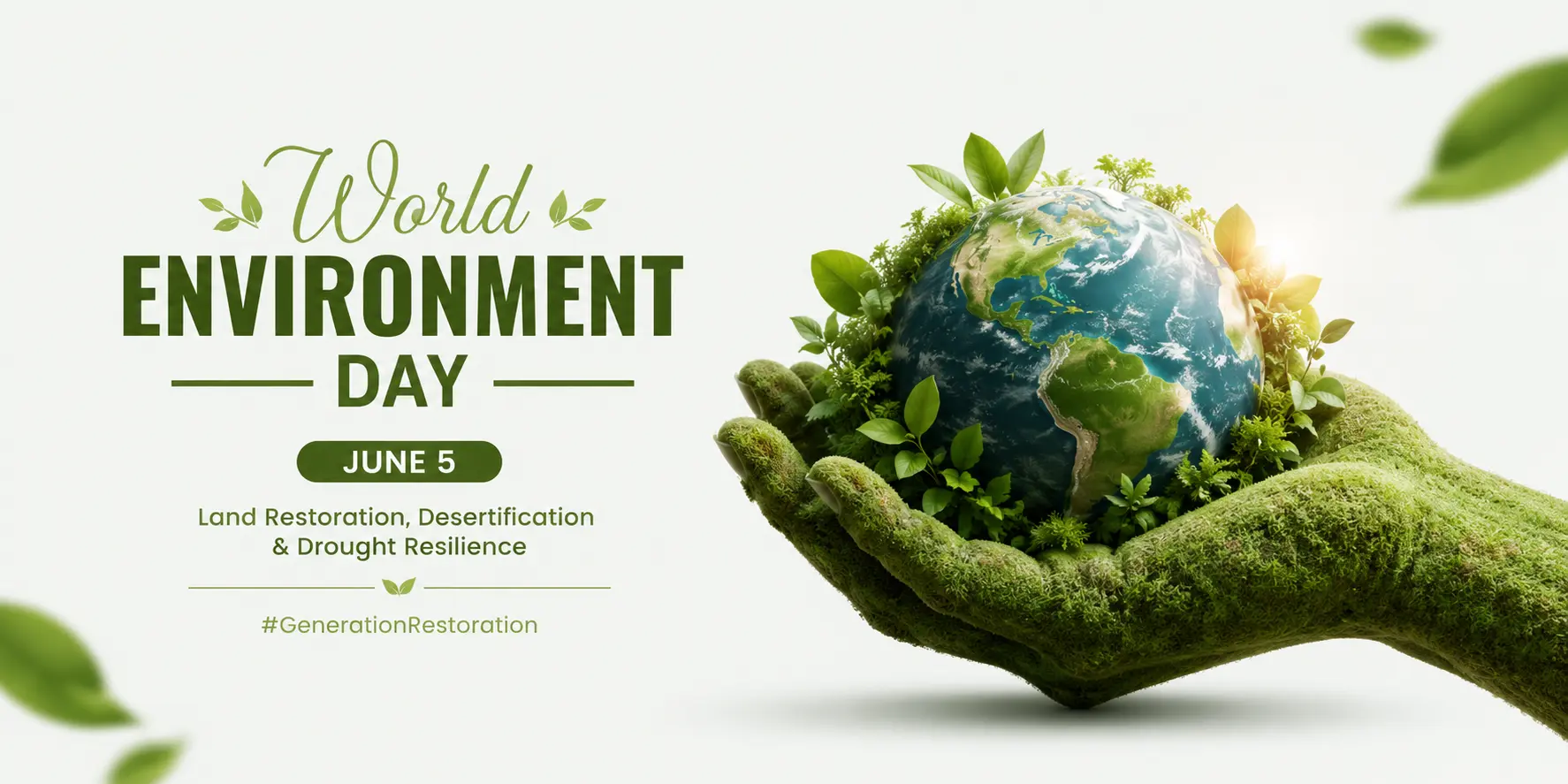
Introduction: Earth Is Sending Us Signals — Are We Listening?
Picture a glacier collapsing silently into a warming ocean. Picture a forest burning for weeks without pause — not in one country, but across three continents simultaneously. Picture a child in a coastal village watching the sea creep closer to her doorstep each monsoon season, with nowhere to go.
These are not hypothetical scenes from a dystopian novel. They are the reality of our planet in 2026 — a world where 2015 through 2025 have officially been recorded as the hottest eleven years in human history, where one million species teeter on the edge of extinction, and where air pollution alone claims an estimated 7 million lives every year according to the World Health Organization.
In the face of this mounting crisis, one day on the global calendar stands as both a warning and a rallying cry: World Environment Day 2026, observed on Friday, June 5, 2026, under the powerful theme “Inspired by Nature. For Climate. For Our Future.”
This year’s theme is not simply a slogan. It is a declaration — that nature is not a luxury to be protected after economic growth, but the very foundation upon which all climate action must be built. Hosted by the Republic of Azerbaijan in Baku, and driven by the United Nations Environment Programme (UNEP) under the campaign hashtag #NowForClimate, World Environment Day 2026 calls every government, business, community, and individual to act — urgently, boldly, and together.
What Is World Environment Day?

World Environment Day is the United Nations’ principal platform for environmental public outreach and awareness. Observed annually on June 5 since 1973, it is coordinated by the UN Environment Programme (UNEP) and brings together governments, corporations, non-governmental organizations, schools, and citizens from more than 150 countries each year.
The day was established by the UN General Assembly in 1972 and has since grown into the world’s largest global platform for environmental engagement and action. It is not a public holiday in any country, yet it mobilizes tens of millions of people — online and offline — around a focused environmental theme selected each year.
What makes World Environment Day unique is its reach. From remote villages in Sub-Saharan Africa to urban centres in East Asia, the day translates global environmental science into local community action. It bridges the gap between international policy and individual behavior, making it both symbolically powerful and practically transformative.
UNEP’s role is central: it selects the annual theme, designates a host country, launches the global campaign, and provides resources, data, and communication toolkits to participants worldwide. The result is a synchronized global moment — a single day when humanity, across all its divisions, focuses collective attention on the health of our shared home.
World Environment Day 2026 Theme

Official Theme: “Inspired by Nature. For Climate. For Our Future.”
The official theme for World Environment Day 2026 is “Inspired by Nature. For Climate. For Our Future.” The campaign hashtag is #NowForClimate, launched by UNEP to drive mobilisation around urgent climate action.
This is perhaps the most ambitious and emotionally resonant theme the day has carried in recent years. It comes at a defining moment — as climate change accelerates beyond the projections of even cautious models, and as nature-based solutions emerge as humanity’s most viable and powerful tool in the fight against ecological breakdown.
What Does This Theme Mean?
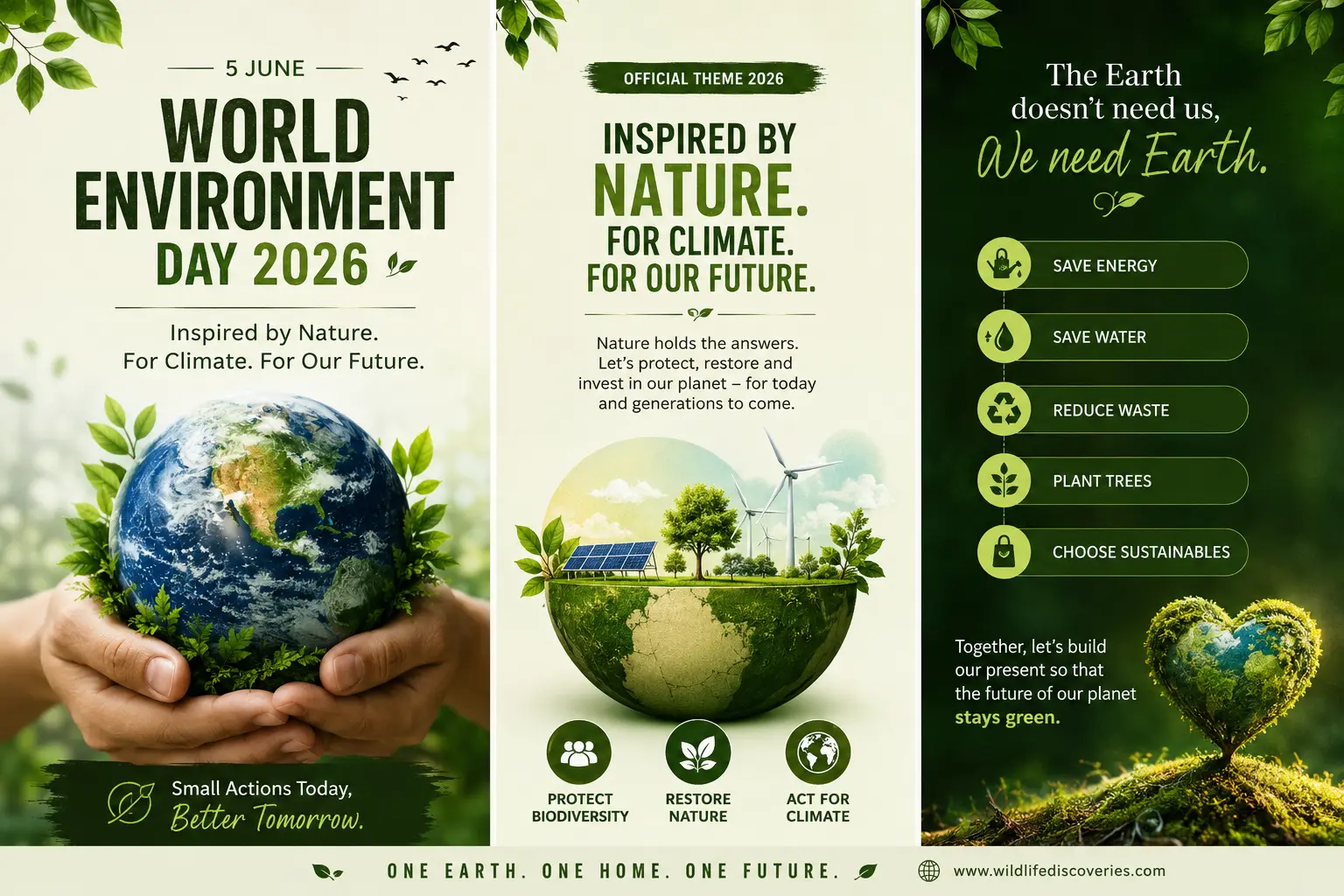
At its heart, the theme carries a three-part message:
“Inspired by Nature” — Nature is not just the victim of climate change; it is also the teacher, the model, and the solution. Mangrove forests protect coastlines better than concrete seawalls. Wetlands filter water more efficiently than treatment plants. Indigenous forest management systems have maintained biodiversity for centuries. The theme urges us to look to natural systems — their resilience, their interconnection, their economy — as blueprints for how human civilization must reorganize itself.
“For Climate” — The 2026 campaign places climate change at the center of the environmental agenda. Climate change is not one issue among many; it is the multiplier that amplifies every other crisis. It drives biodiversity loss, intensifies pollution, triggers drought and floods, and erodes the ecosystems that billions of people depend on. Acting for climate is acting for everything.
“For Our Future” — This phrase is a bridge between generations. It acknowledges that the decisions made today — by governments, by industries, by voters, by consumers — will determine what kind of world young people inherit. It is a statement of responsibility and hope simultaneously.
Together, the theme declares: when we work with nature, not against it, we have the tools to address the climate crisis — and to build a livable future.
Why This Theme Matters in 2026
The timing of this theme is deliberate. The year 2026 arrives midway between the original 2020 targets of the Paris Agreement and the critical 2030 deadline for the Global Biodiversity Framework. Forecasts from the IPCC warn that by 2050, droughts may affect over three-quarters of the world’s population. The window for course correction is not merely narrowing — it is almost closed.
The 2026 theme acknowledges this urgency. It states clearly that climate action is not just about reducing carbon emissions — it is about rethinking the systems that power economies and repairing humanity’s relationship with the natural world.
History of World Environment Day
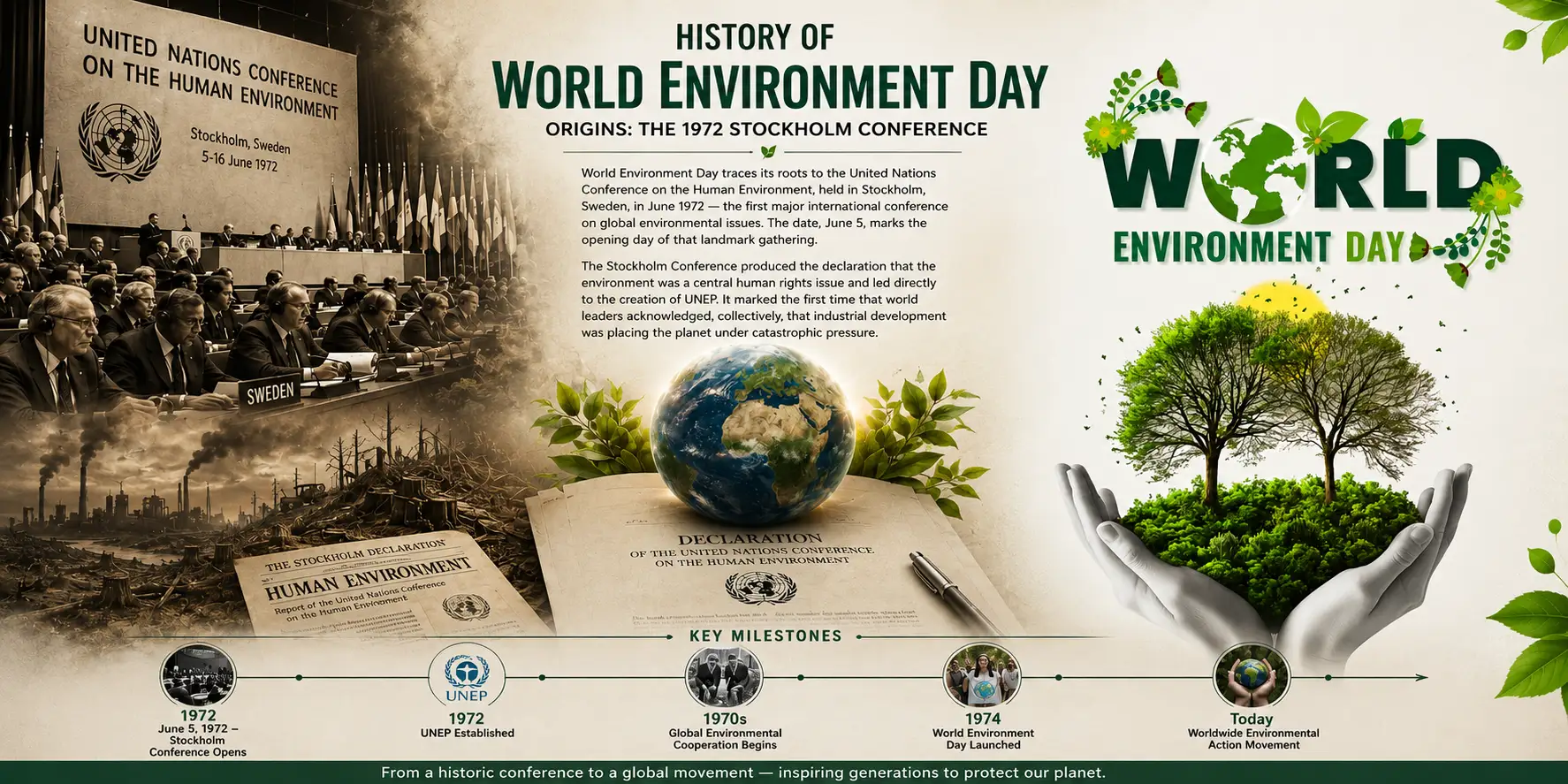
Origins: The 1972 Stockholm Conference
World Environment Day traces its roots to the United Nations Conference on the Human Environment, held in Stockholm, Sweden, in June 1972 — the first major international conference on global environmental issues. It was here that the idea was first proposed and designated. The date, June 5, marks the opening day of that landmark gathering.
The Stockholm Conference produced the declaration that the environment was a central human rights issue and led directly to the creation of UNEP. It marked the first time that world leaders acknowledged, collectively, that industrial development was placing the planet under catastrophic pressure.
World Environment Day Timeline
| Year | Theme | Host Country |
|---|---|---|
| 1973 | Only One Earth | USA |
| 1992 | Earth Summit Awareness | Brazil |
| 2002 | Give Earth a Chance | China |
| 2010 | Many Species. One Planet. One Future | Rwanda |
| 2019 | Beat Air Pollution | China |
| 2021 | Ecosystem Restoration | Pakistan |
| 2022 | Only One Earth | Sweden |
| 2023 | Beat Plastic Pollution | Côte d’Ivoire |
| 2024 | Land Restoration, Desertification & Drought | Saudi Arabia |
| 2025 | Plastic Pollution (Beat Plastic Pollution) | Republic of Korea |
| 2026 | Inspired by Nature. For Climate. For Our Future. | Azerbaijan |
Each theme reflects the dominant environmental anxiety of its era. From ozone depletion in the 1980s to plastic pollution in the 2020s, the evolution of World Environment Day themes is, in many ways, a chronicle of humanity’s growing ecological reckoning.
A pivotal milestone came in 2021, when the theme of Ecosystem Restoration aligned with the launch of the UN Decade on Ecosystem Restoration (2021–2030). The 2022 return to Stockholm — exactly 50 years after the original conference — was another powerful moment, reminding the world how far it had come, and how far it still had to go.
World Environment Day 2026 Host Country: Azerbaijan
Why Azerbaijan?
On June 5, 2026, the Republic of Azerbaijan will host the global commemoration of World Environment Day in Baku. This was announced in June 2024, during an official visit by UNEP Executive Director Inger Andersen to Baku.
Azerbaijan’s selection is deeply meaningful. The country sits at the crossroads of East and West along the historic Silk Road and is a land of remarkable natural diversity. Its landscape spans two major climate zones — subtropical and temperate — and encompasses eight distinct climate types, from subtropical forests to alpine ecosystems, supporting extraordinarily rich biodiversity.
Azerbaijan is also the nation that hosted COP29 in November 2024, making Baku a recognized international site for climate negotiations. This continuity — from COP29 to World Environment Day 2026 — sends a powerful signal about Azerbaijan’s commitment to keeping climate action at the top of the global agenda.
As a Paris Agreement Party, Azerbaijan has committed to reducing emissions by 40% by 2035 compared to 1990 levels, and is actively pursuing green growth and renewable energy development. The country’s national campaign for World Environment Day 2026 emphasizes that nature is not optional — it is central to climate resilience and a collective future.
Why World Environment Day Is Important
1. Climate Change
The climate crisis is the defining emergency of the 21st century. Global temperatures have already risen by approximately 1.1–1.2°C above pre-industrial levels. Each fraction of a degree matters — the difference between 1.5°C and 2°C of warming is the difference between manageable disruption and civilizational upheaval. World Environment Day focuses annual global attention on this reality and demands action.
2. Wildlife Conservation
Understanding why wildlife conservation is important begins with understanding that every species plays a functional role in its ecosystem. The loss of one species creates ripple effects that destabilize food webs, reduce ecosystem services, and ultimately threaten human food security. World Environment Day amplifies conservation messaging to a global audience of tens of millions.
3. The Pollution Crisis
From microplastics in the deep ocean to nitrogen-saturated rivers, pollution is quietly dismantling the ecological systems that underpin all life. Air pollution causes 7 million premature deaths annually. Ocean plastic could outweigh fish by 2050. Animals affected by climate change are also the primary victims of pollution — and the two crises are deeply intertwined.
4. Ecosystem Destruction
According to UNEP and IPBES, three-quarters of the planet’s land surface has been significantly altered by human activity. Understanding different types of ecosystems and their characteristics reveals how fragile and irreplaceable these systems are — and why their protection must be the foundation of all environmental policy.
5. Human Survival
This is not abstract. Ecosystems provide clean air, clean water, fertile soil, pollination of crops, climate regulation, and disease control. Environmental destruction is not just an ecological problem — it is a direct threat to human civilization.
Global Environmental Challenges in 2026
Biodiversity Loss
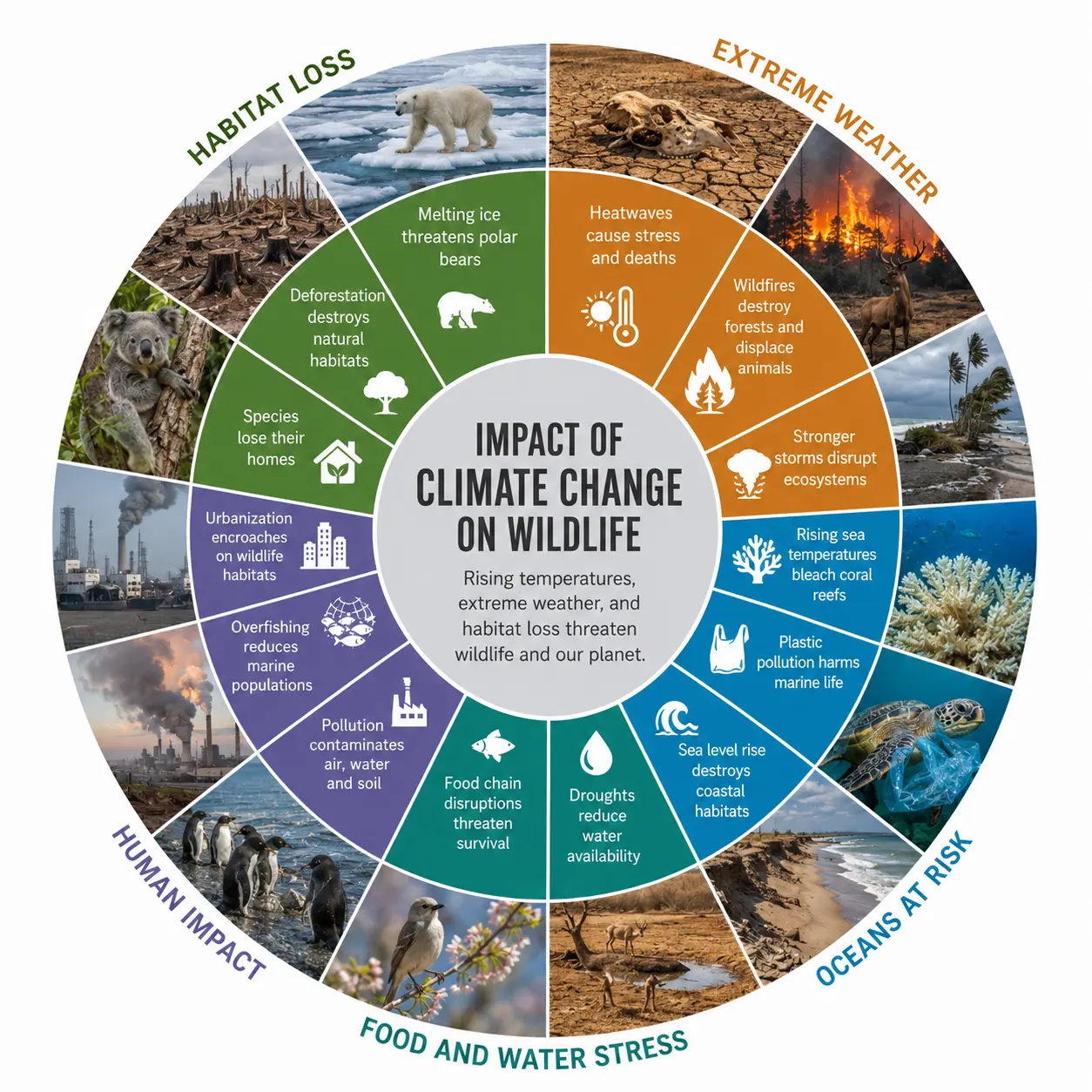
UNEP and the Intergovernmental Science-Policy Platform on Biodiversity and Ecosystem Services (IPBES) estimate that one million species are currently threatened with extinction. This is the sixth mass extinction event in Earth’s history — and the first caused by a single species. The Endangered Species Guide 2026 documents dozens of animals that stand at the brink.
Deforestation
Every minute, an area of forest equivalent to roughly 27 football fields is destroyed globally. Forests are not just carbon sinks — they are the homes of more than 80% of terrestrial biodiversity. Their loss drives climate change, eliminates habitat, and displaces indigenous communities. Endangered animals of the rainforest face compounding threats from deforestation and climate disruption simultaneously.
Plastic Pollution
The world produces over 400 million metric tons of plastic each year. Less than 10% is recycled. Plastic has been found in the deepest ocean trenches, in polar ice, in human blood, and in the lungs of marine mammals. It is a crisis without borders.
Ocean Degradation
Ocean temperatures are rising, acidification is intensifying, and coral reefs — which support roughly 25% of all marine species — are bleaching at unprecedented rates. Deep sea creatures and fascinating ocean species face threats they have never encountered in evolutionary history.
Species Extinction
The extinction rate today is estimated at 1,000 times the natural background rate. Animal extinctions — how many species are already gone is a question with a deeply sobering answer, and one that World Environment Day forces the world to confront each year.
Connection Between Environment & Wildlife Conservation
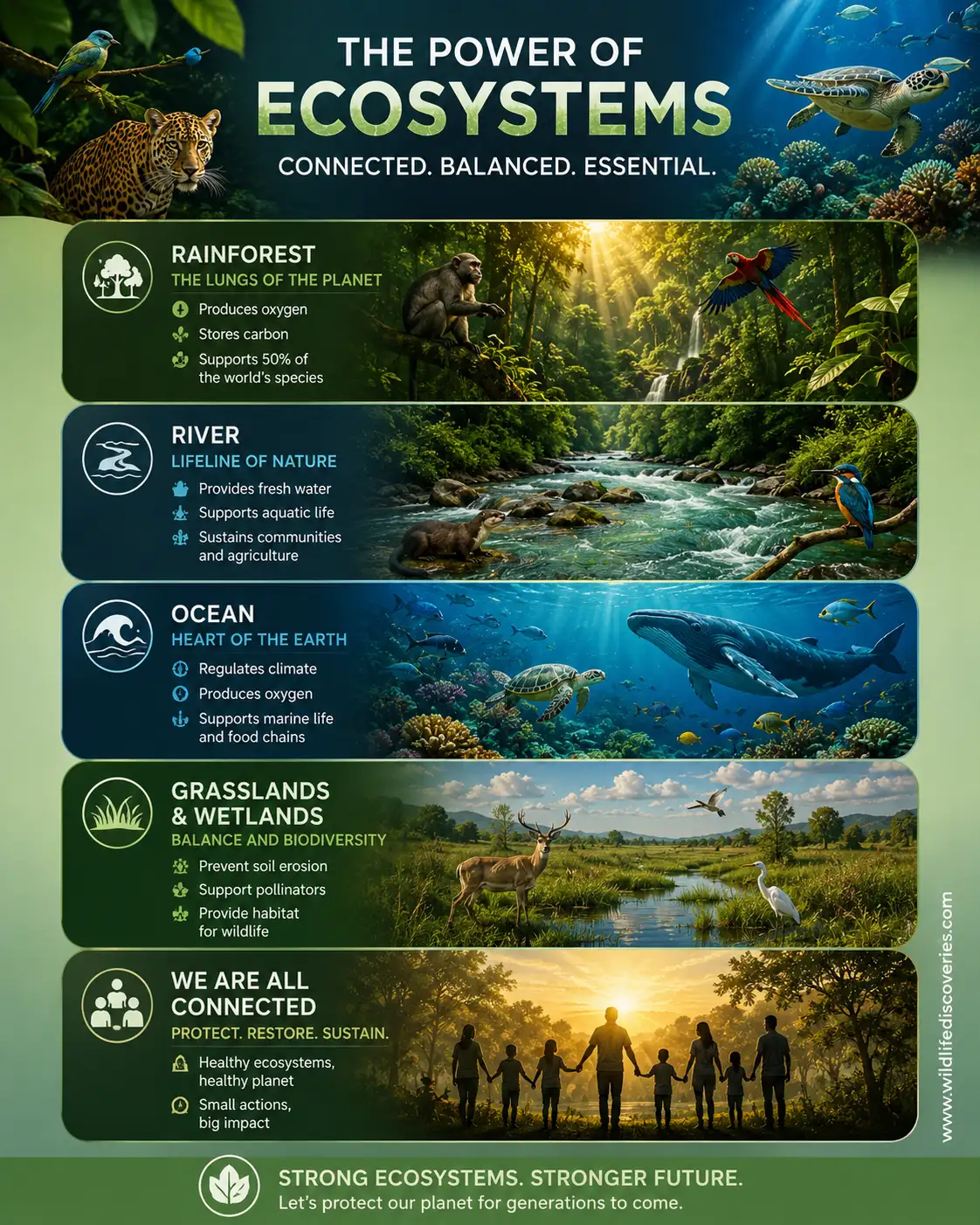
Every environmental challenge is ultimately a wildlife conservation challenge. Ecosystems function as interconnected webs — remove one strand, and the entire structure weakens.
Pollinators — bees, butterflies, and birds — are responsible for approximately one-third of the food humans eat. Their populations are in steep decline due to habitat loss, pesticide use, and climate change. Protecting pollinators means protecting the food system.
Forest ecosystems are among the most biodiverse habitats on Earth. A single hectare of Amazon rainforest can contain more tree species than all of North America. When we protect forests, we protect the climate, the water cycle, and hundreds of thousands of species simultaneously.
Endangered species are not just icons of conservation — they are indicators of ecosystem health. When apex predators like tigers or snow leopards disappear, prey populations explode, vegetation is over-grazed, and entire ecosystems collapse. Tiger reserves in India in 2025 represent one of the most successful examples of targeted conservation protecting broader ecosystem health.
This interconnection is why the 2026 theme, “Inspired by Nature,” is so strategically powerful. It places nature — in its entirety, its complexity, and its genius — at the center of climate strategy.
How World Environment Day Impacts Wildlife Conservation
World Environment Day creates direct, measurable impacts on wildlife conservation through four key mechanisms:
Conservation Awareness — Annual campaigns educate hundreds of millions of people about species under threat. For many, World Environment Day is the first time they learn the scale of biodiversity loss. Awareness precedes action.
Policy Influence — The day creates political pressure. Governments use it to launch new legislation, announce conservation commitments, and respond to public demand for stronger environmental protections. The 2022 Global Biodiversity Framework, adopted at COP15, was shaped in part by decades of awareness-building that World Environment Day contributed to.
Global Campaigns — UNEP’s global campaigns — like #BeatPlasticPollution and #NowForClimate — create unified messaging that travels across media, social platforms, schools, and government channels simultaneously. World Wildlife Day 2026 similarly builds momentum that compounds throughout the year.
Public Participation — When communities plant trees, clean coastlines, reduce plastic use, and advocate for wildlife corridors, they create real change. World Environment Day activates this participation at a scale no other environmental observance can match.
Did You Know? The ozone layer is one of the most successful environmental recovery stories in history. After the Montreal Protocol was signed in 1987 to phase out ozone-depleting substances, scientists now project that the ozone layer will recover to pre-1980 levels by approximately 2066. This proves that when the global community commits to science-based environmental action, recovery is possible.
Real Environmental Success Stories
The news from our planet is not only dark. There are reasons for genuine hope:
Ozone Layer Recovery — The Montreal Protocol, often called the most successful international environmental agreement in history, has demonstrably reversed ozone depletion. It is proof that coordinated global action works.
Reforestation Projects — Ethiopia’s Green Legacy Initiative has planted billions of trees. Costa Rica reversed decades of deforestation and now has over 52% forest cover. India’s network of forest reserves continues to expand, protecting some of the world’s most critical biodiversity hotspots.
Wildlife Recoveries — Mountain gorilla populations in Central Africa have increased from fewer than 300 individuals to over 1,000 thanks to intensive conservation programs. Humpback whale populations have rebounded dramatically following commercial whaling bans. The Arabian Oryx, once declared extinct in the wild, was successfully reintroduced to its native desert habitat.
These stories matter. They demonstrate that extinction is not inevitable, that ecosystems can recover, and that human beings are capable of extraordinary things when the will to act is present.
How Individuals Can Participate in World Environment Day 2026
Every person on Earth has a role to play. Here are concrete actions anyone can take:
- Reduce single-use plastic — Carry a reusable bag, bottle, and cutlery. Refuse unnecessary plastic packaging.
- Plant native trees and plants — Support local reforestation efforts or plant in your own garden to support pollinators and local biodiversity.
- Support wildlife conservation organisations — Donations, volunteering, and advocacy all contribute to protecting endangered species. What can we do to protect endangered animals provides practical, evidence-based guidance.
- Reduce your carbon footprint — Walk, cycle, use public transport, eat less meat, and choose renewable energy where possible.
- Use the hashtag #NowForClimate — Amplify the 2026 campaign by sharing actions, stories, and commitments on social media.
- Participate in local events — Join cleanups, tree plantings, or educational workshops organized in your community.
- Engage with youth-led movements — Mentor young people, support climate education, and amplify youth voices.
World Environment Day Activities & Celebrations
On and around June 5, communities worldwide will organize:
- School programs — Lessons, art competitions, debates, and pledges focused on the 2026 theme
- Community cleanups — Beach, river, and urban cleanups coordinated through UNEP’s global event registry
- NGO campaigns — Major conservation organizations will launch new reports, pledge drives, and advocacy campaigns
- Corporate sustainability announcements — Businesses use World Environment Day to announce new climate commitments and sustainability targets
- Social media challenges — #NowForClimate will trend globally, with millions sharing personal actions
- Government events — National ceremonies, policy announcements, and environmental award presentations
Key Facts About World Environment Day 2026
| Fact | Detail |
|---|---|
| Date | Friday, June 5, 2026 |
| Official Theme | “Inspired by Nature. For Climate. For Our Future.” |
| Campaign Hashtag | #NowForClimate |
| Host Country | Republic of Azerbaijan |
| Host City | Baku |
| Organized by | UNEP (UN Environment Programme) |
| Countries Participating | 150+ |
| First Celebrated | 1973 |
| Origin | 1972 Stockholm Conference |
| 2026 Focus | Climate Change & Nature-Based Solutions |
The Future of the Planet: Hope vs. Crisis
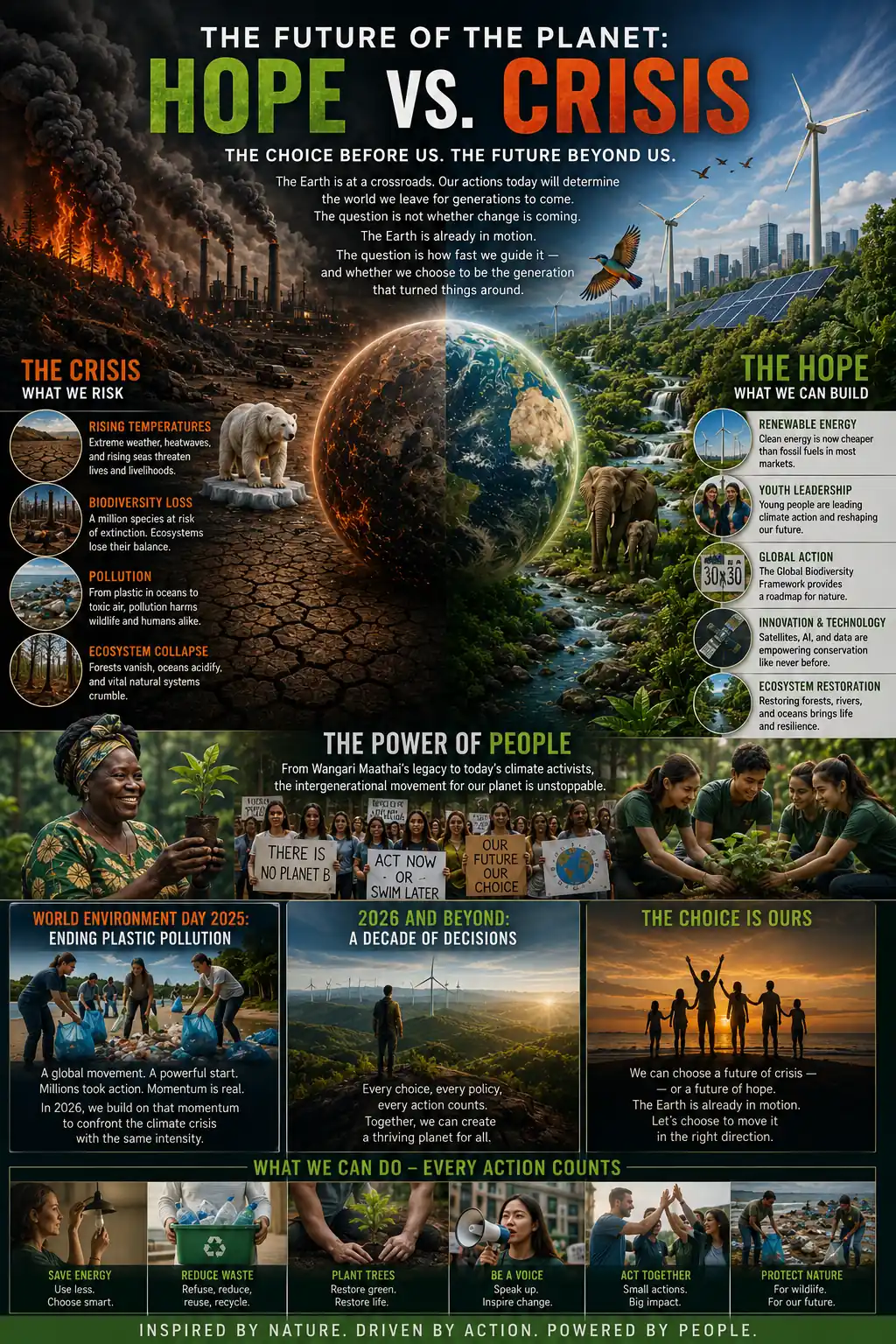
The scientific picture is clear: without dramatic, immediate action to reduce emissions, halt biodiversity loss, and restore degraded ecosystems, the planet will warm beyond the thresholds that current human civilization was built to endure.
Yet the picture is also clear that transformation is possible. Renewable energy is now cheaper than fossil fuels in most markets. Youth-led climate movements have rewritten the terms of political debate in dozens of countries. The Global Biodiversity Framework provides a roadmap. Technology, from satellite monitoring of deforestation to AI-assisted species tracking, gives conservationists tools their predecessors never had.
The role of youth cannot be overstated. Young people are not simply the inheritors of this crisis — they are already among its most effective solvers. From Wangari Maathai’s legacy to today’s school climate strikers, the intergenerational thread of environmental activism is one of humanity’s most powerful forces for change.
World Environment Day 2025 — focused on ending plastic pollution — demonstrated the extraordinary momentum that a single year of targeted global campaigning can build. In 2026, that momentum must be directed at the climate crisis with the same intensity.
The question, as UNEP frames it in the 2026 campaign, is not whether change is coming. The Earth is already in motion. The question is how fast we guide it — and whether we choose to be the generation that turned things around.
Frequently Asked Questions (FAQs)
Q1. What is the theme for World Environment Day 2026?
The official theme for World Environment Day 2026 is “Inspired by Nature. For Climate. For Our Future.” The campaign hashtag is #NowForClimate, and the day is hosted by the Republic of Azerbaijan in Baku on June 5, 2026.
Q2. When is World Environment Day 2026?
World Environment Day 2026 falls on Friday, June 5, 2026. It is observed annually on June 5, marking the opening day of the 1972 UN Conference on the Human Environment in Stockholm.
Q3. Which country is hosting World Environment Day 2026?
The Republic of Azerbaijan is the official host country for World Environment Day 2026. The global commemoration will take place in Baku, Azerbaijan’s capital.
Q4. Why is the 2026 theme focused on climate and nature?
UNEP chose this theme because climate change and biodiversity loss are deeply interconnected crises. Nature-based solutions — protecting forests, restoring wetlands, rewilding degraded land — are among the most cost-effective and powerful tools available for climate mitigation and adaptation.
Q5. What is the hashtag for World Environment Day 2026?
The official campaign hashtag is #NowForClimate, launched by UNEP to drive global mobilisation around climate action ahead of the UN Climate Change Conference 2026 in Antalya, Türkiye.
Q6. How many countries participate in World Environment Day?
Over 150 countries participate in World Environment Day each year, making it the largest global platform for environmental public outreach in the world.
Q7. How can I participate in World Environment Day 2026?
You can register your event at worldenvironmentday.global, join a local cleanup or tree-planting drive, use #NowForClimate on social media, reduce your plastic and carbon footprint, and support wildlife conservation organisations in your region.
Q8. What was the World Environment Day 2025 theme?
World Environment Day 2025 focused on beating plastic pollution and was hosted by the Republic of Korea. It called on communities worldwide to advocate for solutions to the global plastic pollution crisis.
Conclusion: The Earth Is Speaking — It’s Time to Answer
Every flood that submerges a city, every wildfire that consumes a forest, every species that vanishes from the Earth forever — these are messages. The planet is speaking in the only language it has: consequence.
World Environment Day 2026 asks us to listen. The theme, “Inspired by Nature. For Climate. For Our Future,” is not a passive invitation — it is an urgent call to look at the world’s forests, oceans, mountains, and rivers, and to understand that within those systems lies not just beauty, but survival.
The science tells us that nature-based solutions can provide up to 30% of the climate mitigation needed by 2030. Indigenous communities have been demonstrating sustainable coexistence with nature for thousands of years. We have the knowledge, the technology, and — increasingly — the motivation. What we must now summon is the collective will.
On June 5, 2026, whether you are a policymaker in Baku, a student in a classroom, a farmer on the edge of a shrinking forest, or a parent watching the news with worry in your eyes — you are part of this story. And you have a role in how it ends.
The Earth is sending signals. The only question now is: what signal will you send back?
About the Author
Sagar Rawat
Wildlife Communicator & Digital Content Strategist
Sagar Rawat is a wildlife communicator and digital content strategist with a background in Arts and Digital Marketing. He specialises in making complex conservation science accessible, engaging, and shareable for general audiences worldwide.
At Wildlife Discoveries, Sagar covers wildlife news, animal behaviour, global conservation events, and species profiles — translating scientific discoveries into stories that inform and inspire. He firmly believes that awareness is the first step toward conservation, and that every person who reads about a species is one more person who cares about saving it.
Sagar manages the Wildlife Discoveries content strategy and social presence, working to grow a community of people passionate about the natural world.
Explore more articles by Sagar Rawat on Wildlife Discoveries