Raimona Bent-toed Gecko: New Species Discovered in Assam
Raimona Bent-toed Gecko: New Species Discovered in Assam's Kokrajhar

The jungle does not give up its secrets easily.
In the Kachugaon forests of Assam’s Kokrajhar district, where ancient trees press close and the air sits heavy with moisture, nightfall transforms the forest floor into something entirely different. Leaves shift. Bark breathes. And somewhere in that darkness, a small lizard — patterned like shadow itself — has been living, hunting, and surviving for thousands of years without a single human being knowing its name.
Meet Cyrtodactylus raimonaensis — the Raimona Bent-toed Gecko. Discovered near the boundary of Raimona National Park and formally described in April 2026, this newly identified species is the latest proof that the forests of Northeast India are still holding secrets that science has yet to uncover. Published in the world’s leading taxonomy journal Zootaxa by a team of 12 researchers, the Raimona Bent-toed Gecko is not just a new species — it is a reminder of what we stand to lose if these forests disappear before we even learn who lives in them.
Quick Facts: Raimona Bent-toed Gecko at a Glance
| Feature | Detail |
|---|---|
| Scientific Name | Cyrtodactylus raimonaensis |
| Common Name | Raimona Bent-toed Gecko |
| Max Body Length (SVL) | 71.1 mm |
| Body Shape | Rounded, bluntly conical |
| Discovery Location | Kachugaon, Kokrajhar district, Assam, India |
| Habitat | Forests near Raimona National Park |
| Elevation Range | 85 m – 1,042 m above sea level |
| Published In | Zootaxa journal |
| Discovery Year | 2026 |
| Research Team | 12 scientists |
| Named After | Raimona National Park, Assam |
Deep inside the dense forests of Assam’s Kokrajhar district, where the Eastern Himalayas taper into lush lowland jungles, a team of scientists made a discovery that placed this remote corner of Northeast India firmly on the global biodiversity map. A small, intricately patterned lizard — observed clinging to bark and leaf litter in the darkness — turned out to be a species completely unknown to science.
Formally described in 2026 and published in the prestigious journal Zootaxa, the Raimona Bent-toed Gecko (Cyrtodactylus raimonaensis) is the latest confirmation of something scientists have long suspected: Northeast India, particularly Assam, remains one of the most underexplored wildlife corridors on Earth. Every new survey of its forests risks encountering a creature that has never been named.
What Is the Raimona Bent-toed Gecko?
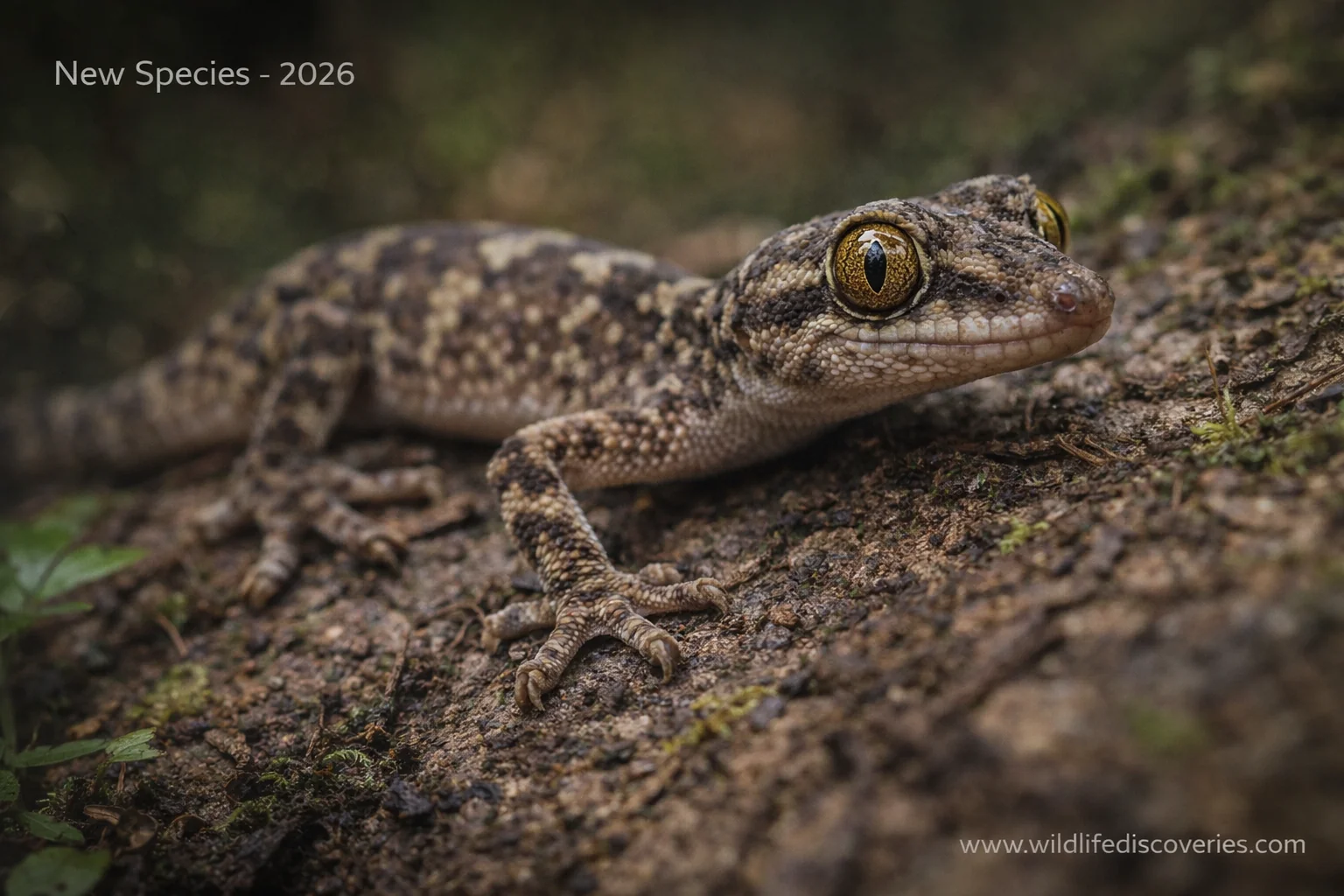
The Raimona Bent-toed Gecko is a newly described reptile belonging to the genus Cyrtodactylus — one of the most species-rich and diverse groups of geckos found across South and Southeast Asia. The genus is named for the characteristic curved (or “bent”) toes that give these lizards exceptional grip on bark, rock surfaces, and forest floor debris.
Cyrtodactylus raimonaensis is classified within the Cyrtodactylus septentrionalis species group, a determination made on the basis of gene sequence analysis. It is closely related to other species found in the broader northeastern Indian and Himalayan foothills region, but possesses a unique combination of physical characteristics that clearly distinguish it as a separate species.
The discovery was announced on April 13, 2026, by Assam Chief Minister Himanta Biswa Sarma, who described it as a “remarkable discovery” that underscores the ecological wealth of the state.
Physical Description: What Does the Raimona Bent-toed Gecko Look Like?
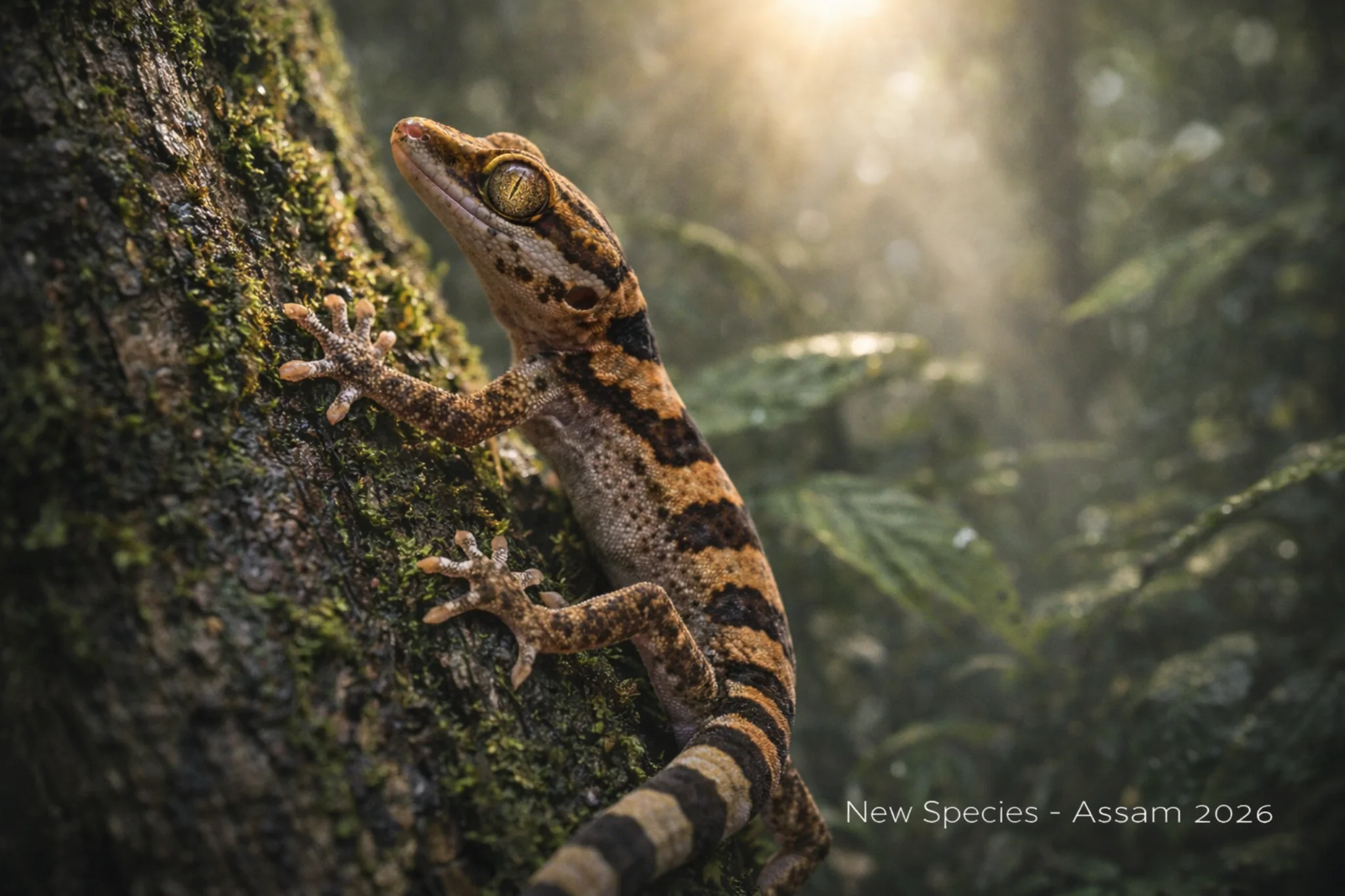
The Raimona Bent-toed Gecko is a moderate-sized lizard. Its maximum recorded snout-vent length (SVL) — the standard measurement used for lizards, from the tip of the snout to the base of the tail — is 71.1 mm, with its overall form described as rounded and bluntly conical.
Several physical features make Cyrtodactylus raimonaensis visually distinctive:
- Dorsal tubercles: Rows of small, raised bumps running along its back — a characteristic feature of the Cyrtodactylus genus, often used to distinguish species.
- Scale patterns: Specific arrangements of scales across its body that differ measurably from closely related species in the region.
- Dark blotches: Irregular dark markings distributed along the body, which provide camouflage against the mottled bark and leaf litter of its forest habitat.
- Banded tail: The tail carries alternating bands of light and dark coloration — a pattern typical of many Cyrtodactylus species and useful in species identification.
The research team confirmed the species’ identity through a combination of its physical (morphological) features and genetic data — a dual approach now considered the scientific gold standard for describing new reptile species.
Where Was It Discovered?
The Raimona Bent-toed Gecko was found in the Kachugaon region of Kokrajhar district in western Assam, near the boundary of Raimona National Park. This location sits at the southern foothills of the Eastern Himalaya, in a landscape of thick deciduous and semi-evergreen forests interspersed with grasslands and river systems.
The discovery site lies within a region that has only recently attracted significant scientific attention. Raimona National Park itself was declared a national park as recently as 2021, making it one of Assam’s newest and least-studied protected areas. Its relative youth as a formally protected zone means large portions of its flora and fauna have never been systematically surveyed — and the Raimona Bent-toed Gecko is one of the first species to emerge from that scientific frontier.
The forests around the park are characterised by thick vegetation and varied microhabitats — conditions that provide ideal cover for secretive, nocturnal reptiles like geckos, which are naturally difficult to detect and study.
Raimona National Park: A Biodiversity Hotspot
To understand the significance of this discovery, it helps to understand the remarkable landscape in which it was made.
Raimona National Park is located in the westernmost part of Assam, at the southern foothills of the Eastern Himalaya. Spanning altitudes from 85 metres to 1,042 metres above sea level, the park encompasses a dramatic range of elevational habitats — from warm lowland forests to cooler hillside terrain — supporting extraordinary biological diversity.
Raimona does not stand alone. Together with Phibsoo Wildlife Sanctuary in Bhutan and Buxa Tiger Reserve in West Bengal, it forms a transboundary conservation landscape of more than 2,400 square kilometres — one of the largest contiguous protected forest corridors in this part of Asia.
The park is perhaps best known as the stronghold of Bodoland’s mascot and one of India’s most endangered primates: the Golden Langur (Trachypithecus geei). But Raimona’s wildlife extends far beyond this iconic primate. The park is also home to:
- Asian Elephant (Elephas maximus)
- Royal Bengal Tiger (Panthera tigris tigris)
- Clouded Leopard (Neofelis nebulosa)
- Indian Gaur (Bos gaurus)
- Wild Buffalo (Bubalus arnee)
- Spotted Deer (Axis axis)
- Multiple Hornbill species
- Over 150 butterfly species
- 170 bird species
- 380 plant species, including rare orchids
Into this already remarkable list, the Raimona Bent-toed Gecko now takes its place.
The Scientific Discovery: How Was It Found and Confirmed?
The formal description of Cyrtodactylus raimonaensis is the result of work by a team of 12 scientists, whose findings were published in Zootaxa — the world’s largest journal dedicated to the taxonomy and classification of animals.
Geckos of the Cyrtodactylus genus are notoriously difficult to study. They are predominantly nocturnal, expertly camouflaged, and tend to inhabit dense, structurally complex forest environments that make systematic surveys challenging. Many species within the genus look superficially similar, and distinguishing them reliably requires both careful morphological measurement and modern genetic analysis.
The research team used exactly this approach. Physical characteristics — including tubercle rows, scale counts, body proportions, and coloration patterns — were measured and compared against all known species in the Cyrtodactylus group found in this region. These measurements were then cross-validated with genetic sequencing data, which confirmed that the Kokrajhar specimens belonged to a distinct, previously undescribed evolutionary lineage.
The result: a species new to science, named after the national park near which it was found — a deliberate choice by the researchers to draw global attention to Raimona and the conservation value of its forests.
Why Is This Discovery Important for India’s Biodiversity?
India is one of the world’s 17 megadiverse countries — a term used by conservation scientists to describe nations that together harbour more than 70% of Earth’s biodiversity. Within India, the northeastern states occupy a particularly special ecological position.
Assam and the surrounding states of Northeast India fall within the Eastern Himalaya biodiversity hotspot — one of only 36 regions on Earth designated as biodiversity hotspots, defined by their exceptional concentration of endemic species and the severe threats they face. The region is considered one of the most important — and most threatened — wildlife corridors connecting South Asia and Southeast Asia.
The discovery of the Raimona Bent-toed Gecko is significant for several reasons:
It confirms undocumented richness. Experts note that many species in Northeast India remain undocumented, and continued exploration is likely to reveal further new species. The Raimona Bent-toed Gecko is evidence that even well-trafficked areas near established parks can hide species unknown to science.
It justifies conservation investment. A newly described species named after a national park strengthens the scientific and political case for protecting that park. Raimona was declared a national park only in 2021 — this discovery, just five years later, validates that decision.
It adds to India’s reptile diversity records. India currently recognises hundreds of lizard species, but herpetologists (scientists who study reptiles and amphibians) widely believe the actual number is significantly higher. Each new Cyrtodactylus description chips away at that knowledge gap.
The Broader Context: Cyrtodactylus — The Most Diverse Gecko Genus on Earth
The Raimona Bent-toed Gecko belongs to Cyrtodactylus, which is currently one of the most species-rich genera of vertebrates on the planet. With new species being described at a remarkable pace across South and Southeast Asia, Cyrtodactylus exemplifies a broader truth about biodiversity science: we are still in the midst of discovering the natural world, even in the 21st century.
Across Northeast India, Myanmar, Bangladesh, and the Himalayan foothills, dozens of new Cyrtodactylus species have been described in the past decade. Each discovery points to the same conclusion: the forests of this region, though under growing pressure from deforestation and development, still shelter life that science has never formally acknowledged.
Frequently Asked Questions (FAQs)
What is the Raimona Bent-toed Gecko? The Raimona Bent-toed Gecko (Cyrtodactylus raimonaensis) is a newly described lizard species discovered near Raimona National Park in Kokrajhar district, Assam, India. It was formally described in 2026 and published in the scientific journal Zootaxa.
Where exactly was the Raimona Bent-toed Gecko found? It was found in the Kachugaon region of Kokrajhar district in western Assam, near the boundary of Raimona National Park, at the southern foothills of the Eastern Himalaya.
Why is it called the Raimona Bent-toed Gecko? It is named after Raimona National Park, near which it was discovered. The “bent-toed” part of the name refers to the characteristic curved toes of all geckos in the Cyrtodactylus genus, which help them grip surfaces.
How big is the Raimona Bent-toed Gecko? It is a moderate-sized gecko with a maximum snout-vent length (SVL) of 71.1 mm. Its body shape is described as rounded and bluntly conical.
Is Raimona National Park known for wildlife? Yes. Raimona National Park — declared in 2021 — is home to the endangered Golden Langur, Royal Bengal Tiger, Asian Elephant, Clouded Leopard, and hundreds of bird, butterfly, and plant species. It forms part of a transboundary conservation corridor of over 2,400 sq km shared with Bhutan and West Bengal.
Who discovered the Raimona Bent-toed Gecko? The species was described by a team of 12 scientists, whose findings were published in Zootaxa in April 2026. Assam Chief Minister Himanta Biswa Sarma publicly announced the discovery on April 13, 2026.
Is the Raimona Bent-toed Gecko endangered? Its conservation status has not yet been formally assessed. However, the researchers and the Assam government have emphasised the need for continued habitat protection and scientific research to safeguard the species and its forest ecosystem.
A Discovery That Belongs to a Forest Worth Protecting
When a new species is named after a place, it does more than record a scientific fact — it creates a permanent bond between a creature and its home. Every future researcher who studies Cyrtodactylus raimonaensis will know exactly where it belongs, and exactly what must be preserved for it to survive.
The forests of Raimona are thick, complex, and alive in ways that remain only partially understood. The Raimona Bent-toed Gecko is not an ending — it is an opening: a reminder that the forests of Northeast India are still telling us who lives within them, one species at a time.
Sources: Zootaxa (2026); Government of Assam; Assam Chief Minister’s Office; Northeast Now; The News Mill; Pratidin Time.
Related reads: Stanley’s Dwarf Shrew: The Tiny 3-Gram Mammal Discovered in Ethiopia, 9100-Meter Mystery Mollusc: New Deep-Sea Discovery Endangered Species Guide 2026: Meaning, List & Conservation