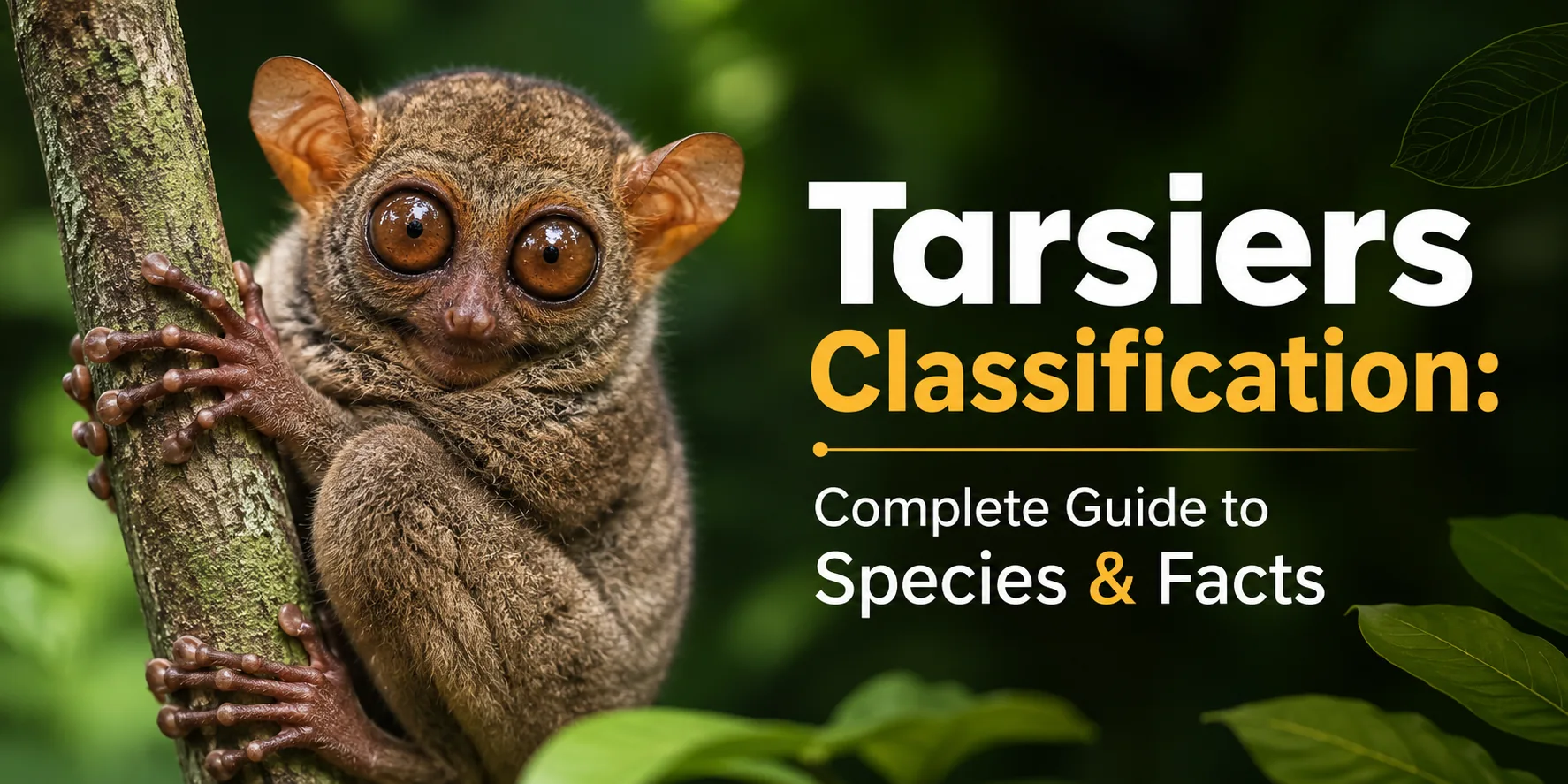
There is a primate alive today with eyes so large that each one is heavier than its entire brain. It can rotate its head 180 degrees like an owl, leap 40 times its own body length in a single jump, and has remained biologically almost unchanged for 45 million years — long before monkeys, apes, or humans existed in any recognizable form.
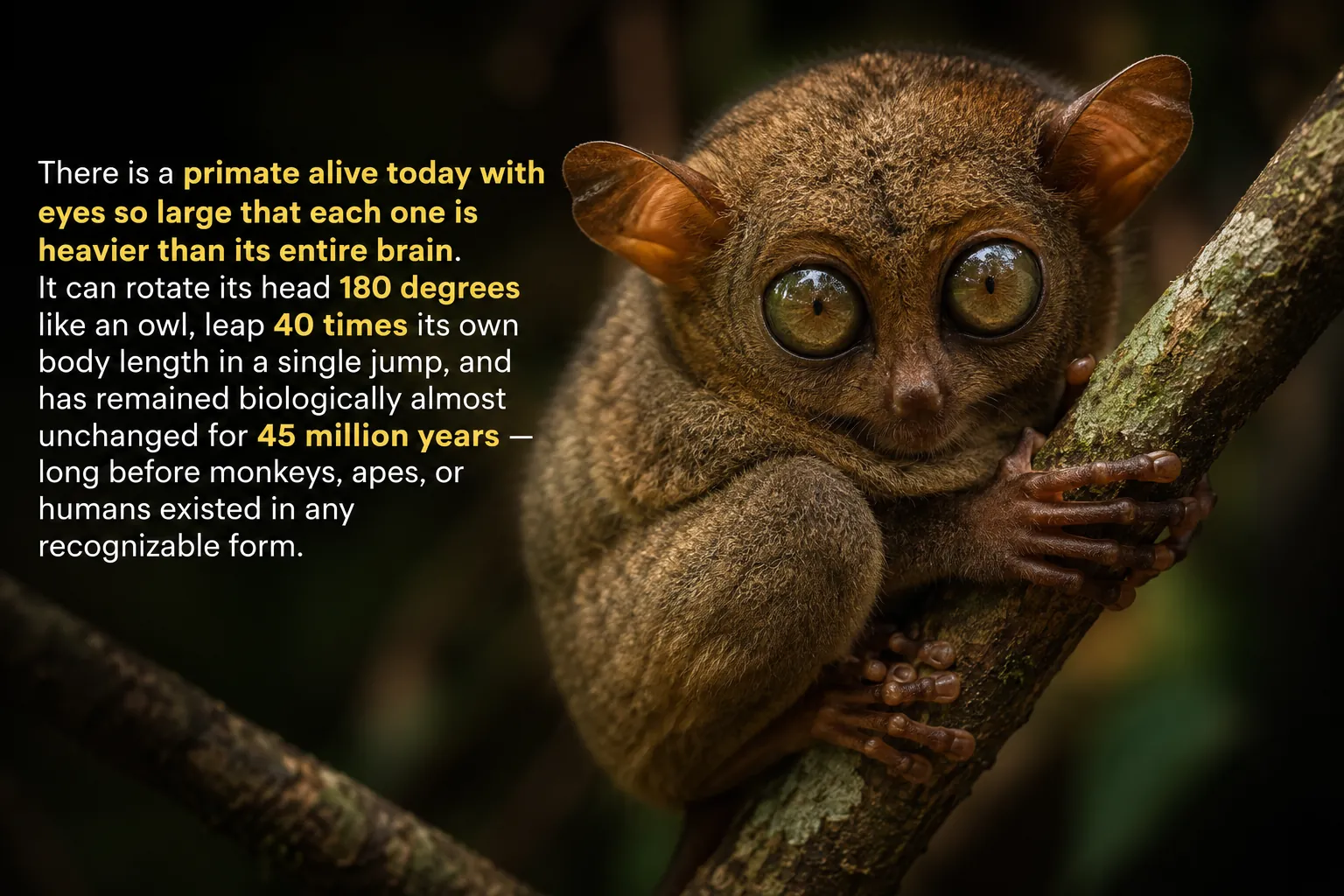
This is the tarsier: one of the strangest, oldest, and most scientifically debated primates on the planet. Scientists have spent over a century arguing about exactly where it belongs on the primate family tree — and the debate isn’t fully settled even now.
This guide breaks down the complete Tarsiers Classification, their evolutionary history, physical adaptations, species diversity, and conservation status — everything you need to understand why this tiny nocturnal hunter occupies such a unique place in primate biology.
What Is the Tarsiers Classification?
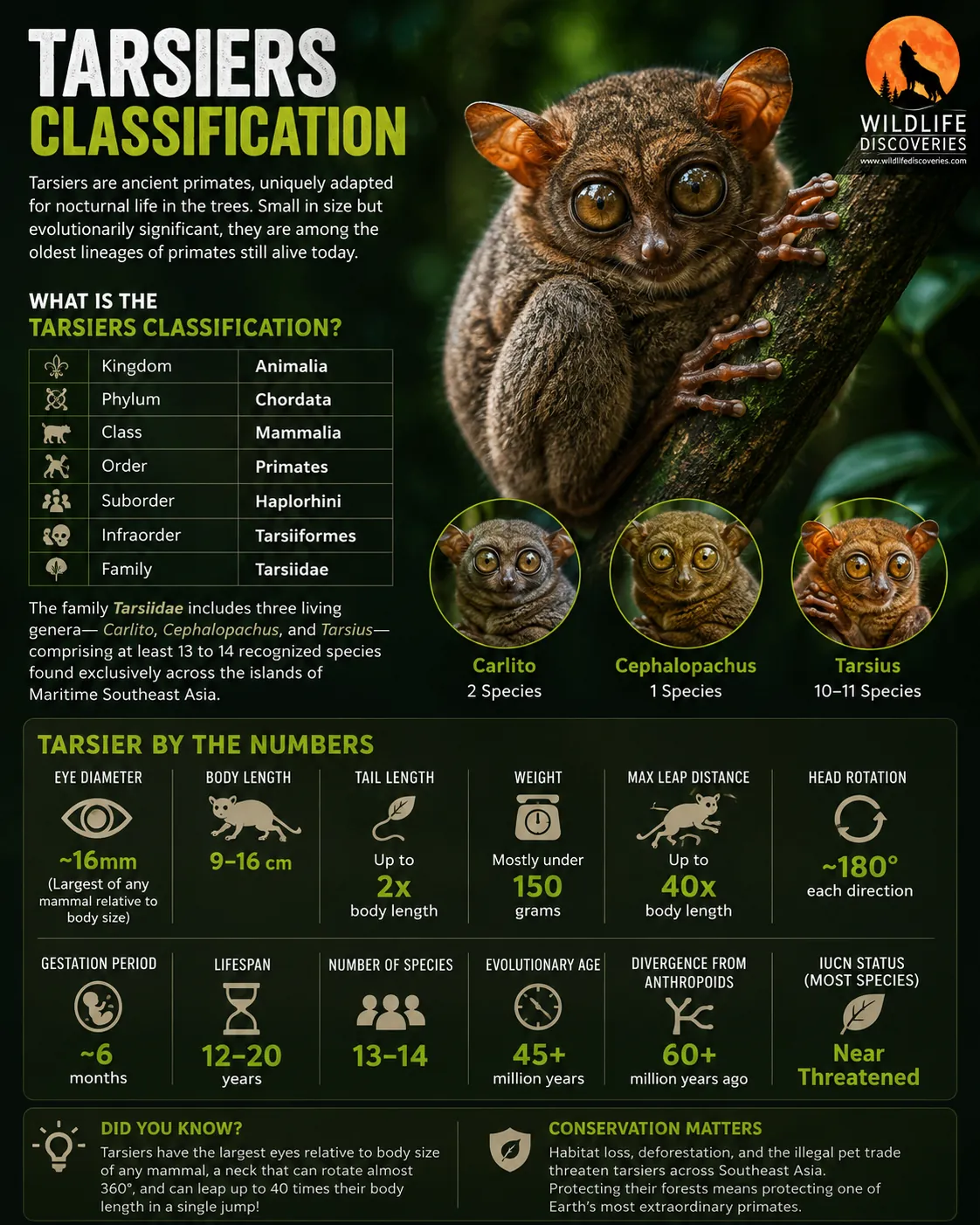
Tarsiers belong to Kingdom Animalia, Phylum Chordata, Class Mammalia, Order Primates, Suborder Haplorhini, Infraorder Tarsiiformes, Family Tarsiidae. This family contains three living genera — Carlito, Cephalopachus, and Tarsius — comprising at least 13 to 14 recognized species found exclusively across the islands of Maritime Southeast Asia.
Tarsier By the Numbers
| Metric | Data |
|---|---|
| Eye diameter | ~16mm (largest of any mammal relative to body size) |
| Body length | 9–16 cm |
| Tail length | Up to 2x body length |
| Weight | Mostly under 150 grams |
| Max leap distance | Up to 40x body length |
| Head rotation | ~180° each direction |
| Gestation period | ~6 months |
| Lifespan | 12–20 years |
| Number of species | 13–14 |
| Evolutionary age | 45+ million years |
| Divergence from anthropoids | 60+ million years ago |
| IUCN status (most species) | Near Threatened |
What Is a Tarsier?
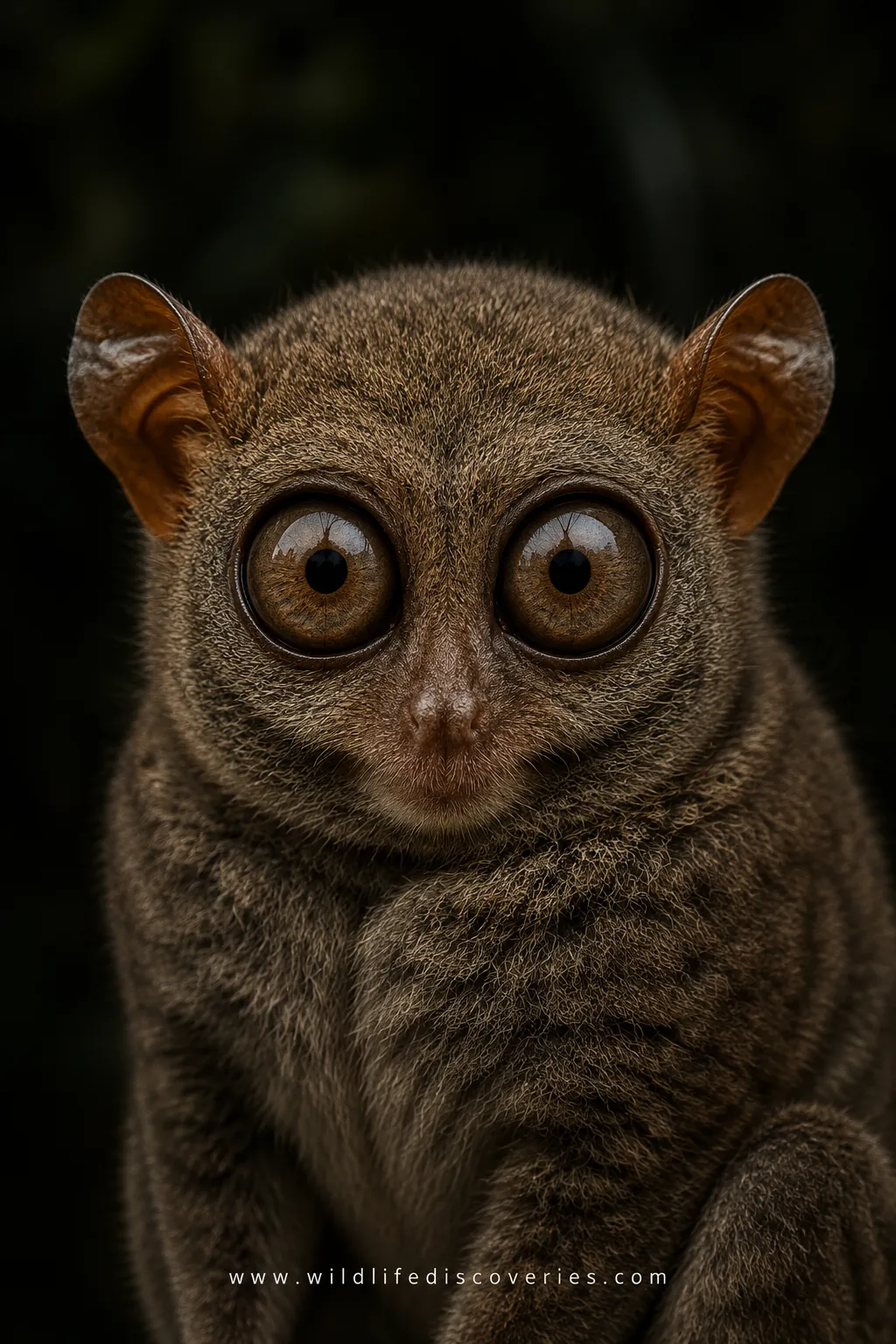
A tarsier is a small, nocturnal primate instantly recognizable by its enormous round eyes, long hind limbs, and extraordinary jumping ability. Adults measure just 9 to 16 cm in body length — small enough to fit in a human palm — yet their tail is often twice that length again.
Scientific classification: Family Tarsiidae, Order Primates Appearance: Grey to brown fur, oversized eyes, elongated fingers with adhesive pads, long naked tail Distribution: Islands of the Philippines, Borneo, Sumatra, and Sulawesi (Indonesia) Diet: Strictly carnivorous — insects, small vertebrates, occasionally small birds and bats Behavior: Nocturnal, solitary or pair-living depending on species, vertical clinging and leaping locomotion
What makes tarsiers scientifically fascinating is their intermediate position between two major primate lineages. Their nocturnal habits and vertical-clinging locomotion resemble lemurs and lorises. But their dry noses, eye structure, and placental biology align them far more closely with monkeys, apes, and humans — the group scientists call haplorhines. This dual identity has made tarsiers one of the most studied and re-studied lineages in all of primatology.
Scientific Classification of Tarsiers
Understanding tarsier taxonomy requires walking through each level of biological classification, because tarsiers challenge the categories at nearly every step.
| Taxonomic Rank | Classification |
|---|---|
| Kingdom | Animalia |
| Phylum | Chordata |
| Class | Mammalia |
| Order | Primates |
| Suborder | Haplorhini |
| Infraorder | Tarsiiformes |
| Family | Tarsiidae |
| Genera | Carlito, Cephalopachus, Tarsius |
| Species | 13–14 recognized (ongoing research) |
Why Each Level Matters
Order Primates places tarsiers alongside lemurs, monkeys, apes, and humans — all animals sharing traits like forward-facing eyes, grasping hands, and enlarged brains relative to body size.
Suborder Haplorhini (“dry-nosed primates”) is the critical dividing line. This suborder separates tarsiers, monkeys, apes, and humans from the Strepsirrhini — lemurs, lorises, and galagos, which retain a moist, dog-like nose (rhinarium). Tarsiers lost this moist nose feature, aligning them biologically with monkeys and apes despite looking nothing like either.
Infraorder Tarsiiformes is unique in modern primates because it contains only a single living family. Millions of years ago, this infraorder included dozens of genera spread across Asia, Europe, and North America. Today, every one of them is extinct except the tarsiers.
Family Tarsiidae is the sole surviving family within Tarsiiformes, making tarsiers a true evolutionary relic — the last living branch of an ancient primate lineage that once thrived across three continents.
Why Tarsiers Belong to Primates but Differ from Monkeys and Apes
Tarsiers meet every core definition of a primate: forward-facing eyes for depth perception, grasping hands and feet, nails instead of claws (mostly), and a relatively large brain-to-body ratio. But they diverge sharply from monkeys and apes in three critical ways: they are the only strictly carnivorous primates alive today, they rely on vertical clinging-and-leaping locomotion rather than quadrupedal walking or brachiation, and they retain a handful of ancestral traits — like an unfused tibia and fibula — that monkeys and apes lost long ago.
This combination of “ancient” and “advanced” traits is precisely why taxonomists have re-classified tarsiers multiple times over the past century.
➡️ For a broader look at how animals are grouped, see our guide: What Are the Classification of Animals?
Evolution of Tarsiers
Ancient Ancestors and a 45-Million-Year Fossil Record
The fossil record indicates that tarsier dentition has changed remarkably little — aside from size — over the past 45 million years. Tarsier-like fossils and stem anthropoid fossils both appear in the middle Eocene deposits of China, dating to roughly 45–55 million years ago, placing tarsiers among the oldest recognizable primate lineages on Earth.
Within the family Tarsiidae, paleontologists have identified extinct genera such as Xanthorhysis, confirming that tarsiiform primates were once far more diverse than the single surviving family suggests.
The Great Taxonomic Debate
Few primate lineages have been reclassified as often as the tarsier. In 1967, researchers placed tarsiers in the suborder Prosimii alongside lemurs and lorises. By 1985, taxonomists split them into their own suborder, Tarsioidea, recognizing that tarsiers didn’t fit comfortably with either prosimians or anthropoids (monkeys and apes).
The debate continues in modern molecular biology. Some researchers argue that anthropoids and tarsiers are sister taxa, descended from a common ancestor that split apart tens of millions of years ago. Others maintain that both groups emerged independently from within the broader omomyiform primate radiation — an extinct group of small, primitive primates from the Eocene epoch.
Molecular analyses place the divergence between tarsiers and anthropoids at over 60 million years ago — meaning tarsiers separated from the lineage leading to monkeys, apes, and humans before most modern mammal orders had even diversified.
Relationship with Lemurs
Despite superficial similarities — nocturnal habits, large eyes, similar body size — tarsiers are not closely related to lemurs. Lemurs belong to the Strepsirrhini suborder, while tarsiers belong to Haplorhini. Their resemblance is a case of convergent evolution: both lineages independently evolved traits suited to nocturnal insect-hunting.
Relationship with Monkeys and Apes
Genetically and anatomically, tarsiers are closer to monkeys and apes than to lemurs. They share the haplorhine “dry nose,” similar retinal structure, and comparable placental development. This is precisely why tarsiers are considered evolutionary intermediates — a living bridge between the strepsirrhine and anthropoid branches of the primate family tree.
Latest Molecular Research
Recent genomic studies continue to refine tarsier phylogeny. A 2010 taxonomic revision split the genus Tarsius into three genera — Carlito, Cephalopachus, and Tarsius — based on geographic isolation and consistent morphological and genetic distinctions between Philippine, western, and eastern populations. This revision elevated what were previously considered subspecies groups to full genus status, reflecting how much genetic divergence has accumulated across the tarsier’s fragmented island range.
Types of Tarsiers
Taxonomists currently recognize three genera and roughly 13–14 species within Tarsiidae, though ongoing genetic research continues to identify new species, particularly on Sulawesi.
Philippine Tarsier (Carlito syrichta)
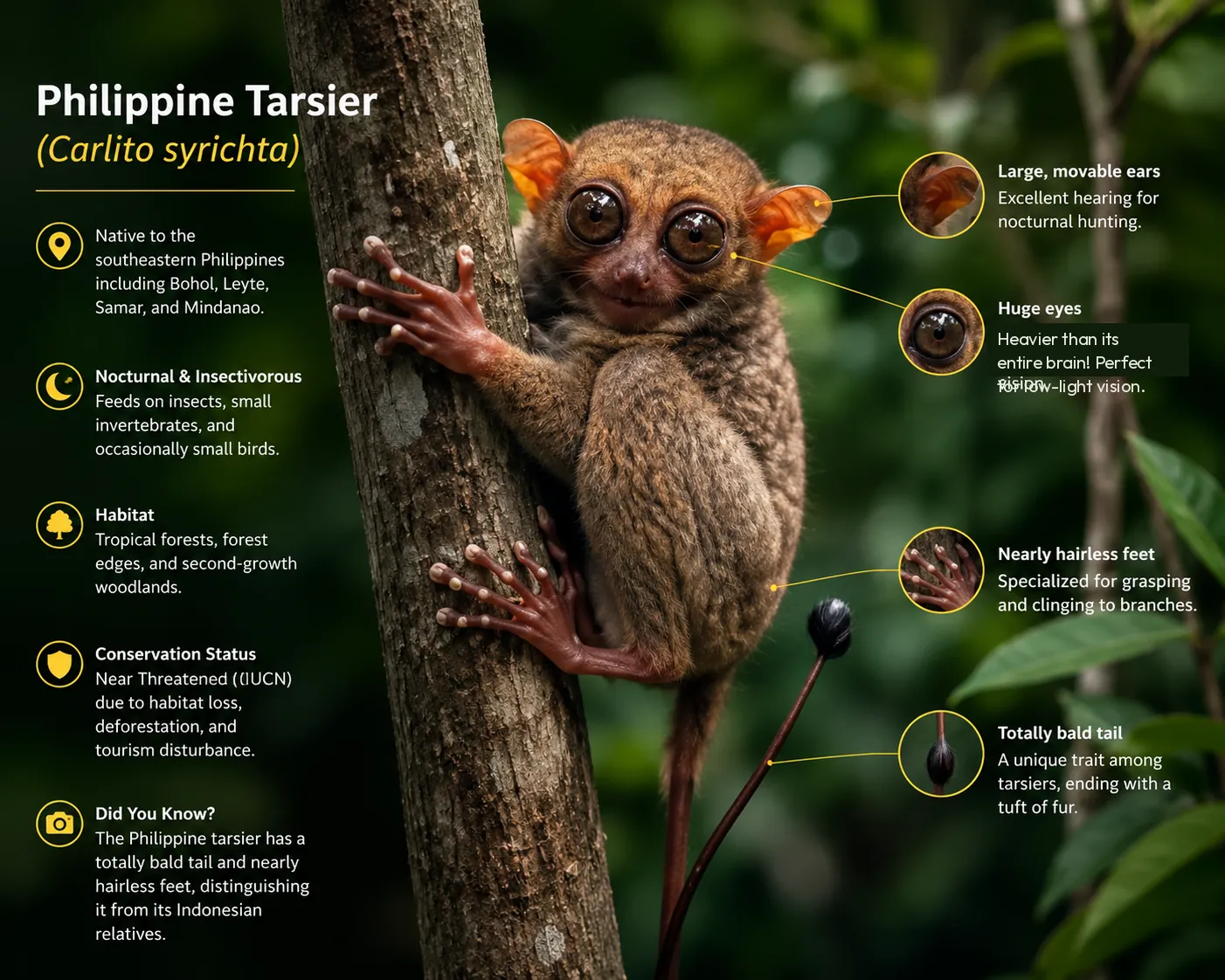
Native to the southeastern Philippines, including Bohol, Leyte, Samar, and Mindanao. It has a totally bald tail and nearly hairless feet, distinguishing it from its Indonesian relatives. This is the most widely recognized tarsier species globally, largely due to conservation tourism centered in Bohol.
Western Tarsier / Horsfield’s Tarsier (Cephalopachus bancanus)
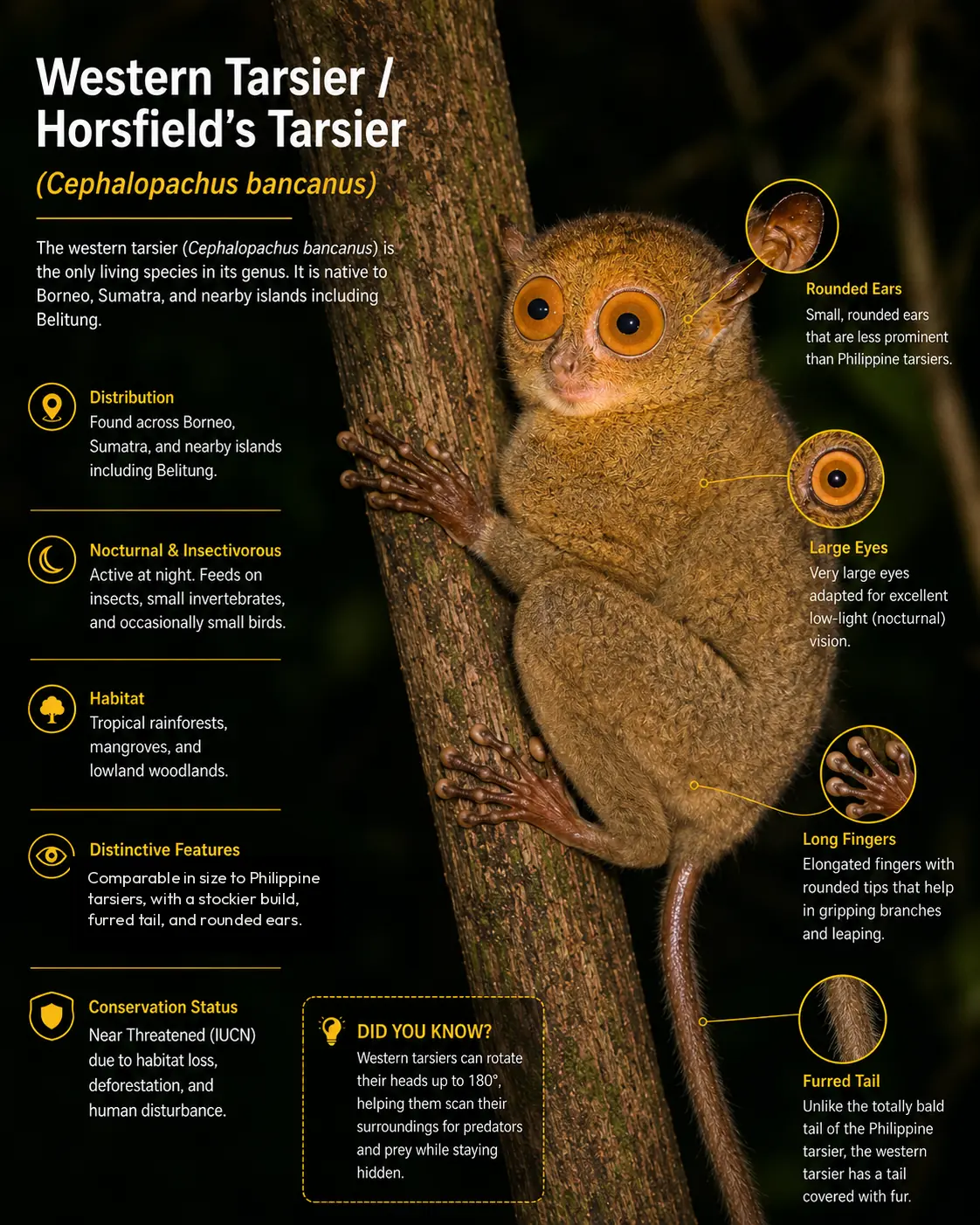
Found across Borneo, Sumatra, and nearby islands including Belitung. This species includes several subspecies, such as the Bornean tarsier and Belitung Island tarsier. It is the sole living member of its genus.
Eastern Tarsiers (Tarsius species)
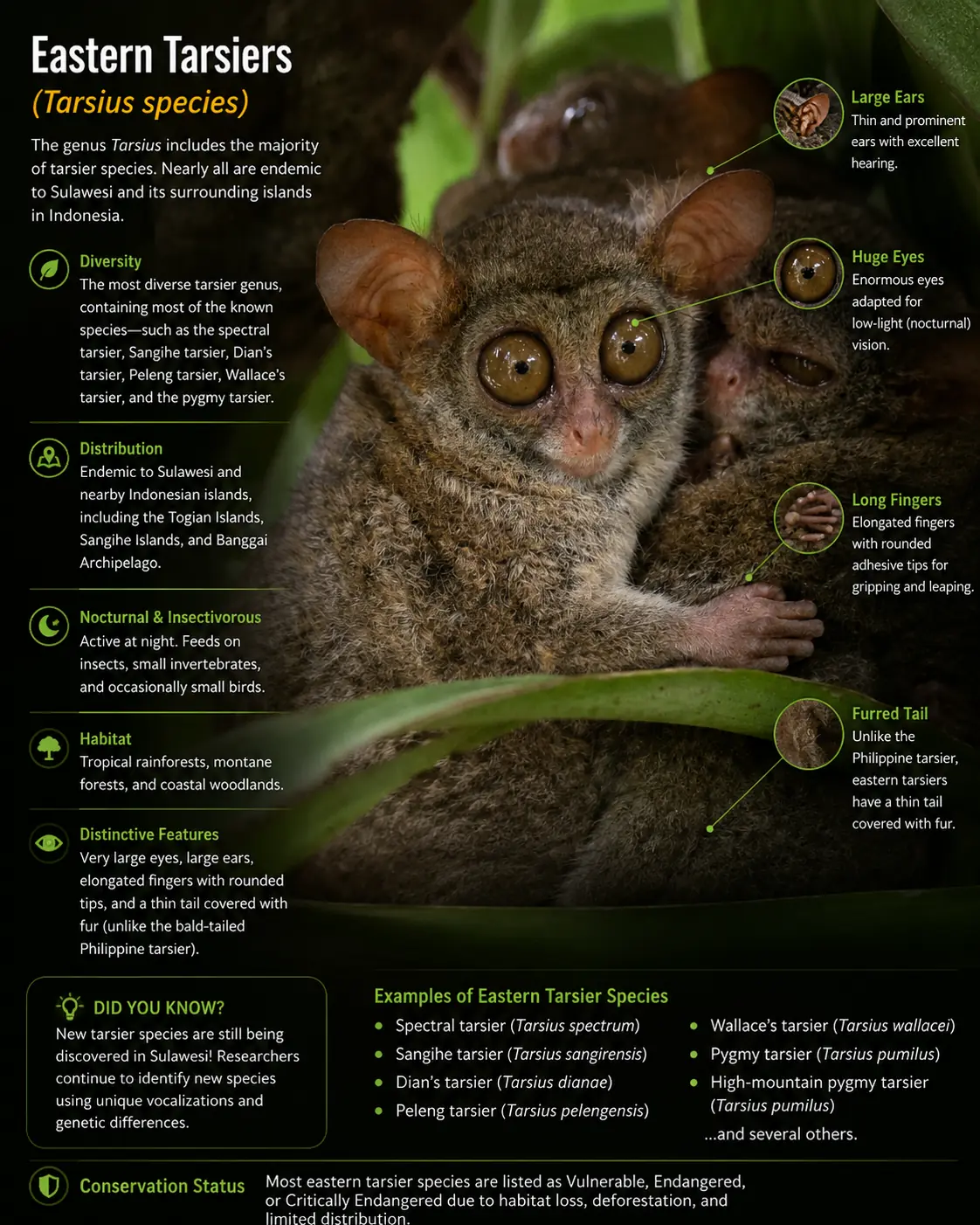
This is by far the most diverse genus, containing the majority of tarsier species — the spectral tarsier, Sangihe tarsier, Dian’s tarsier, Peleng tarsier, Wallace’s tarsier, and the extraordinary pygmy tarsier, among others. Nearly all eastern tarsier species are endemic to Sulawesi and its surrounding islands in Indonesia.
Recent Species Discoveries
The high-mountain pygmy tarsier (Tarsius pumilus) is one of the most remarkable rediscovery stories in modern primatology. After the last confirmed sighting in 1921, scientists assumed the species was extinct for nearly 90 years — until researchers rediscovered a living population in the highlands of Sulawesi in 2008. New species descriptions have continued into the 2010s, with researchers formally describing additional Sulawesi tarsier species based on distinct vocalizations and genetic markers, underscoring how much remains undiscovered about this family.
Physical Characteristics
Tarsiers possess a set of adaptations found nowhere else among primates — a body plan built almost entirely around nocturnal ambush hunting.
Huge eyes: Each eye is roughly 16mm in diameter — proportionally the largest eyes of any mammal relative to body size. A tarsier’s eyes are so large they cannot rotate in their sockets; to compensate, evolution gave them an extraordinary solution.
180-degree head rotation: Because their eyes are fixed in place, tarsiers can rotate their heads nearly 180 degrees in each direction — much like an owl — allowing them to scan their entire surroundings without moving their body and alerting prey.
Long hind limbs: Their name derives from the dramatically elongated tarsus bone in their ankle, which acts like a spring-loaded lever. This adaptation allows tarsiers to leap distances of up to 40 times their own body length in a single jump.
Long fingers with adhesive pads: Elongated digits tipped with expanded, sticky pads allow tarsiers to grip smooth vertical surfaces and vines securely, even while landing at speed after a jump.
Fur and tail: Soft, dense fur ranges from grey to reddish-brown depending on species. The tail is long, thin, and often nearly hairless except for a small tuft at the tip, used primarily for balance rather than grasping.
Night vision: Despite their enormous eyes, tarsiers lack the reflective tapetum lucidum layer that most nocturnal mammals use to enhance night vision — an unusual trait that suggests their ancestors may once have been diurnal (day-active) before shifting to nocturnal life.
Jumping ability: Combining explosive hind-limb power with a lightweight body (most species weigh under 150 grams), tarsiers are considered among the most capable leapers of any mammal relative to their size.
Tarsier vs. Lemur vs. Galago: How Do They Compare?
Tarsiers are frequently confused with lemurs and galagos because all three are small, nocturnal, big-eyed primates. But their evolutionary paths, biology, and classification are quite different. Here’s how they stack up:
| Feature | Tarsier | Lemur | Galago (Bushbaby) |
|---|---|---|---|
| Suborder | Haplorhini | Strepsirrhini | Strepsirrhini |
| Nose type | Dry (like humans) | Moist (rhinarium) | Moist (rhinarium) |
| Diet | Strictly carnivorous | Mostly herbivorous/omnivorous | Omnivorous (fruit + insects) |
| Native region | Southeast Asia | Madagascar only | Sub-Saharan Africa |
| Eye adaptation | Fixed, cannot rotate | Can move slightly | Can move slightly |
| Locomotion | Vertical clinging & leaping | Varies by species | Vertical clinging & leaping |
| Tapetum lucidum (night-vision layer) | Absent | Present | Present |
| Closest relatives | Monkeys, apes, humans | Lorises, galagos | Lorises, lemurs |
The most important distinction is taxonomic: tarsiers sit in Haplorhini alongside monkeys and apes, while both lemurs and galagos belong to Strepsirrhini. This means a tarsier is, biologically, more closely related to a human than it is to a lemur — despite looking far more similar to the lemur at first glance.
Myth vs. Fact: Common Tarsier Misconceptions
Myth: Tarsiers are a type of lemur. Fact: They are not. Tarsiers belong to Haplorhini, the same suborder as monkeys and apes. Lemurs belong to the separate suborder Strepsirrhini. Their resemblance is coincidental, driven by both groups independently adapting to nocturnal life.
Myth: Tarsiers are rodents or “bush babies.” Fact: Tarsiers are true primates, not rodents. While galagos (bushbabies) share a similar body plan and vertical-leaping style, they are a completely separate strepsirrhine family native to Africa, not Asia.
Myth: Tarsiers can be kept safely as exotic pets. Fact: Tarsiers are illegal or heavily restricted as pets throughout their native range and under CITES. Captive individuals frequently die within two years and are prone to self-injury from stress — they are fundamentally unsuited to captivity.
Myth: All tarsiers look and behave the same. Fact: The three genera differ meaningfully in tail texture, vocal behavior, social structure, and habitat preference. Some species live in monogamous pairs; others are strictly solitary.
Myth: Tarsiers have excellent night vision because of their huge eyes. Fact: Despite their enormous eyes, tarsiers actually lack the tapetum lucidum — the reflective layer that gives most nocturnal mammals enhanced night vision. Their giant eyes compensate for this missing adaptation through sheer light-gathering surface area instead.
Behavior
Nocturnal lifestyle: Tarsiers are active almost exclusively at night, sleeping through daylight hours clinging vertically to a tree trunk or vine, camouflaged against the bark.
Communication: Species vary widely in vocal behavior. Some, like the spectral tarsier, produce loud, complex duet calls used to defend territory, while others rely primarily on ultrasonic calls beyond typical human hearing range — a trait that has only been documented through specialized recording equipment.
Territory: Social structure varies significantly by species. Some tarsiers are strictly solitary; others form monogamous pairs or small family groups that share and defend a territory using scent marking and vocal calls.
Diet: Tarsiers are the only exclusively carnivorous primates alive today. Their diet consists almost entirely of insects — beetles, crickets, moths, and cicadas — supplemented occasionally with small vertebrates including lizards, small birds, and even bats caught mid-flight.
Hunting: Hunting is a purely ambush-based strategy. A tarsier will remain motionless on a vertical perch, using its acute hearing and directional head rotation to detect prey movement, then launch an explosive leap to seize it with both hands.
Predators: Natural predators include owls, snakes, and small wild cats. Because tarsiers are so small and slow-moving during daylight hours, they rely almost entirely on camouflage and stillness for daytime protection.
Reproduction: Female tarsiers typically give birth to a single offspring after a gestation period of around six months — unusually long for such a small mammal. Newborns are remarkably well-developed at birth, with open eyes and the ability to cling to branches within hours.
Habitat and Distribution
Tarsiers are found exclusively across the islands of Maritime Southeast Asia — a range that, while geographically limited today, was once far broader. Fossil evidence confirms tarsiiform primates historically inhabited parts of Europe, North Africa, Asia, and North America before shifting climate and competition confined the surviving family to their current island strongholds.
Philippines: Southeastern islands including Bohol, Samar, Leyte, and Mindanao — home of the Philippine tarsier Indonesia: Sumatra, Belitung, and especially Sulawesi, which hosts by far the greatest diversity of tarsier species anywhere in the world Malaysia and Borneo: Home to the western or Horsfield’s tarsier
Tarsiers favour dense, vine-rich forest with liana growth, since vines provide the vertical support structures essential to their leaping locomotion. They inhabit both primary old-growth rainforest and secondary forest, though population density is consistently lower in disturbed habitats. Some populations tolerate low scrubby vegetation and forest edges near villages, but thrive best in continuous, undisturbed canopy.
Elevation range varies by species, with most populations found from sea level up to roughly 750 meters (2,460 feet), though certain high-mountain species like the pygmy tarsier have adapted to significantly higher elevations on Sulawesi.
➡️ Explore related habitat topics: Different Types of Ecosystems and Characteristics
Why Tarsiers Are Unique Among Primates
Few animals occupy as strange a scientific position as the tarsier. Several features make this family genuinely unlike any other primate group alive today:
Disproportionate eyes: No other primate — or arguably no other mammal — has eyes this large relative to body size. Each eyeball is heavier than the tarsier’s entire brain.
Brain adaptations: Because their eyes cannot move in their sockets, tarsiers evolved compensating neurological pathways controlling rapid head rotation, effectively substituting head movement for eye movement.
Vertical clinging and leaping: This specialized locomotion style, shared with only a handful of other primates like galagos, represents one of the most biomechanically efficient movement strategies in the animal kingdom.
Evolutionary position: As the last surviving lineage of an infraorder that once spanned three continents, tarsiers represent an evolutionary “living fossil” — a direct window into a 45-million-year-old primate body plan.
Ecological niche: As the only fully carnivorous primates, tarsiers occupy an ecological role found nowhere else in the primate order — functioning more like small nocturnal predators than typical fruit- or leaf-eating primates.
Conservation Status
Current IUCN Classification
Most tarsier species, including the well-studied Philippine tarsier, are currently listed as Near Threatened on the IUCN Red List, based on an estimated population decline of under 30% over three generations (roughly 20 years). However, this classification has shifted multiple times over the past three decades — from Endangered, to Lower Risk/Conservation Dependent, to Data Deficient, and finally to Near Threatened in 2008.
Some researchers argue this status is now outdated. Post-typhoon population surveys in the Philippines recorded density drops from approximately 157 individuals per square kilometer to just 36 individuals per square kilometer following a major storm — a decline severe enough that several primatologists have formally recommended upgrading the Philippine tarsier’s status to Vulnerable.
Major Threats
Habitat loss: Agricultural expansion and urbanization have destroyed significant portions of tarsier habitat, with some regions experiencing over 30% forest loss between 1978 and 2008 alone.
Illegal pet trade: Despite legal protection, tarsiers remain a target for the illegal exotic pet trade, particularly in urban markets. Captive tarsiers have an extremely poor survival record — many die within two years due to their highly specialized live-insect diet and severe stress sensitivity. Tarsiers are also known to engage in self-injurious behavior when held captive, making them fundamentally unsuited to life outside their natural habitat.
Climate change and natural disasters: Typhoons and extreme weather events have caused documented, severe population crashes in localized tarsier populations, highlighting how vulnerable these small, geographically restricted species are to environmental disruption.
Light and noise pollution: As strictly nocturnal animals, tarsiers are unusually sensitive to artificial light and human noise near forest edges, both of which disrupt their hunting behavior and sleep cycles.
➡️ Learn how you can help: What Can We Do to Protect Endangered Animals? | Why Is Wildlife Conservation Important?
Importance in Forest Ecosystems
Tarsiers play a distinct and often underappreciated ecological role. As dedicated insect predators, they help regulate populations of beetles, crickets, and other invertebrates within their forest habitat, contributing to natural pest control that benefits the broader ecosystem.
Their presence also serves as a bioindicator of forest health. Because tarsiers require dense, structurally complex, vine-rich forest to survive, healthy tarsier populations typically signal a broader intact ecosystem — one capable of supporting the full web of species that depend on old-growth or well-preserved secondary forest.
Their position within the food chain — as prey for owls and snakes, and predator to a wide range of insects — makes them a meaningful link connecting invertebrate and vertebrate food webs within Southeast Asian rainforest ecosystems.
15 Interesting Facts About Tarsiers
- A tarsier’s eyeball is physically larger and heavier than its own brain
- They can rotate their heads almost 180 degrees in either direction, much like owls
- Tarsiers are the only fully carnivorous primates alive today
- They can leap distances of up to 40 times their own body length
- The pygmy tarsier was believed extinct for nearly 90 years before its rediscovery in 2008
- Some species communicate using ultrasonic calls beyond the range of human hearing
- Their name comes from their dramatically elongated tarsus (ankle) bone
- Tarsiers lack the reflective eye layer (tapetum lucidum) most nocturnal animals rely on
- Fossil evidence shows tarsiiform primates once lived across Europe, Asia, and North America
- A newborn tarsier can cling to branches within hours of birth
- Sulawesi hosts the greatest tarsier species diversity on Earth
- Their total body length is just 9–16 cm, but their tail can be twice that length
- Captive tarsiers often die within two years, making them entirely unsuitable as pets
- Genetic divergence between tarsiers and anthropoid primates dates back over 60 million years
- Tarsiers were reclassified into three separate genera only as recently as 2010
Frequently Asked Questions
What is the scientific classification of a tarsier? Tarsiers belong to Kingdom Animalia, Phylum Chordata, Class Mammalia, Order Primates, Suborder Haplorhini, Infraorder Tarsiiformes, and Family Tarsiidae — the sole surviving family within their infraorder.
Are tarsiers monkeys? No. Tarsiers are not monkeys, though they belong to the same suborder (Haplorhini) as monkeys, apes, and humans. They form their own distinct family, Tarsiidae, separate from all monkey and ape lineages.
How many species of tarsier are there? Taxonomists currently recognize 13 to 14 species across three genera — Carlito, Cephalopachus, and Tarsius — though ongoing genetic research on Sulawesi continues to identify additional species.
Why do tarsiers have such large eyes? Their oversized eyes evolved to maximize light capture for nocturnal hunting. Because the eyes are too large to rotate within their sockets, tarsiers compensate with an almost 180-degree head rotation instead.
Are tarsiers endangered? Most species, including the Philippine tarsier, are currently classified as Near Threatened by the IUCN, though several researchers argue certain populations meet the criteria for Vulnerable status due to accelerating habitat loss and localized population crashes.
What do tarsiers eat? Tarsiers are the only strictly carnivorous primates alive today. Their diet consists mainly of insects, supplemented occasionally with small vertebrates such as lizards, small birds, and bats.
Where do tarsiers live? Tarsiers are found exclusively across Maritime Southeast Asia, including the Philippines, Sumatra, Borneo, and especially Sulawesi in Indonesia, which hosts the greatest diversity of tarsier species.
Can tarsiers be kept as pets? No. Tarsiers are illegal or heavily restricted as pets in most of their native countries and under CITES regulations. They also have an extremely poor survival rate in captivity, often dying within two years due to specialized dietary needs and severe stress sensitivity.
How is a tarsier different from a lemur? Despite superficial similarities, tarsiers and lemurs are not closely related. Lemurs belong to the suborder Strepsirrhini, while tarsiers belong to Haplorhini — the same suborder as monkeys, apes, and humans.
What is the oldest evidence of tarsier evolution? Fossil evidence places tarsiiform primates in the middle Eocene of China roughly 45–55 million years ago, with dental structures that have remained remarkably unchanged in form, aside from size, ever since.
Suggested external references for further reading: IUCN Red List (Tarsiidae assessments), Britannica (Tarsier), Animal Diversity Web, Smithsonian National Zoo, IUCN/SSC Primate Specialist Group.