Cordyceps Spider” Found: Spider That Mimics Deadly Fungus
Nature Just Invented a New Kind of Deception — And It Involves a Spider Pretending to Be a Disease

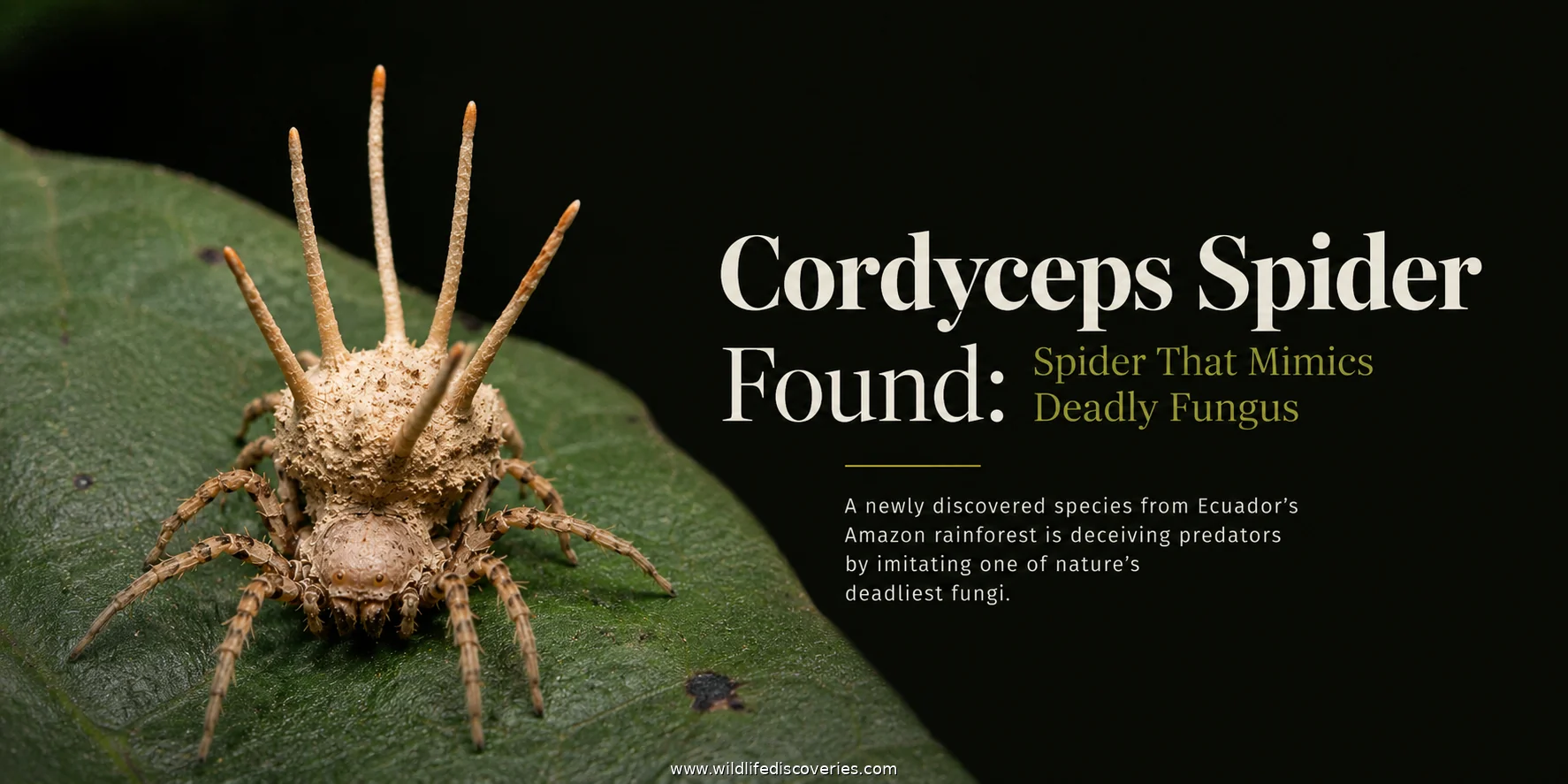
Deep in the Ecuadorian Amazon, scientists have discovered a real-life Cordyceps spider — and it’s unlike anything biology has ever recorded. On a rainy nighttime hike, a herpetologist named Alexander Bentley flipped over what he expected to be a dead spider consumed by a parasitic fungus. He had seen that before — the pale, elongated, finger-like growths erupting from an infected spider’s body, one of nature’s most macabre sights. But something was off.
The dead spider moved.
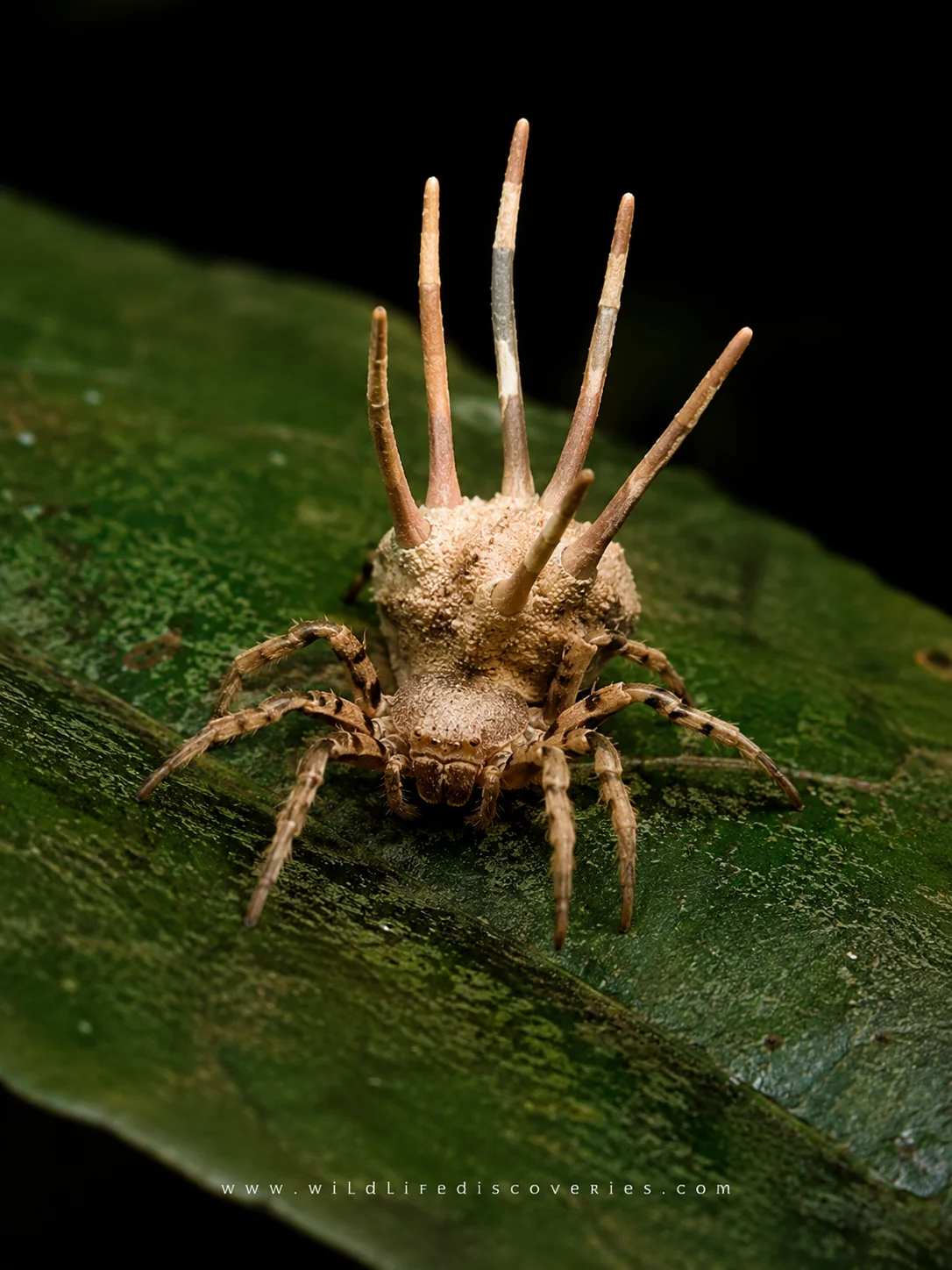
What Bentley had found wasn’t a fungus-killed carcass at all. It was a living, breathing spider — one that had evolved to look exactly like one. In February 2026, scientists formally introduced this Cordyceps-mimicking creature to the world: Taczanowskia waska, a newly described species of orb-weaving spider from the Ecuadorian Amazon that represents the first documented case in scientific history of a spider mimicking a parasitic fungus that kills other spiders.
This discovery — published in the peer-reviewed journal Zootaxa — has left biologists rethinking how far evolution can push the art of deception. It’s the real-life version of The Last of Us, and it’s hiding on a leaf in Ecuador right now.
Discovery: When, Where, and How It Happened
Every great scientific discovery has an origin story, and this one began far from any laboratory — on a quiet, rain-soaked trail deep in the Amazon.
The Night Walk That Changed Arachnology
The story begins not in a laboratory but on a nighttime tour in the Waska Amazonía reserve, located within the Llanganates-Sangay Connectivity Corridor in Pastaza Province, Ecuador. This remote stretch of cloud forest connecting the Llanganates and Sangay National Parks is considered one of the most biodiverse corridors on Earth — a WWF-designated “Gift to the Earth” — where new species are discovered with startling regularity.
Alexander Griffin Bentley, a herpetologist and associate researcher at Ecuador’s National Institute of Biodiversity (INABIO), was leading a group of visitors through the forest. He spotted something on the underside of a leaf — pale, elongated, spike-like projections on what appeared to be a spider corpse infested with Gibellula fungus. A common enough sight in tropical forests.
But the “corpse” moved.
Bentley photographed the creature and posted the images to iNaturalist, the global citizen science platform where naturalists share wildlife observations. Initially, even the iNaturalist community believed it was a fungus-covered spider carcass. It was only on closer re-examination by community members that someone looked more carefully at the photographs and realized: this was a living spider, not a dead one.
That post launched an international scientific investigation.
From iNaturalist to Zootaxa — The Road to Formal Description
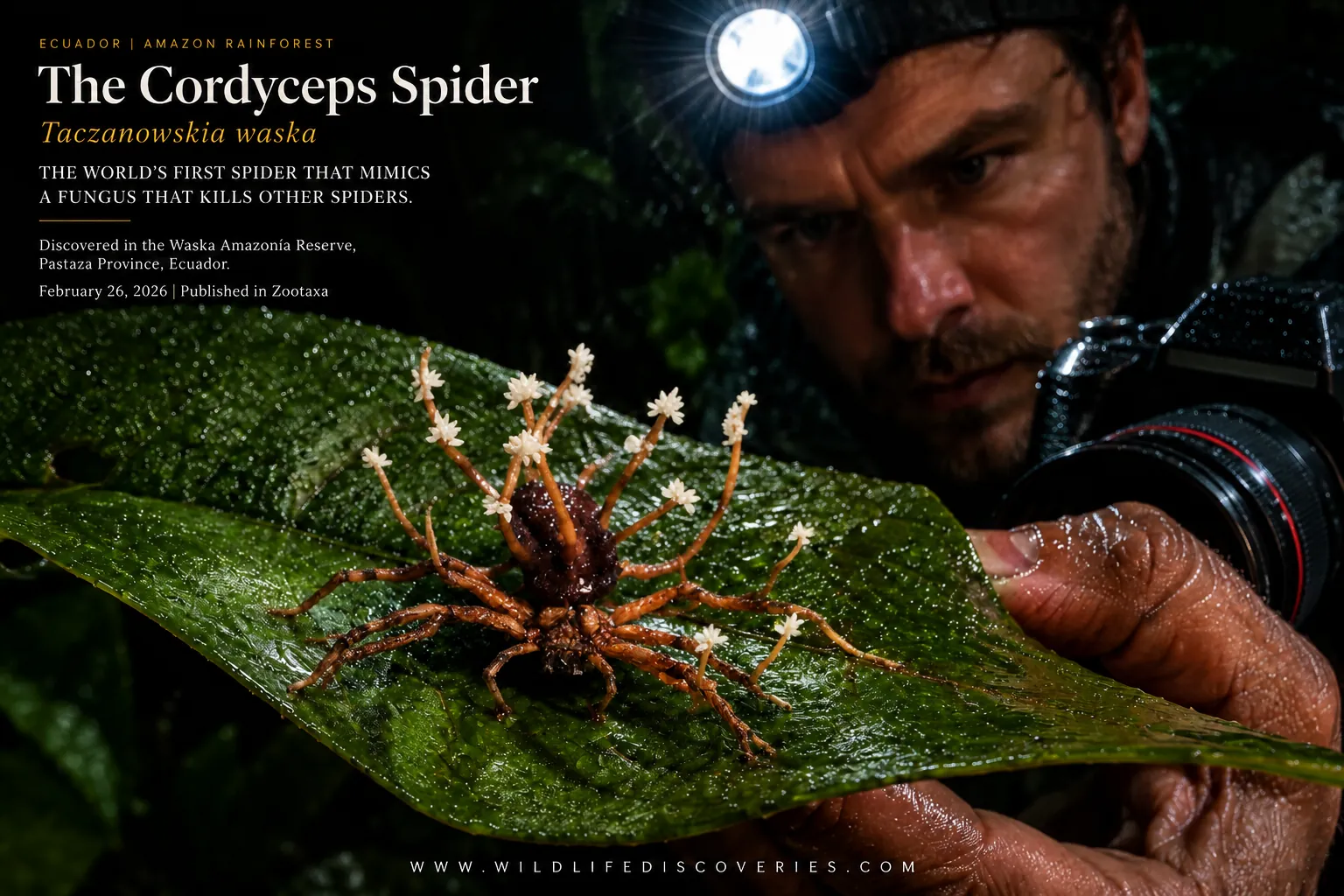
Bentley connected with David Ricardo Díaz-Guevara, an arachnid curator at INABIO and lead author of the eventual study. Together with Nadine Dupérré of the Leibniz Institute for the Analysis of Biodiversity Change (LIB) at the Museum of Nature Hamburg in Germany, the team examined the specimen against reference collections from museums across the world, comparing it to historical specimens that had sat in drawers for decades.
Their findings were formally published on February 26, 2026, in Zootaxa (DOI: 10.11646/zootaxa.5760.5.4) under the title “The Cordyceps Spider”: Taczanowskia waska sp. nov. (Araneae: Araneidae), a new spider species and a novel case of mimicry of an araneopathogenic fungus (Cordycipitaceae: Gibellula).
The species name waska honors both the Fundación Waska Amazonía — the Ecuadorian conservation nonprofit where Bentley works — and the Kichwa word waska, meaning “root” or “vine,” a reference to the plant on which the spider was first encountered.
Scientific Name & Classification
| Classification Level | Detail |
|---|---|
| Kingdom | Animalia |
| Phylum | Arthropoda |
| Class | Arachnida |
| Order | Araneae |
| Family | Araneidae (orb-weavers) |
| Genus | Taczanowskia |
| Species | waska |
| Common Name | Cordyceps Spider / Amazon Fungus-Mimicking Spider |
| Published | February 26, 2026 — Zootaxa |
| DOI | 10.11646/zootaxa.5760.5.4 |
The genus Taczanowskia honors Władysław Taczanowski, a 19th-century Polish zoologist known for his work on South American fauna. The genus is considered rare and poorly studied — members are seldom encountered in the wild, which explains why this extraordinary mimicry went undetected for so long.
What Makes Taczanowskia waska Uniquely Extraordinary
1. The World’s First Spider Known to Mimic a Fungus
Mimicry in nature is common. Stick insects look like twigs. Leaf-tailed geckos look like bark. Some butterflies mimic toxic species. But mimicry has always followed a predictable logic: animals mimic other animals, or neutral parts of the landscape. Taczanowskia waska breaks all of those rules.
This is the first documented case in scientific history of any spider mimicking the appearance of a pathogenic fungus — specifically, one that infects and kills members of its own taxonomic group. The authors describe it as a completely novel category of mimicry, one that no existing framework in the scientific literature had previously anticipated.
2. The Fungus It Mimics: Gibellula — A Spider Killer
To understand how disturbing this mimicry really is, you need to understand what Taczanowskia waska is pretending to be.
The spider mimics fungi in the genus Gibellula, belonging to the family Cordycipitaceae — the same biological family as the infamous Cordyceps fungi, which are known for hijacking insect behavior and killing their hosts in order to spread spores. Gibellula species are specifically araneopathogenic, meaning they exclusively target and kill spiders.
When Gibellula infects a spider, it colonizes its body and eventually kills it. The fungal fruiting bodies then erupt from the spider’s exoskeleton — producing pale, elongated, finger-like protrusions that stick outward from the dead host’s body. The infected corpse typically remains stuck to the underside of a leaf, exactly where humid conditions help the fungus spread its spores.
Taczanowskia waska has evolved its own anatomy to reproduce this image with stunning accuracy.
3. How the Spider Fakes It — The Anatomy of Deception
The mimicry of Taczanowskia waska is structural, not behavioral — built directly into its body:
- Pale coloration: The spider’s overall body color is a washed-out, bleached white or pale cream — mimicking the color of fungal tissue, which is visually distinct from the darker, richer tones of a healthy living spider.
- Elongated abdominal projections: The spider has unusual spike-like projections extending from its abdomen that closely replicate the protruding fruiting bodies of Gibellula fungus growing on a real spider carcass.
- Smooth, fungal-textured surface: The surface texture of the spider’s body completes the illusion by resembling the soft, matte appearance of fungal growth rather than the glossy or textured exoskeleton of a typical spider.
The resemblance is so accurate that Bentley — a trained naturalist who regularly encounters Gibellula-infected spiders in the field — initially classified it as a dead specimen on first sight. Even experienced iNaturalist users were fooled by photographs.
4. The Behavioral Layer: Stillness as Camouflage
The anatomical disguise is reinforced by behavior. Like other members of the Taczanowskia genus, T. waska appears to remain completely motionless on the undersides of leaves — the exact microhabitat where Gibellula fungi grow on their spider hosts.
This combination of appearance and posture creates a multi-layered illusion. To a predator scanning the leaf layer, the spider doesn’t just look like a dead fungus-covered carcass — it behaves like one too.
5. A Dual-Purpose Survival Strategy
The authors propose that this mimicry serves two simultaneous purposes, which is rare even among mimics:
Defensive: A predator — say, a bird, lizard, or parasitic wasp — scanning the leaf surface for prey has every reason to ignore what appears to be a spider already killed and consumed by fungus. It signals contagion. It signals something already dead and decomposing. It offers nothing worth the energy of eating. By inhabiting this perceptual category, T. waska may dramatically reduce the likelihood of being attacked.
Offensive (hunting): The same disguise may allow the spider to remain undetected by its own prey — insects and other small arthropods that would flee from an obvious predator — until it is close enough to strike.
A single adaptation that simultaneously reduces predation risk and increases hunting success is exceptionally rare in nature, and it is precisely what makes T. waska one of the most remarkable mimics ever documented.
The Citizen Science Angle: How iNaturalist Cracked the Case
One of the most striking elements of this discovery is how it happened. Taczanowskia waska was not found by a formally funded expedition armed with specimen collection permits. It was found by a naturalist on a tourist walk, photographed on a smartphone, uploaded to a free citizen science platform, and identified by community members re-examining pictures that initially fooled everyone.
The formal scientific paper itself explicitly credits iNaturalist as the origin of the discovery, and the authors used the platform to identify four additional spider species across other countries — in Vietnam, Brazil, Uganda, and Madagascar — that appear to display similar fungal mimicry, though they have not yet been formally described.
Nadine Dupérré of the Museum of Nature Hamburg summarized what this means for biodiversity science: discoveries like these demonstrate the value of both scientific museum collections and community-based observation networks working together. Historical specimens in museum drawers in Hamburg and Budapest confirmed species identities; a nighttime tourist walk in Ecuador provided the living specimen; and an online community identified what trained eyes initially missed.
This is increasingly how 21st-century species discovery works.
Conservation Status and Why This Discovery Matters
Beyond its bizarre disguise, Taczanowskia waska‘s story raises an important question: how safe is this newly discovered species, and what does its existence tell us about the forest it calls home? It’s a question that ties directly into why wildlife conservation matters today, especially as scientists warn that species are disappearing faster than they can be documented.
Current Conservation Status
Taczanowskia waska has not yet been formally assessed by the IUCN Red List, as the species was only described in February 2026. Currently, the species is known from just two locations in the world: the Waska Amazonía headquarters in Mera, Pastaza Province, Ecuador, and a separate locality in Bolivia. That extraordinarily limited known range makes any assessment of its population size or vulnerability essentially impossible with current data.
The Habitat: A Biodiversity Hotspot Under Pressure
The Llanganates-Sangay Connectivity Corridor — where T. waska was first found — is not just any patch of forest. It was designated a “Gift to the Earth” by the WWF in 2002, recognizing its extraordinary concentration of biodiversity and endemism within a geographically small area. New species of frogs, plants, and now spiders have been described from this corridor with remarkable regularity.
Yet even this protected corridor faces growing threats: deforestation on its margins, infrastructure pressure, climate-driven shifts in cloud forest elevation, and the broader crisis of Amazonian habitat loss. Scientists estimate that over 86% of Earth’s species remain undescribed — and the Amazon’s leaf-litter, canopy, and understory hold an unknowable fraction of that total. Species like T. waska likely exist in dozens of variants across the region, none of them yet known to science, some of them potentially already lost before discovery.
The Bigger Significance: A New Category of Mimicry
Beyond conservation, the scientific implications of this discovery extend into evolutionary biology, arachnology, and the study of animal-fungal interactions. The authors note that T. waska does not just add a species to a list — it opens an entirely new question about how mimicry can evolve. If a spider can evolve to mimic a disease, not an animal or landscape feature, what other categories of mimicry remain unrecognized in forests humans have barely surveyed?
Quick-Reference Species Profile
| Feature | Detail |
|---|---|
| Scientific Name | Taczanowskia waska |
| Formally Described | February 26, 2026 (Zootaxa) |
| Discovery Location | Waska Amazonía Reserve, Pastaza Province, Ecuador |
| Ecosystem | Llanganates-Sangay Connectivity Corridor, Ecuadorian Amazon |
| Known Range | Two locations: Ecuador and Bolivia |
| Family | Araneidae (orb-weavers) |
| Mimics | Gibellula spp. — spider-killing parasitic fungi (Cordycipitaceae) |
| Mimicry Type | Structural (anatomical) + behavioral — first known case of spider-fungus mimicry |
| Key Physical Traits | Pale coloration, elongated abdominal projections, motionless on leaf undersides |
| IUCN Status | Not yet assessed |
| Lead Researcher | David R. Díaz-Guevara (INABIO, Ecuador) |
| Co-Authors | Alexander Griffin Bentley (INABIO); Nadine Dupérré (LIB, Hamburg) |
| Publication DOI | 10.11646/zootaxa.5760.5.4 |
| Discovery Method | Citizen science (iNaturalist) + museum specimen comparison |
FAQ: Taczanowskia waska — The Amazon Fungus-Mimicking Spider
Q: What is the scientific name of the Amazon spider that mimics a fungus?
A: The spider’s scientific name is Taczanowskia waska. It was formally described in February 2026 in the peer-reviewed journal Zootaxa by researchers from Ecuador, Germany, and the international scientific community.
Q: Where was Taczanowskia waska discovered?
A: It was first found in the Waska Amazonía reserve, located within the Llanganates-Sangay Connectivity Corridor in Pastaza Province, Ecuador. A second location has since been identified in Bolivia.
Q: What fungus does Taczanowskia waska mimic?
A: The spider mimics fungi in the genus Gibellula, from the family Cordycipitaceae — the same fungal family as the famous Cordyceps fungi. Gibellula species are araneopathogenic, meaning they specifically infect and kill spiders.
Q: Is this the first spider to mimic a fungus?
A: Yes. According to the study’s authors, Taczanowskia waska represents the first formally documented case in scientific history of a spider mimicking the appearance of a parasitic fungus that infects spiders. It opens an entirely new category of mimicry.
Q: How does the spider pull off the disguise?
A: Through a combination of pale, washed-out coloration and elongated spike-like projections extending from its abdomen — both of which closely replicate the appearance of Gibellula fungal fruiting bodies growing on a dead spider. The spider reinforces this by remaining motionless on the undersides of leaves, exactly where Gibellula-infected spider corpses are found.
Q: Why does the spider mimic a fungus — what’s the advantage?
A: Scientists believe the mimicry serves a dual purpose: it discourages predators (who would avoid what appears to be a diseased, infected carcass) while simultaneously allowing the spider to remain undetected by potential prey until it is close enough to attack.
Q: How was Taczanowskia waska discovered?
A: The discovery began when herpetologist Alexander Bentley found the spider during a nighttime tour in the Ecuadorian Amazon, mistook it for a fungus-killed spider, and photographed it for iNaturalist. Community members on the platform later identified it as a living spider, prompting a formal scientific investigation.
Q: Is Taczanowskia waska related to the Cordyceps fungi from The Last of Us?
A: The fungi it mimics — Gibellula — belongs to the same family (Cordycipitaceae) as Cordyceps, which inspired the zombie fungus in the game and TV series. The spider doesn’t use or carry this fungus; it has simply evolved to look like a spider killed by it.
Q: Is this spider dangerous to humans?
A: There is no evidence that Taczanowskia waska poses any threat to humans. It is a small orb-weaving spider adapted for hunting small insects and arthropods in the Amazon canopy.
Q: What is Taczanowskia waska‘s conservation status?
A: The IUCN has not yet formally assessed the species, as it was only described in 2026. It is currently known from only two locations in the world, making its population size and full range largely unknown.
What This Discovery Tells Us About Life on Earth
Taczanowskia waska is a small spider. Pale, motionless, a few centimeters long, hiding on a leaf in a forest most humans will never visit. And yet it has done something that 50,000+ known spider species had never done before: evolved to look like death itself to stay alive.
The implications ripple outward in every direction. For evolutionary biologists, it raises new questions about the categories of mimicry and how natural selection can arrive at solutions no one anticipated. For conservationists, it is a reminder that the Amazon’s leaf-level world is full of animals whose existence, let alone survival strategies, remain entirely unknown. For citizen scientists, it is proof that a photograph posted online by a tour guide on a rainy night can open a scientific frontier.
Scientists believe roughly 86% of Earth’s species have never been formally described. The Amazon alone may harbor 50,000 to 100,000 undiscovered spider species. Taczanowskia waska is one of the ones that got lucky — spotted, photographed, identified, and named before its forest could be logged, its corridor degraded, or its leaf-level world emptied out.
How many others haven’t been?
Sources: Zootaxa (DOI: 10.11646/zootaxa.5760.5.4), Leibniz Institute for the Analysis of Biodiversity Change (LIB), ScienceDaily, SciTechDaily, Phys.org, A-Z Animals, Indian Defence Review.