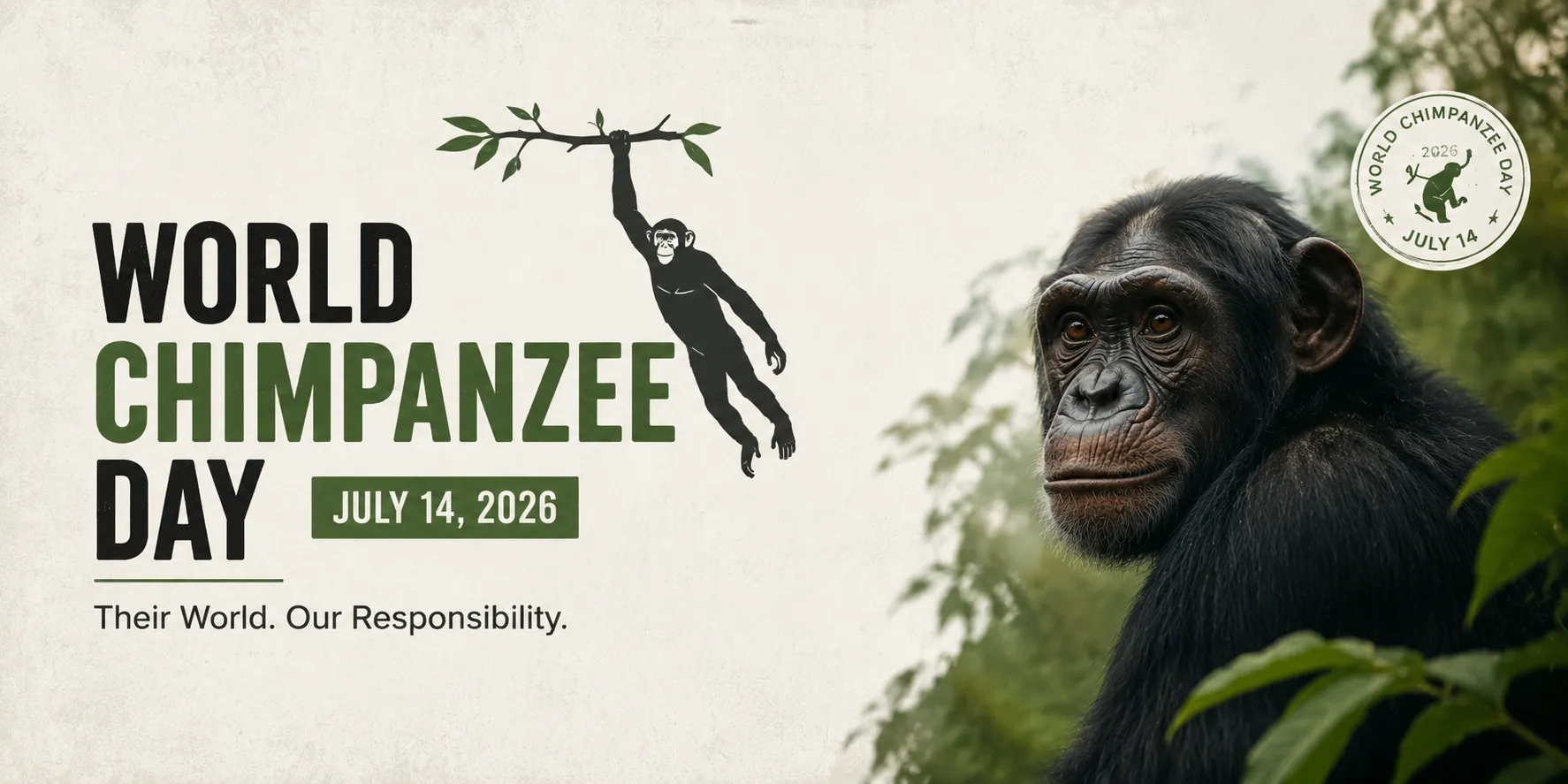
On July 14, 1960, a young British woman named Jane Goodall stepped off a boat and into the forests of what is now Gombe Stream National Park in Tanzania. She was 26 years old, had no formal university degree, and was about to change the way humanity understood itself.
What she observed in those forests over the following months and years — chimpanzees making and using tools, forming complex social bonds, displaying grief, waging war — dismantled the most fundamental assumption that had separated humans from the rest of the animal kingdom: that we alone were capable of culture.
Every year on July 14, World Chimpanzee Day commemorates that arrival. It is a day to celebrate chimpanzees — not just as fascinating animals, but as our closest living relatives on Earth, sharing an astonishing 98.7% of our DNA, and a species now fighting for survival against threats that are entirely of our own making.
This year’s observance carries extra weight. Jane Goodall passed away in October 2025 at the age of 91, after more than six decades spent advocating for the species she introduced the world to. World Chimpanzee Day 2026 is the first to be marked without her — and, in many ways, the clearest test yet of whether the movement she built can carry itself forward.
What Is World Chimpanzee Day?
World Chimpanzee Day is an annual global observance held on July 14 each year. It was established in 2018 to raise awareness about the conservation status of chimpanzees, promote their welfare both in the wild and in captivity, and honour the scientific legacy of Dr. Jane Goodall.
The day was co-founded by a coalition of conservation organisations including the Jane Goodall Institute, the North American Primate Sanctuary Alliance, Liberia Chimpanzee Rescue and Protection, and the Lincoln Park Zoo. It joins the calendar alongside other global conservation observances such as World Environment Day and World Ocean Day, each aimed at turning awareness into action.
July 14 was chosen specifically because it is the anniversary of the day Jane Goodall first arrived at Gombe in 1960 — a date that marks the beginning of the longest-running wildlife study in history, and arguably the most transformative.
The Most Important Number: 98.7%
Of all the facts about chimpanzees, one stands above the rest in its implications.
Chimpanzees share approximately 98.7% of their DNA with humans, according to the American Museum of Natural History. Some analyses place the figure slightly higher, at 98.8%. Either way, the genetic gap between Homo sapiens and Pan troglodytes (the common chimpanzee) is smaller than the gap between a chimpanzee and a gorilla.
Humans and chimpanzees are, by the standard measures of genetic science, closer to each other than either species is to its next nearest relative.
This proximity is not merely a curiosity. It has profound scientific implications. Chimpanzees are susceptible to many of the same diseases as humans — from common colds to tuberculosis to COVID-19 — because our immune systems are so similar. It is part of why biosecurity at chimpanzee sanctuaries is so carefully managed: a single sick human visitor could trigger an outbreak among a chimpanzee population with no prior immunity.
It also means that studying chimpanzees gives us an unmatched window into human evolutionary history. Every aspect of chimpanzee behaviour — their social structures, their conflict resolution strategies, their emotional lives — has direct parallels to human experience that researchers are still working to fully understand.
A Brief History of Chimpanzees: From 2 Million to 340,000
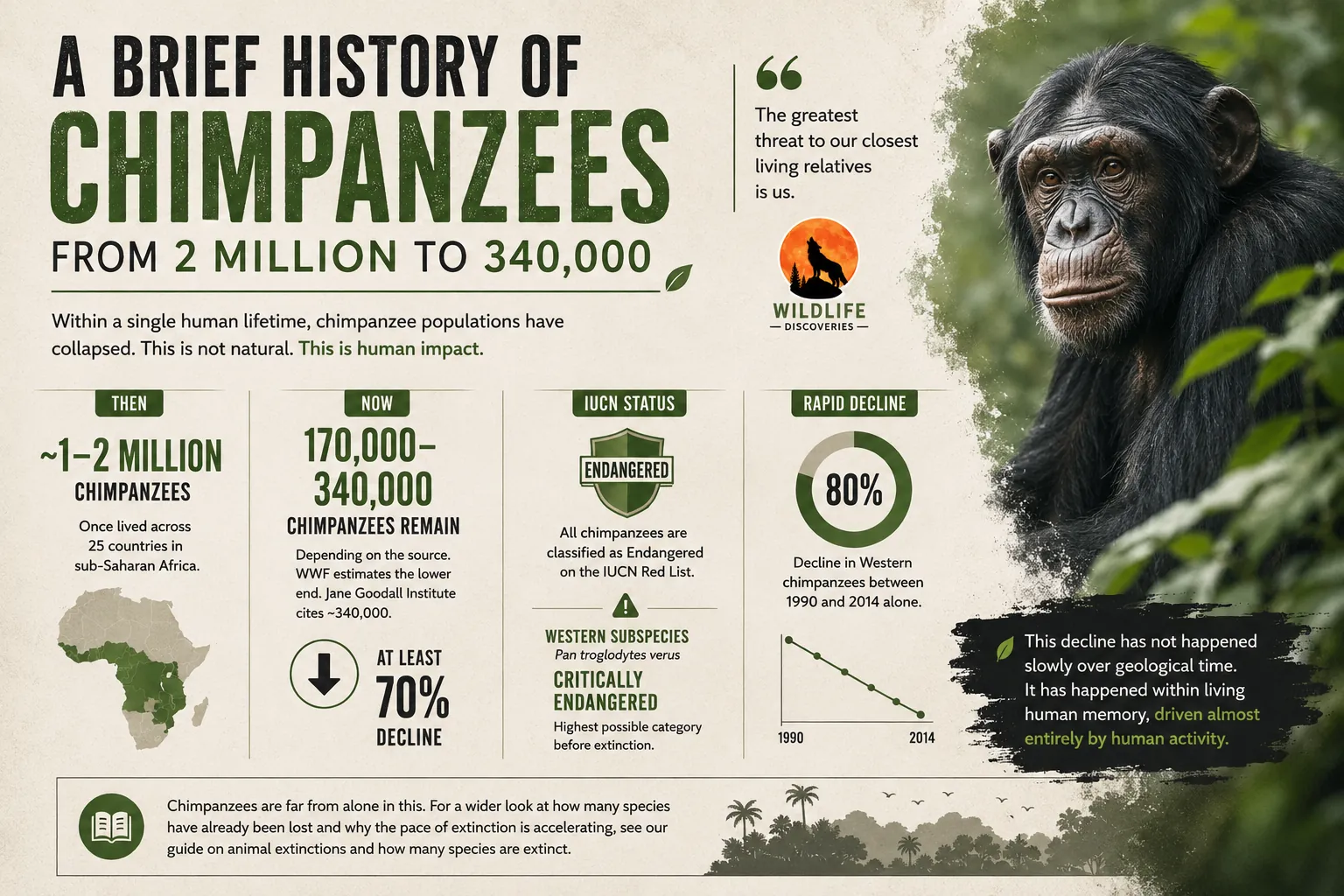
There were once an estimated 1 to 2 million chimpanzees living across 25 countries in sub-Saharan Africa.
Today, depending on the source, between 170,000 and 340,000 wild chimpanzees remain. The WWF estimates the lower end of that range. The Jane Goodall Institute cites approximately 340,000. Both figures represent a catastrophic collapse from historical levels — a decline of at least 70%, and potentially much more.
The IUCN Red List classifies all chimpanzees as Endangered. The western subspecies (Pan troglodytes verus) is listed as Critically Endangered — the highest possible category before extinction. Western chimpanzee numbers dropped by approximately 80% between 1990 and 2014 alone.
This decline has not happened slowly over geological time. It has happened within living human memory, driven almost entirely by human activity. Chimpanzees are far from alone in this — for a wider look at how many species have already been lost and why the pace of extinction is accelerating, see our guide on animal extinctions and how many species are extinct.
The Four Species of Chimpanzee
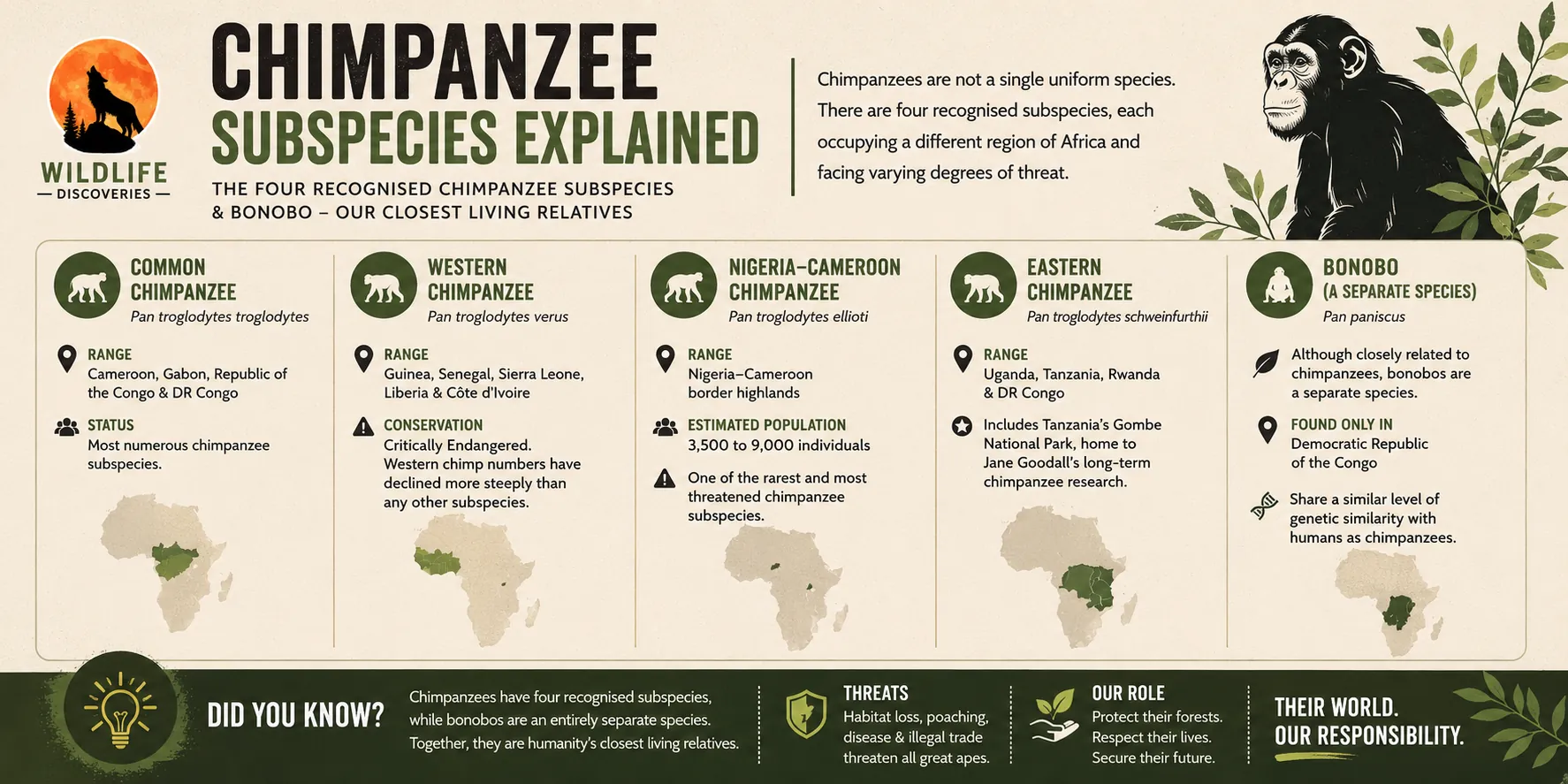
Chimpanzees are not a single uniform species. There are four recognised subspecies, each occupying a different region of Africa and facing varying degrees of threat:
Common Chimpanzee (Pan troglodytes troglodytes) — Found in central Africa, including Cameroon, Gabon, the Republic of Congo, and the Democratic Republic of Congo. This is the most numerous subspecies.
Western Chimpanzee (Pan troglodytes verus) — Found in West Africa, including Guinea, Senegal, Sierra Leone, Liberia, and Côte d’Ivoire. Critically Endangered. Western chimp numbers have declined more steeply than any other subspecies.
Nigeria-Cameroon Chimpanzee (Pan troglodytes ellioti) — A smaller population found in the highlands at the border of Nigeria and Cameroon. Highly endangered with perhaps 3,500 to 9,000 individuals remaining.
Eastern Chimpanzee (Pan troglodytes schweinfurthii) — Found in east and central Africa, including Tanzania (where Goodall’s Gombe study site is located), Uganda, Rwanda, and the Democratic Republic of Congo.
A separate but closely related species, the bonobo (Pan paniscus), is sometimes grouped with chimpanzees in discussions of our closest relatives. Bonobos share the same approximate level of genetic similarity with humans and are found only in the Democratic Republic of Congo.
If you’re curious how subspecies and classifications like these fit into the broader animal kingdom, our guide to the classifications of animals breaks down the full taxonomy.
Jane Goodall and the Discovery That Changed Everything
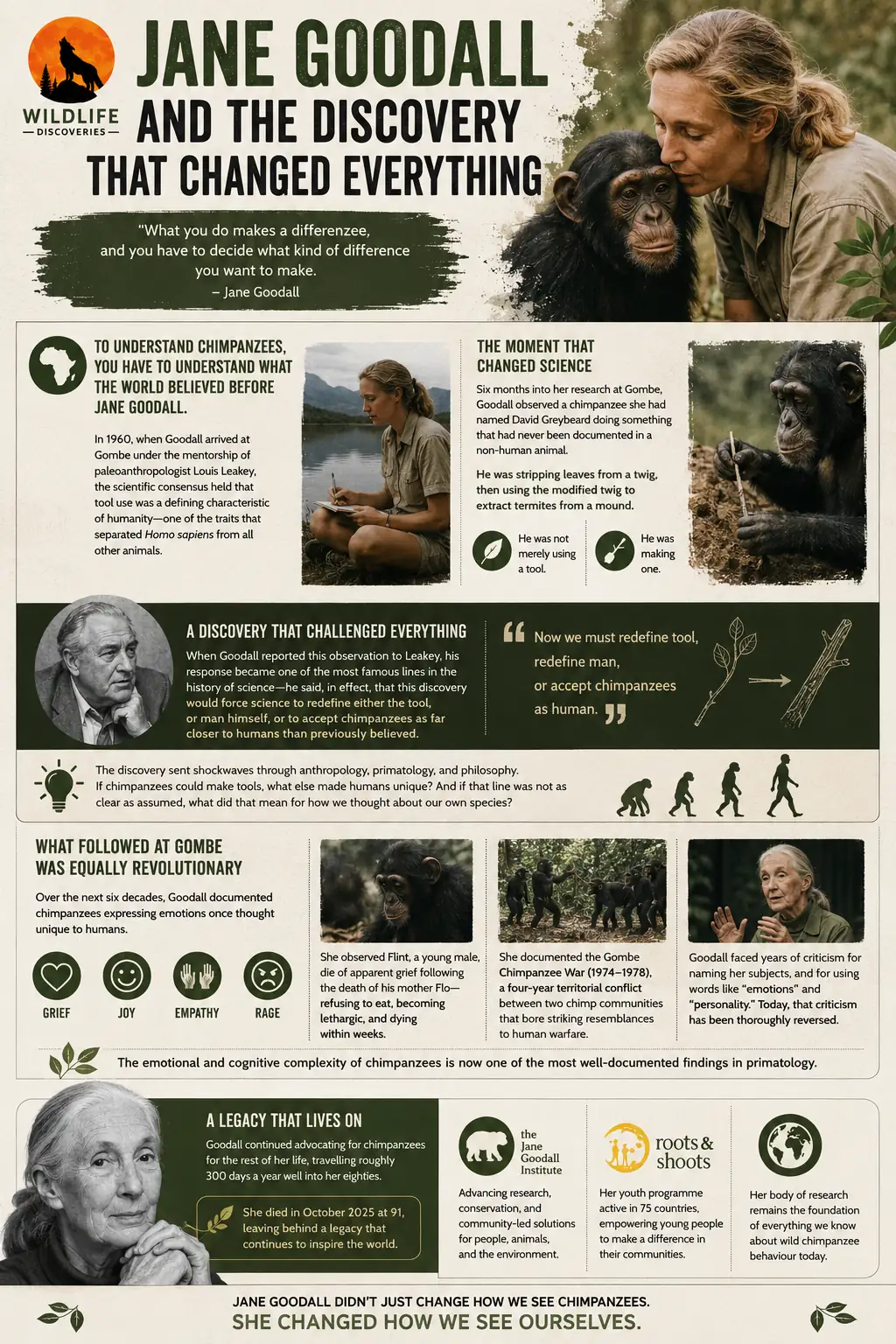
To understand chimpanzees, you have to understand what the world believed before Jane Goodall.
In 1960, when Goodall arrived at Gombe under the mentorship of paleoanthropologist Louis Leakey, the scientific consensus held that tool use was a defining characteristic of humanity — one of the traits that separated Homo sapiens from all other animals.
Six months into her research at Gombe, Goodall observed a chimpanzee she had named David Greybeard doing something that had never been documented in a non-human animal. He was stripping leaves from a twig, then using the modified twig to extract termites from a mound. He was not merely using a tool. He was making one.
When Goodall reported this observation to Leakey, his response became one of the most famous lines in the history of science — he said, in effect, that this discovery would force science to redefine either the tool, or man himself, or to accept chimpanzees as far closer to humans than previously believed.
The discovery sent shockwaves through anthropology, primatology, and philosophy. If chimpanzees could make tools, what else made humans unique? And if that line was not as clear as assumed, what did that mean for how we thought about our own species?
What followed at Gombe over the next six decades was equally revolutionary. Goodall documented chimpanzees expressing emotions that had previously been ascribed only to humans: grief, joy, empathy, and rage. She observed Flint, a young male, die of apparent grief following the death of his mother Flo — refusing to eat, becoming lethargic, and dying within weeks. She documented the Gombe Chimpanzee War (1974–1978), a four-year territorial conflict between two chimp communities that bore striking resemblances to human warfare.
She also endured years of criticism from the scientific establishment for giving her subjects names rather than numbers, and for using words like “emotions” and “personality” to describe their behaviour. That criticism has since been thoroughly reversed. The emotional and cognitive complexity of chimpanzees is now one of the most well-documented findings in primatology.
Goodall continued advocating for chimpanzees for the rest of her life, travelling roughly 300 days a year well into her eighties. She died in October 2025 at 91, leaving behind the Jane Goodall Institute, the Roots & Shoots youth programme active in 75 countries, and a body of research that remains the foundation of everything we know about wild chimpanzee behaviour today.
Chimpanzee Intelligence: What Science Has Revealed
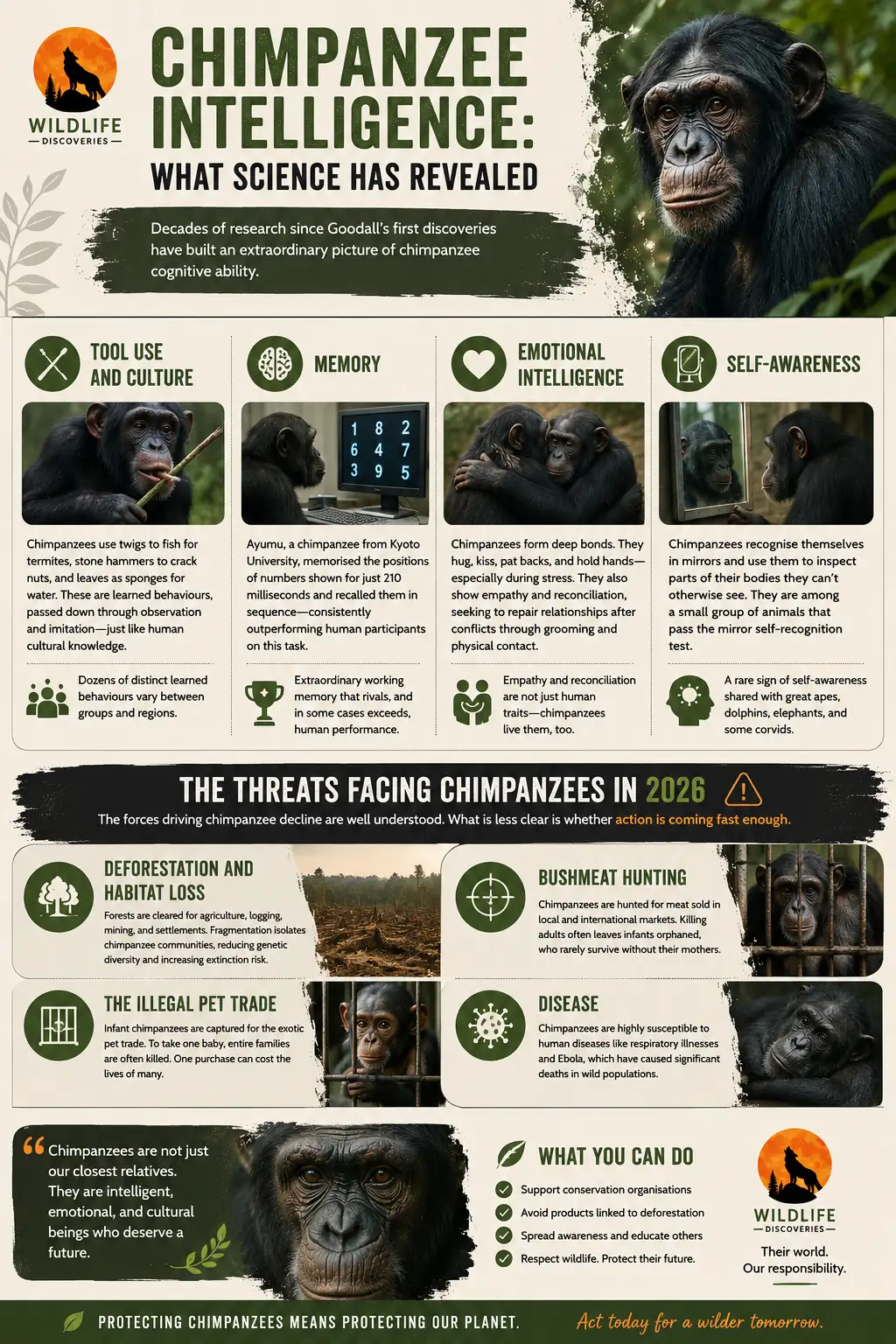
Decades of research since Goodall’s first discoveries have built an extraordinary picture of chimpanzee cognitive ability.
Tool Use and Culture
Chimpanzees at Gombe use twigs to fish for termites. Chimpanzees in West Africa use stone hammers and anvils to crack open hard-shelled nuts. Others use leaves as sponges to extract water from tree cavities. These are not instinctive behaviours — they are learned and culturally transmitted, passed from older individuals to younger ones through observation and imitation, exactly as human cultural knowledge is transmitted.
Researchers have identified dozens of distinct learned behaviours across chimpanzee communities, including feeding techniques, grooming rituals, and tool-use patterns that vary significantly between groups. A chimpanzee in Côte d’Ivoire and a chimpanzee in Tanzania may use tools to solve the same problem in completely different ways — because they inherited different cultural traditions.
Memory
A chimpanzee named Ayumu at the Primate Research Institute at Kyoto University, Japan, became internationally known for an extraordinary demonstration of working memory. In tests, Ayumu was able to memorise the positions of numbers appearing briefly on a screen — for as little as 210 milliseconds — and then correctly recall their positions in sequence, consistently outperforming human participants on this specific task in published comparisons.
Emotional Intelligence
Chimpanzees form deep, long-lasting bonds. They hug, kiss, pat each other on the back, and hold hands — particularly in moments of stress or conflict. Studies tracking chimpanzee communities over extended periods found that behaviours such as touching, hugging, and grooming distressed group members were consistent and repeated, indicating genuine empathy rather than random or accidental comfort-giving.
Chimpanzees also demonstrate what researchers call reconciliation behaviour — after conflicts, former opponents often seek each other out for grooming and physical contact, actively restoring social bonds that aggression has disrupted. This kind of post-conflict behaviour was once thought to be uniquely human.
Self-Awareness
Chimpanzees recognise themselves in mirrors — a test considered a benchmark for self-awareness in animals. They use mirrors to inspect parts of their own bodies they cannot otherwise see, including the insides of their mouths and the backs of their heads. This places them in a very small group of animals — alongside great apes, dolphins, elephants, and some corvids — that have passed the mirror self-recognition test.
The Threats Facing Chimpanzees in 2026
The forces driving chimpanzee decline are well understood. What is less clear is whether action is coming fast enough.
Deforestation and Habitat Loss
Chimpanzees are forest animals. They need large, intact areas of tropical forest to find food, establish territories, and maintain viable breeding populations. Across West and Central Africa, forests are disappearing at an accelerating rate — cleared for agriculture, commercial logging, mining operations, and the expansion of human settlements.
When forest is fragmented into smaller and smaller patches, chimpanzee communities become isolated from each other. Isolated populations cannot maintain genetic diversity. They become increasingly vulnerable to disease, inbreeding, and local extinction, even when individual numbers temporarily appear stable. Forests don’t just shelter chimpanzees — they anchor entire ecosystems, which is why observances like International Forest Day exist to spotlight exactly this kind of habitat loss.
Bushmeat Hunting
Chimpanzees are hunted for bushmeat — their meat sold in local markets and, increasingly, across international black market networks. The killing of adult chimpanzees for bushmeat typically orphans their infants, since chimpanzee mothers nurse and raise their young for several years. Orphaned infant chimpanzees frequently die without expert care.
The Illegal Pet Trade
Baby chimpanzees are captured for the exotic pet market, particularly in parts of Asia and the Middle East where keeping primates as status symbols remains common. To capture a single infant, traffickers typically kill the entire family group — adults will fight to the death to protect their young. This means the purchase of a single chimpanzee may cost the lives of several other individuals. Legal frameworks like the Animal Welfare Act exist to curb exactly this kind of exploitation, though enforcement across borders remains inconsistent — see our explainer on the difference between animal rights and animal welfare for how these protections actually work.
Disease
Chimpanzees’ genetic closeness to humans is a double-edged sword. The same biological similarity that makes them scientifically valuable means they are susceptible to human diseases to which they have no evolved immunity. Respiratory illnesses introduced by researchers, tourists, or local communities have caused significant mortality in wild chimpanzee populations. Ebola virus disease has also killed large numbers of chimpanzees in Central Africa over the past two decades.
Sanctuaries: The Last Resort for Displaced Chimpanzees
For chimpanzees that cannot survive in the wild — orphaned, injured, or confiscated from illegal traders — sanctuaries represent both a rescue and a long-term commitment.
The Tacugama Chimpanzee Sanctuary in Sierra Leone currently cares for more than 120 rescued chimpanzees. Ngamba Island Chimpanzee Sanctuary in Uganda provides a 95-acre forested island home for more than 50 orphaned and rescued individuals.
These facilities do not just provide care. They also work toward reintroduction — the difficult, painstaking process of preparing captive-raised chimpanzees for eventual return to the wild. It is a process that takes years, requires extensive preparation, and does not always succeed. But for some chimpanzees, it offers a path back to where they belong.
For more on how these facilities operate across species, browse our full coverage of wildlife sanctuaries.
How to Observe World Chimpanzee Day 2026
Learn and share. Use the day to read, watch documentaries, and share factual content about chimpanzees. The more widely accurate information circulates, the more difficult it becomes for the illegal trade and destructive practices to operate without scrutiny.
Support accredited sanctuaries. Organisations like the Pan African Sanctuary Alliance (PASA), the Jane Goodall Institute, and the Tacugama Chimpanzee Sanctuary directly fund the care of rescued chimpanzees and the conservation of their habitats. Even small donations contribute to ongoing operations.
Make ethical wildlife tourism choices. If you plan to visit wild chimpanzees in Uganda, Rwanda, or Tanzania, choose operators that follow strict ethical guidelines — maintaining minimum distances from chimpanzee groups, limiting the number of visitors per session, and requiring health screenings.
Avoid the exotic pet trade. Never purchase or support the keeping of chimpanzees or other great apes as pets. Report suspected illegal wildlife trade to local authorities or organisations such as TRAFFIC, the wildlife trade monitoring network.
Want to go further? Our guides on why wildlife conservation matters and what you can do to protect endangered animals cover practical steps that apply well beyond chimpanzees.
Frequently Asked Questions About World Chimpanzee Day
When is World Chimpanzee Day 2026? World Chimpanzee Day 2026 is observed on Tuesday, July 14, 2026.
Why is World Chimpanzee Day on July 14? July 14 marks the anniversary of the day Dr. Jane Goodall first arrived at Gombe Stream National Park in Tanzania in 1960, beginning the longest-running wildlife study in history and transforming our understanding of chimpanzees.
Is Jane Goodall still alive? No. Jane Goodall passed away in October 2025 at the age of 91. Her work continues through the Jane Goodall Institute, the Gombe Stream Research Center, and the global Roots & Shoots youth network she founded.
How much DNA do chimpanzees share with humans? Chimpanzees share approximately 98.7% to 98.8% of their DNA with humans, making them our closest living relatives — closer to us than they are to gorillas.
How many chimpanzees are left in the wild? Estimates vary between 170,000 and 340,000 wild chimpanzees remaining across 25 countries in Africa. This represents a decline of at least 70% from historical population levels of 1 to 2 million individuals.
Are chimpanzees endangered? Yes. All chimpanzees are classified as Endangered on the IUCN Red List. The western chimpanzee subspecies is classified as Critically Endangered, having declined by approximately 80% between 1990 and 2014.
What are the biggest threats to chimpanzees? The primary threats to chimpanzee survival are deforestation and habitat loss, bushmeat hunting, the illegal wildlife trade (particularly capture of infants for the exotic pet market), and disease transmission from humans.
What did Jane Goodall discover about chimpanzees? Jane Goodall’s most famous discovery, made in 1960, was that chimpanzees make and use tools — previously considered a uniquely human trait. She also documented complex social behaviour, emotional depth (including grief and empathy), and distinct cultural traditions that vary between chimpanzee communities. Her work fundamentally changed the scientific understanding of the boundary between humans and other animals.
Can chimpanzees learn language? Chimpanzees cannot produce human speech due to differences in their vocal anatomy. However, chimpanzees have been successfully taught to communicate using sign language and symbol-based systems, demonstrating the ability to learn and use hundreds of symbols meaningfully. The extent to which this constitutes true language understanding remains debated among researchers.
Conclusion
World Chimpanzee Day 2026 is not simply a celebration of an animal. It is a reckoning with what our nearest relatives reveal about us — and this year, it is also the first without the woman who made that reckoning possible.
Chimpanzees grieve. They form friendships. They make tools, transmit culture, and wage wars. They share nearly every feature of our cognitive and emotional architecture — because they are us, from a different branch of the same evolutionary tree, separated by a genetic gap that recent science has made almost impossibly thin.
And they are disappearing.
There were once an estimated 1 to 2 million chimpanzees across 25 countries in Africa. Now there are as few as 170,000 to 340,000. The western subspecies has lost 80% of its population in less than 25 years. The forests they need are being cleared at rates that their slow reproductive biology — females give birth only every four to six years — cannot come close to compensating for.
Whether that trend is reversed or not depends on choices that humans make. About where forests are cleared and where they are protected. About what is bought and sold across international borders. About which species we decide matter enough to fight for.
On World Chimpanzee Day 2026, the most important question is not what chimpanzees are. We know what they are. The question is what we intend to do about it — now that the person who first showed us has to be honoured in memory rather than joined in person.
Sources: Jane Goodall Institute; IUCN Red List; WWF; Pan African Sanctuary Alliance (PASA); American Museum of Natural History; World Chimpanzee Day official site