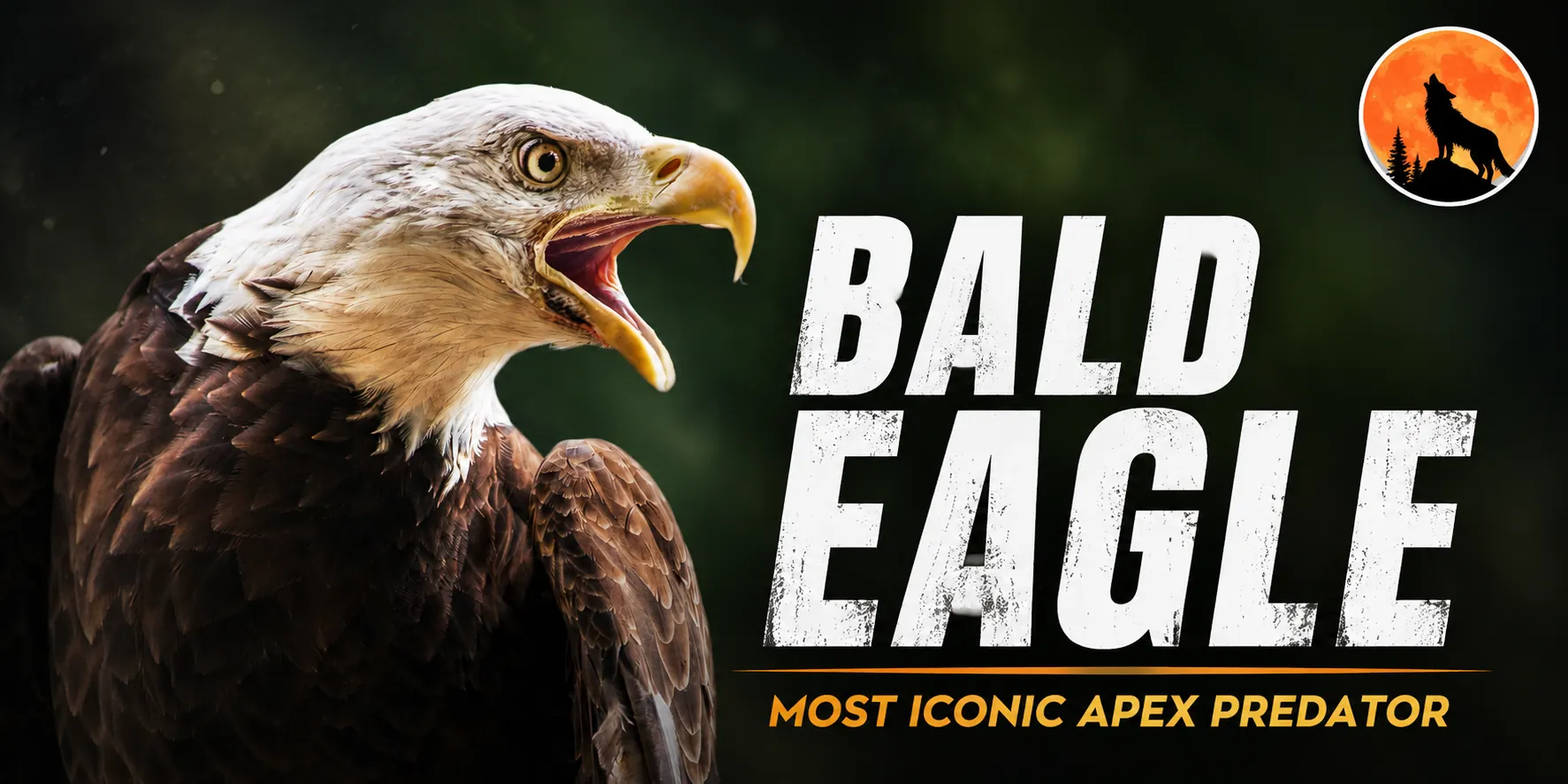
The Bald Eagle is one of the most powerful, recognisable and respected birds of prey in the world. Known for its bright white head, dark brown body, yellow beak and impressive wingspan, this majestic bird is strongly associated with strength, courage, freedom and leadership. It is also the national bird and national emblem of the United States.
The Bald Eagle is native to North America and can be found across Canada, the United States, Alaska and parts of northern Mexico. It usually lives near large bodies of water where fish are easily available and tall trees provide safe places for nesting and resting.
Scientifically known as Haliaeetus leucocephalus, the bald eagle belongs to the Accipitridae family, which includes hawks, kites and other eagles. Its scientific name roughly means “white-headed sea eagle,” describing both its appearance and its close relationship with rivers, lakes and coastal environments.
Quick Facts About the Bald Eagle
| Feature | Information |
|---|---|
| Scientific name | Haliaeetus leucocephalus |
| Bird family | Accipitridae |
| Average wingspan | Approximately 1.8 to 2.3 metres |
| Main diet | Fish, waterbirds, mammals and carrion |
| Natural range | North America |
| Preferred habitat | Rivers, lakes, wetlands and coastlines |
| Nesting pattern | Usually one brood per breeding season |
| Clutch size | Commonly one to three eggs |
| Conservation position | Recovered and no longer federally endangered in the United States |
| National importance | National bird and emblem of the United States |
Physical Appearance and Unique Characteristics
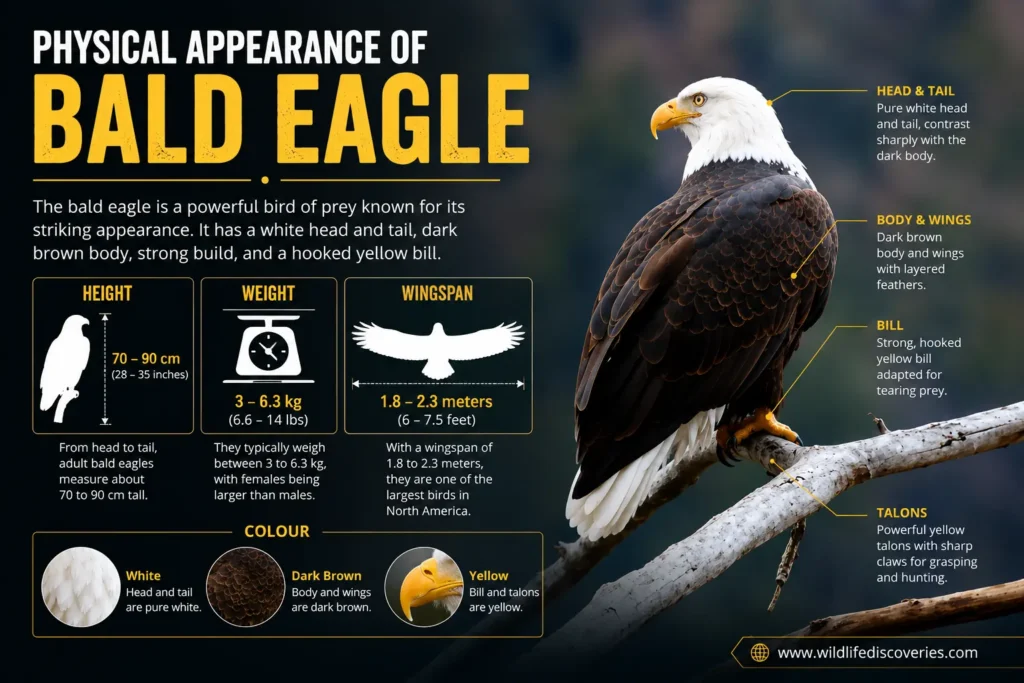
The Bald Eagle has a strong and commanding appearance. Adult birds are recognised by their white-feathered head and tail, dark brown wings and body, and bright yellow beak, feet and eyes. Their broad wings and large body allow them to soar for long periods while searching for food.
Females are generally larger and heavier than males. Although males and females have similar colouring, their size difference can sometimes help experienced observers identify them. Females require a larger body partly because they produce eggs and spend significant time protecting and caring for their young.
Main Physical Features
- A broad wingspan suitable for soaring and gliding
- Strong legs and sharp, curved talons
- A large hooked beak for tearing flesh
- Excellent long-distance eyesight
- Broad wings with separated feather tips
- White head and tail in mature adults
- Dark brown plumage across the body and wings
The talons of a bald eagle are especially important. Rather than using its beak to capture prey, the bird grabs fish and other animals with its feet. The sharp claws provide a secure grip, while the hooked beak is used to tear the food into manageable pieces.
Its vision is another major advantage. Like many birds of prey, it can detect movement and locate potential food from a considerable distance. From a tall tree or while soaring above water, it carefully watches the surface before descending towards its target.
Adult and Juvenile Differences
Young birds look very different from adults. Juveniles have mostly dark brown feathers with irregular patches of white on the body, wings and tail. Their beaks are also darker than those of mature birds. The familiar white head and tail do not appear immediately. The plumage changes gradually, and the bird generally develops its fully recognisable adult appearance at around four to five years of age.
This difference sometimes causes juvenile birds to be confused with golden eagles. However, their body proportions, wing shape, habitat and feather patterns can help distinguish them.
Habitat and Geographical Distribution
The Bald Eagle is found only in North America. Its range extends from Alaska and Canada through the continental United States and into northern Mexico. Some populations remain in the same region throughout the year, while others migrate according to temperature, food availability and water conditions.
These birds are strongly connected with aquatic environments. They are commonly seen near:
- Large rivers
- Freshwater lakes
- Reservoirs
- Coastal shorelines
- Wetlands and marshes
- Estuaries
- Bays and islands
Fish are easier to locate and catch in open, relatively shallow water. Therefore, areas that combine healthy fish populations, open water and suitable nesting trees are especially valuable.
Importance of Forest Areas
A mature forest near a river or lake provides several essential resources. Tall trees offer nesting platforms, protection from weather, resting places and a clear view of the surrounding environment. The birds often choose strong trees that rise above the surrounding canopy and allow easy access during flight.
The ideal nesting location is usually close enough to water for regular hunting but far enough from intense human activity to reduce disturbance. Bald eagles may tolerate some development, especially while feeding, but repeated disturbance close to an active nest can affect breeding behaviour.
During winter, many birds gather around areas where water remains unfrozen. Dams, reservoirs, coastal regions and fast-flowing rivers can attract large groups because fish remain accessible. Communal roosting sites may contain dozens or even hundreds of individuals.
Why Clean Water Matters?
The health of a bald eagle population is closely connected with the health of its aquatic ecosystem. Polluted water may reduce fish populations or allow harmful chemicals to accumulate in the food chain.
Protecting rivers, lakes, wetlands and shorelines therefore benefits not only eagles but also fish, amphibians, waterbirds and nearby communities. Habitat protection is an essential part of preventing future animal extinction and maintaining ecological balance.
Diet, Hunting Skills and Feeding Behaviour
People commonly ask, what do bald eagles eat? Fish form the central part of their diet, but these birds are opportunistic feeders. They adjust their food choices according to location, season and availability.
Common Food Sources
| Food category | Examples |
|---|---|
| Fish | Salmon, herring, catfish, shad and other available species |
| Birds | Ducks, gulls, waterfowl and injured birds |
| Mammals | Rabbits, muskrats and small mammals |
| Reptiles and amphibians | Snakes, turtles and frogs |
| Invertebrates | Crabs and other aquatic animals |
| Carrion | Dead fish, mammals and other animal remains |
Fish are usually preferred because they are abundant in many eagle habitats and can be captured near the water’s surface. However, the bald eagle may also eat birds, reptiles, amphibians, mammals, crabs and carrion.
How Does It Hunt?
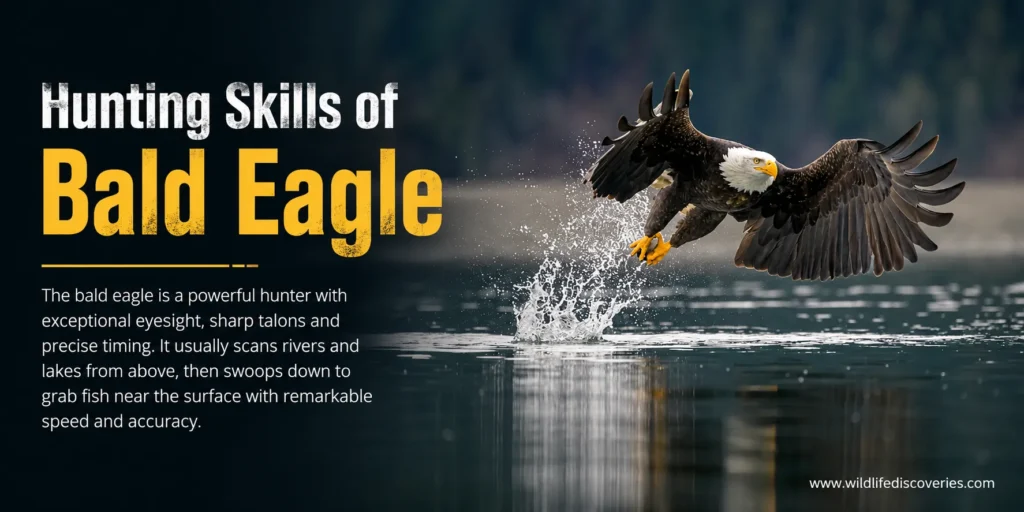
The bird may search for food from a high perch or while soaring. Once it spots a fish near the surface, it descends rapidly, extends its legs and attempts to grasp the fish with its talons.
Unlike some aquatic birds, it does not normally dive deeply underwater. It captures prey at or near the surface and then carries it to a tree, shore or nest.
Its hunting process generally includes:
- Watching the water from a perch or from the air
- Locating a suitable fish or other prey
- Approaching at speed with the feet extended
- Gripping the target with sharp talons
- Carrying or dragging the food to a secure place
- Tearing the meal apart with its hooked beak
A bald eagle is also capable of swimming or using its wings in a rowing motion if it lands in water while holding heavy prey. However, attempting to lift an excessively large fish can be dangerous.
Scavenging and Food Stealing
Although famous as a hunter, this bird is equally willing to take an easy meal. It commonly feeds on dead fish and animal carcasses. Scavenging helps remove organic waste from the environment and returns nutrients to the ecosystem.
It may also chase ospreys and force them to release captured fish. This behaviour, known as kleptoparasitism, allows the eagle to obtain food without completing the entire hunt itself.
These feeding habits show that responsible animal welfare and environmental management must consider the complete food chain. Lead fragments in animal remains, fishing equipment, plastic waste and chemical pollution can all create risks for scavenging birds.
Breeding, Nesting and Life Cycle
A mature bald eagle usually forms a long-term pair bond. Many pairs remain together for years and return to the same nesting territory during each breeding season. If one partner dies, the surviving bird may eventually form a new pair.
Courtship can include calling, chasing and impressive aerial displays. In one dramatic display, two birds may lock their talons while descending through the air before separating.
Nest Construction
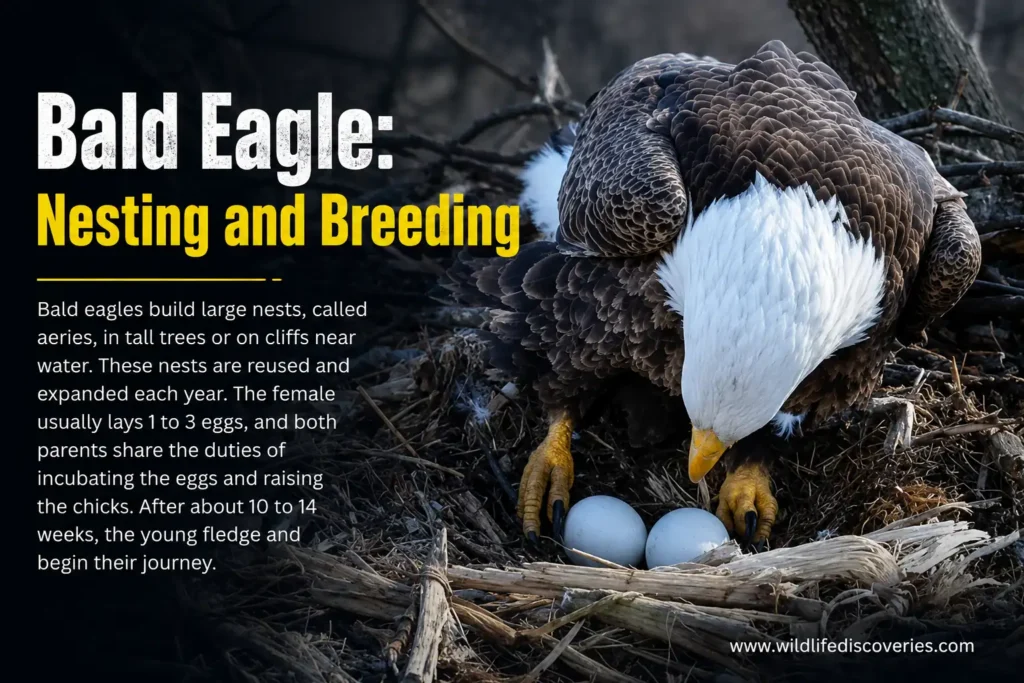
The nest is usually built high in a strong tree near water. In regions without suitable trees, birds may use cliffs or occasionally construct nests on the ground.
Both adults collect sticks and other materials. The centre is lined with softer items such as grass, moss, feathers and plant material. The nest may be reused and enlarged every year, causing older structures to become exceptionally wide and heavy. Typical nests measure around five to six feet across, although long-used nests can become much larger. Bald eagle nests are among the largest nests constructed by any bird species.
Eggs and Incubation
The female generally lays one to three dull-white eggs. Both parents may incubate them, although the female usually spends more time on the nest. The incubation period commonly lasts approximately 34 to 36 days.
After hatching, eaglets are small, weak and covered in soft down. They depend completely on their parents for food, warmth and protection.
Development of the Young
The parents tear food into small pieces and carefully feed the chicks. As the eaglets develop, they grow stronger feathers, practise standing and begin exercising their wings.
The young may remain in the nest for approximately eight to fourteen weeks before fledging, depending on the individual and local conditions. Even after their first flight, they may continue to depend on their parents while learning how to locate and capture food.
The basic life cycle includes:
- Egg development
- Incubation
- Hatching
- Nestling growth
- Wing exercise
- First flight or fledging
- Juvenile independence
- Development of adult plumage
- Pair formation and breeding
Many also wonder how long do bald eagles live. Their average lifespan may be around 20 years in the wild, although some individuals survive considerably longer. Records cited by the National Park Service include wild birds reaching about 28 years and captive individuals living beyond 30 years.
Conservation, Threats and Cultural Importance
One frequently searched question is, are bald eagles endangered? They are no longer listed as endangered or threatened under the United States Endangered Species Act. Their recovery is regarded as a major environmental achievement.
In 1963, only about 487 nesting pairs were estimated to remain in the lower 48 states. By the time the species was removed from the endangered list in 2007, the estimated number had increased to 9,789 breeding pairs. Estimates based on 2018–2019 data later placed the population in the lower 48 states at approximately 316,700 individuals, including more than 71,000 breeding pairs.
Why Did the Population Decline?
The decline was caused by several connected problems:
- Illegal shooting and trapping
- Loss of nesting and feeding habitat
- Contaminated food and water
- Human disturbance near nests
- Poisoning from pesticides
- Reduced reproductive success
- Collisions and electrocution
One of the most damaging chemicals was DDT. It accumulated through the food chain and interfered with calcium formation, leading to thin eggshells that could break during incubation.
The restriction of DDT, legal protection, nest monitoring, habitat restoration and public education helped the species recover.
Are They Still Protected?
Although the bald eagle is no longer federally endangered, it remains protected under important American laws, including the Bald and Golden Eagle Protection Act and the Migratory Bird Treaty Act. These protections restrict killing, capturing, possessing, selling or seriously disturbing the birds, their nests and their eggs.
Recovery does not mean that all dangers have disappeared. Current threats include:
- Shoreline development
- Removal of mature nesting trees
- Lead poisoning
- Collisions with vehicles and structures
- Electrocution from power infrastructure
- Fishing hooks and discarded line
- Oil spills and chemical pollution
- Disturbance around breeding territories
Protecting the species requires long-term cooperation between government agencies, conservation organisations, landowners and local communities. This species is also one of the best examples of successful wildlife conservation.
Cultural Importance
The bird has been the national emblem of the United States since 1782. It appears on official seals, coins, currency, government buildings and military symbols. Its powerful appearance has made it an international representation of freedom, courage and independence.
For many Indigenous peoples of North America, eagles also hold deep spiritual and cultural importance. Eagle feathers and imagery may represent honour, leadership, prayer, wisdom or a connection between the physical and spiritual worlds. These traditions are older than the bird’s use as a national emblem and should be discussed with respect.
The Wider Conservation Lesson
The recovery of the bald eagle proves that species decline can sometimes be reversed through science, legislation, public awareness and habitat protection. However, conservation work must begin before populations reach critically low levels.
Protecting endangered animals requires healthy ecosystems, clean waterways, responsible development and control of toxic substances. Saving a single species also supports countless organisms sharing the same habitat.
The survival of the bald eagle is therefore more than the story of one famous bird. It demonstrates how determined conservation action can protect biodiversity and reduce the risk of extinction.
Key Takeaways
- The bald eagle is a large North American bird of prey scientifically known as Haliaeetus leucocephalus.
- It is not actually bald; mature adults have a clearly visible white-feathered head and tail.
- Fish form the main part of its diet, although it also eats birds, mammals, reptiles and carrion.
- It commonly lives near rivers, lakes, wetlands, reservoirs and coastal environments.
- Mature trees are important for nesting, roosting and observing feeding areas.
- Pairs often maintain long-term bonds and may reuse the same nesting territory for several years.
- Young birds do not immediately have the white head and tail seen in adults.
- The species experienced a serious decline because of hunting, habitat loss and pesticides such as DDT.
- It was removed from the United States endangered species list in 2007 following a remarkable recovery.
- Continuing conservation is necessary because pollution, lead exposure, collisions and habitat disturbance remain significant threats.
Frequently Asked Questions (FAQs)?
1. Why is it called a bald eagle when it has feathers on its head?
The name does not mean that the bird has no feathers. The word “bald” was historically associated with being white-headed or white-marked. Adult birds have a complete covering of white feathers on the head.
2. Where do bald eagles live?
They are native to North America and are found throughout Alaska, Canada, the continental United States and parts of northern Mexico. They prefer locations near lakes, rivers, wetlands and coastlines where fish and suitable nesting trees are available.
3. What is the main food of a bald eagle?
Fish are its primary food source. However, it may also eat waterbirds, small mammals, reptiles, amphibians, crabs and carrion. Its exact diet depends on season, habitat and local food availability.
4. Do bald eagles mate for life?
Pairs often remain together for many years and return to the same nesting territory. If one member of the pair dies or disappears, the surviving individual may eventually choose another mate.
5. Is the bald eagle still endangered?
No, it is not currently listed as endangered or threatened under the United States Endangered Species Act. It was removed from the federal endangered species list in 2007 after its population recovered. Nevertheless, it continues to receive legal protection, and conservation measures remain necessary.