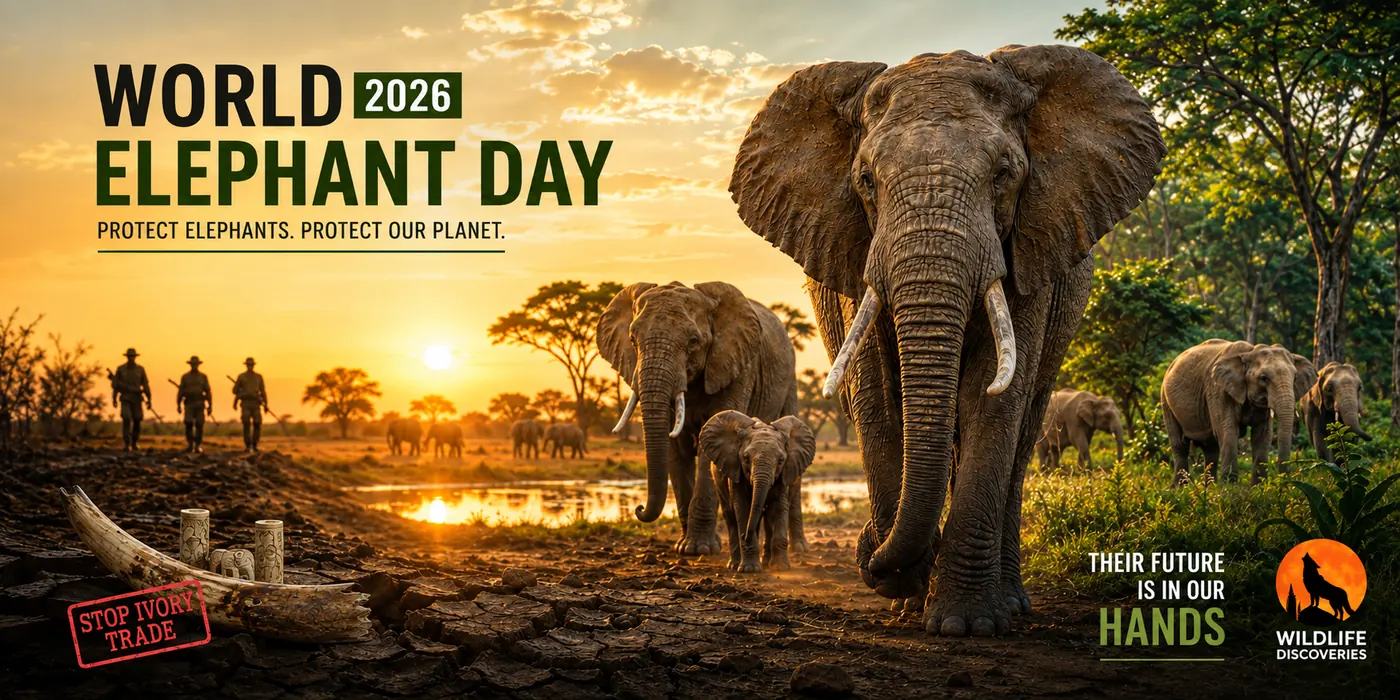
Every August 12, the world pauses to think about the largest land animal on Earth — not just because of its size, but because of what it represents: intelligence, family, memory, ecological power, and a conservation crisis that is unfolding faster than most people realize.
World Elephant Day was established in 2012 with a single, urgent message: elephants are running out of time. In the fourteen years since, that message has only grown more pressing. An estimated 100 African elephants are killed by poachers every single day. Asian elephant populations have collapsed to as few as 40,000 individuals worldwide. The forests and savannas that elephants depend on are disappearing at rates their slow reproductive biology cannot compensate for.
This August 12, 2026, here is everything you need to know about why elephants matter, why they are in danger, and what it would mean for all of us if we lost them.
What Is World Elephant Day?
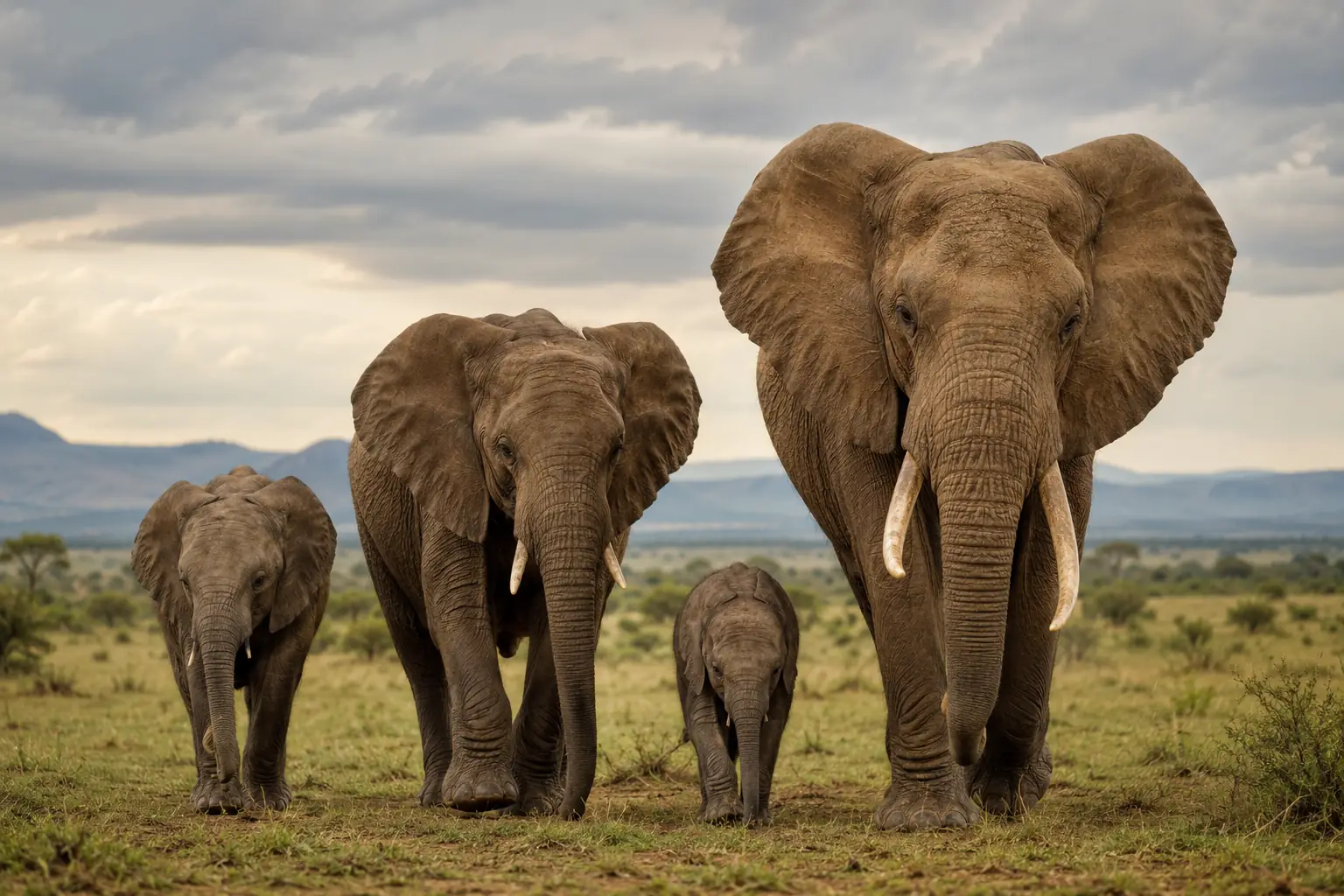
World Elephant Day is an annual global conservation observance held every year on August 12. It was co-founded in 2012 by Canadian filmmaker Patricia Sims and the Elephant Reintroduction Foundation of Thailand, alongside more than 100 elephant conservation organisations worldwide.
The first World Elephant Day was marked by the release of a documentary titled Return to the Forest, narrated by William Shatner, which focused on the reintroduction of captive elephants into the wild — setting the tone for everything the day stands for.
Since then, World Elephant Day has grown into one of the most widely recognised wildlife awareness events on the global calendar, mobilising millions of people, governments, and organisations around a shared mission: ensuring that both African and Asian elephants have a future.
Three Species, Three Stories of Decline
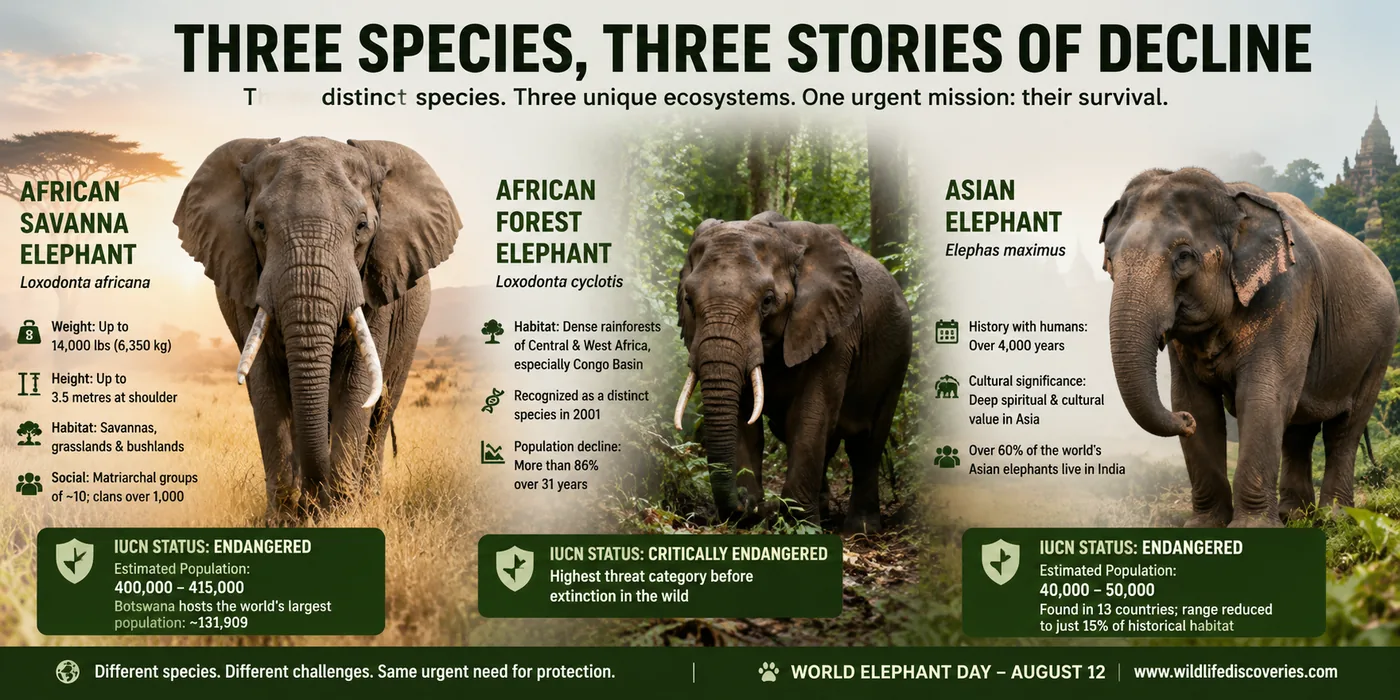
One of the most important things to understand about elephants is that “elephants” is not a single category. There are three distinct species, each with its own biology, range, and conservation status — and all three are in serious trouble.
African Savanna Elephant (Loxodonta africana)
The largest land animal on Earth. African savanna elephants can weigh up to 14,000 lbs (6,350 kg) and stand up to 3.5 metres at the shoulder. They live in the open grasslands, savannas, and bushlands of sub-Saharan Africa, typically in matriarchal family groups of around ten individuals that can aggregate into clans of over a thousand.
IUCN Status: Endangered. Approximately 400,000 to 415,000 African savanna elephants are estimated to remain in the wild. Botswana hosts the world’s largest single population, with approximately 131,909 individuals — making it the global stronghold for this species. But even Botswana’s relative abundance cannot mask the continental crisis.
African Forest Elephant (Loxodonta cyclotis)
Smaller and more elusive than its savanna cousin, the African forest elephant lives in the dense rainforests of Central and West Africa, particularly the Congo Basin. It was only recognised as a distinct species from the savanna elephant in 2001 — meaning it has existed in scientific literature as its own species for less than 25 years.
IUCN Status: Critically Endangered. This is the highest threat category before extinction in the wild. Forest elephant populations have been decimated by poaching and the destruction of Central African rainforests, and their numbers have fallen by more than 86% over 31 years according to IUCN assessments.
Asian Elephant (Elephas maximus)
Smaller than African elephants, with distinctly rounder ears and a more domed head, Asian elephants have lived alongside human civilisations for more than 4,000 years. In Thailand, they are a national icon. In India, they carry deep cultural and spiritual significance. Over 60% of the world’s remaining Asian elephants live in India, where human-elephant coexistence is the primary conservation challenge.
IUCN Status: Endangered. Only an estimated 40,000 to 50,000 Asian elephants remain in the wild — split across 13 countries in South and Southeast Asia. Their range has contracted to just 15% of their historical habitat, making them one of the most range-restricted large mammals on Earth.
Quick Facts: Elephants at a Glance
| Feature | African Savanna | African Forest | Asian |
|---|---|---|---|
| IUCN Status | Endangered | Critically Endangered | Endangered |
| Wild Population | ~400,000–415,000 | Severely depleted | ~40,000–50,000 |
| Weight | Up to 14,000 lbs | Up to 6,000 lbs | Up to 12,000 lbs |
| Ears | Large, map-shaped | Smaller, oval | Smallest, rounded |
| Gestation | 22 months | 22 months | 22 months |
| Lifespan | 60–70 years | 60–70 years | 60–70 years |
| Trunk muscles | ~150,000 | ~150,000 | ~150,000 |
The Ivory Crisis: What Is Still Driving Elephants Toward Extinction
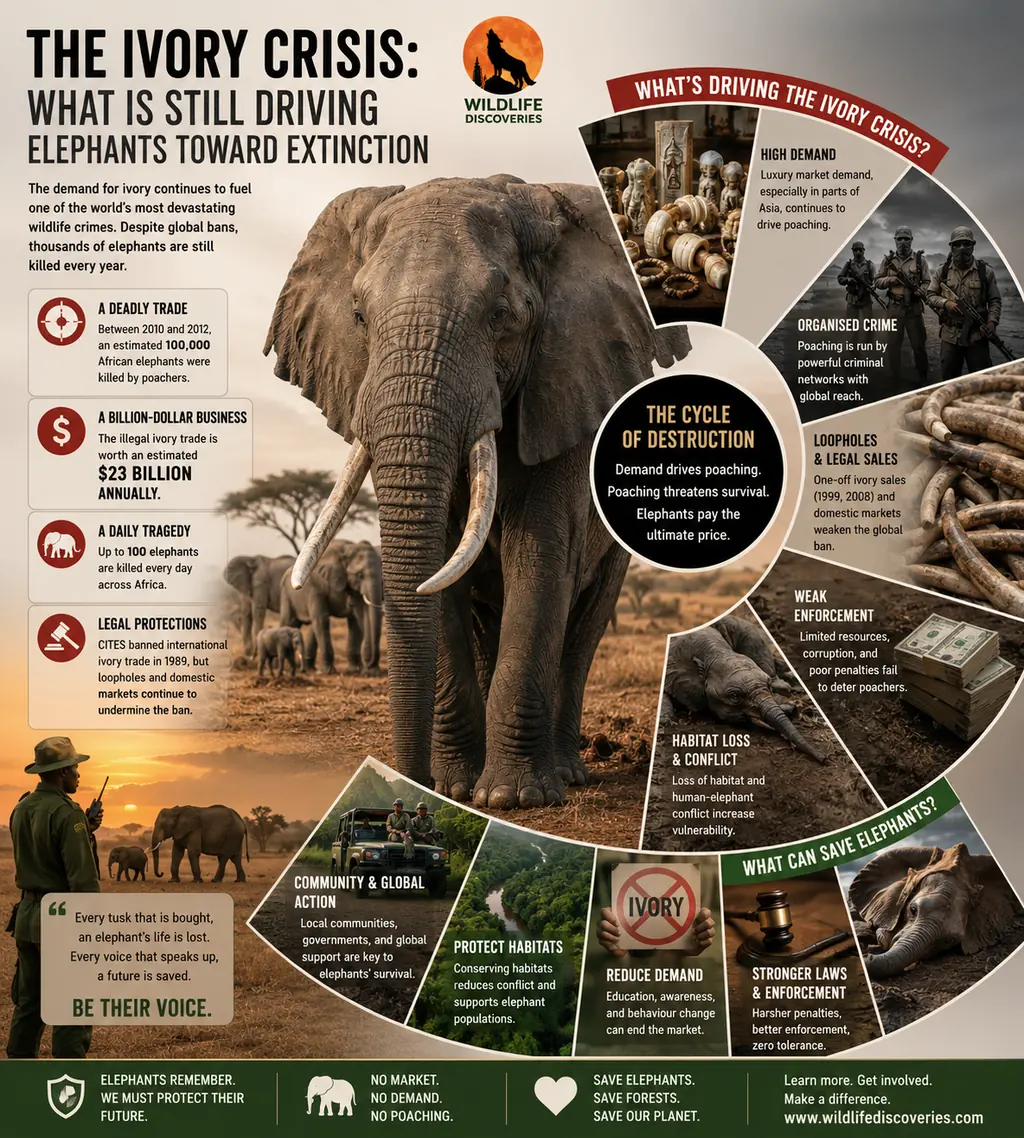
The single most destructive force in elephant history is the demand for ivory.
Elephant tusks are made of dentine — the same material as human teeth, just in a dramatically different form. They grow continuously throughout an elephant’s life and can reach lengths of over 2 metres and weights of over 45 kg in large African bulls. And for centuries, the beauty and workability of ivory has made it one of the most coveted materials in the world.
The consequences have been catastrophic.
Between 2010 and 2012 alone, poaching rates reached a 25-year high, with an estimated 100,000 African elephants killed in those three years. The price of ivory in China tripled between 2010 and 2014, driving a surge in illegal killing that fundamentally destabilised elephant populations across sub-Saharan Africa. The illegal ivory trade is estimated to be worth $23 billion annually — making it one of the most profitable forms of wildlife crime in the world.
The mechanics of ivory poaching are brutal. Poachers use everything from poisoned arrows to automatic weapons. They increasingly operate as part of organised criminal networks with international distribution chains. Elephants are killed for their tusks alone — their bodies left to decompose on the savanna, their calves orphaned. Some estimates suggest that as many as 100 elephants are killed every day on the African continent.
In 1989, the Convention on International Trade in Endangered Species (CITES) banned the international ivory trade. The ban triggered an immediate decline in poaching rates. But loopholes, one-off legal ivory sales approved by CITES in 1999 and 2008, and the persistence of domestic ivory markets in several countries have undermined the ban’s effectiveness. Despite progress, poaching remains a critical threat in 2026.
The Ecosystem Engineer: Why Losing Elephants Means Losing Entire Landscapes
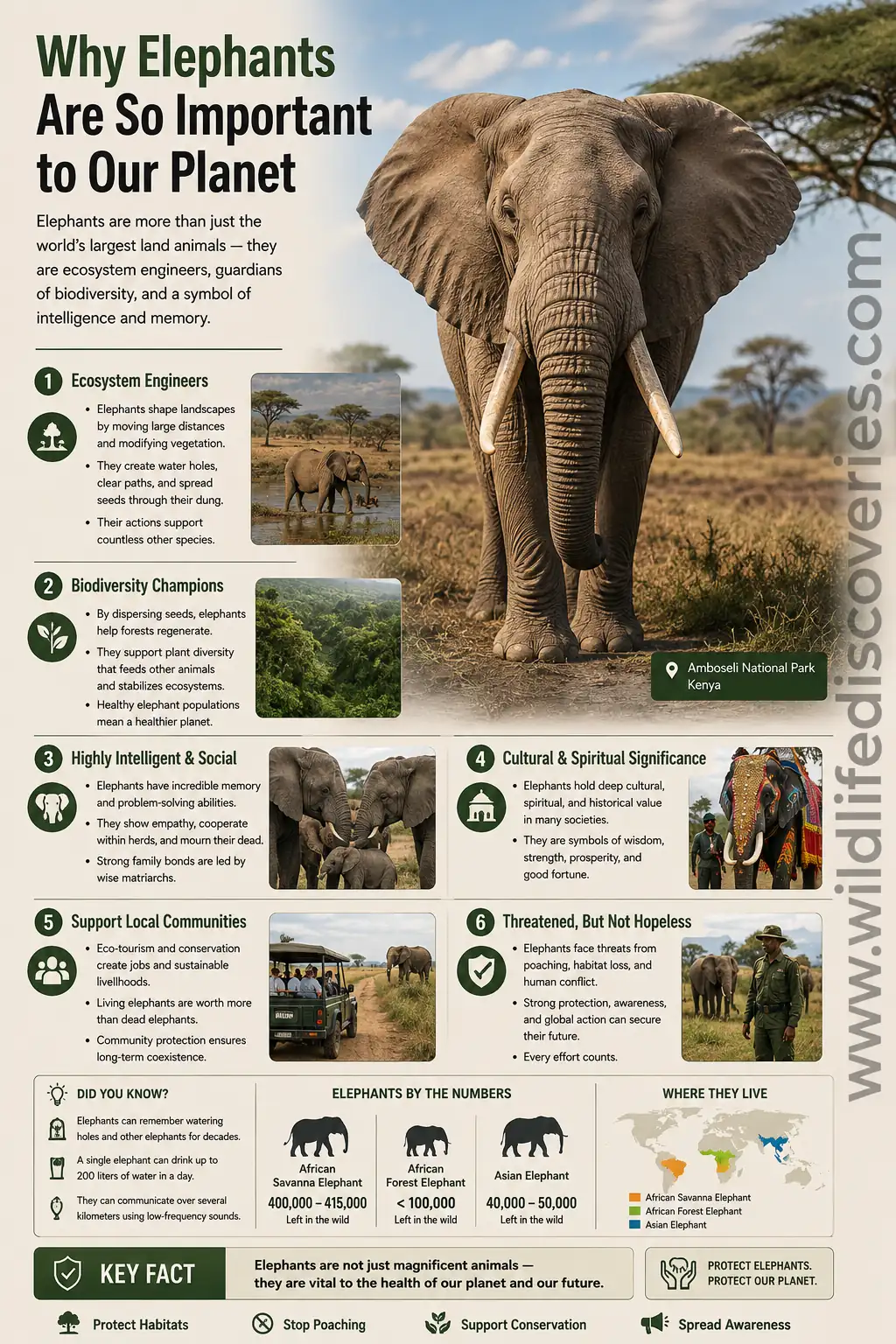
Elephants are what ecologists call ecosystem engineers — animals whose physical activities so dramatically reshape their environment that entire communities of other species depend on them.
This is not a metaphor. It is a documented ecological reality.
In African savannas, elephants knock down trees and uproot vegetation as they feed, creating open clearings that allow grasses to grow and smaller browsers to access vegetation they could not otherwise reach. They dig water holes with their tusks in dry riverbeds — providing water sources that dozens of other species rely on during droughts. Their dung is a critical mechanism for seed dispersal: a single elephant can distribute seeds across enormous distances, carrying them far from parent trees and fertilising them in nutrient-rich deposits. Studies have shown that some tree species in African forests are entirely dependent on elephants for seed germination.
In forest ecosystems, African forest elephants create gaps in the dense canopy as they move and feed, allowing light to reach the forest floor and promoting plant diversity. The trails they forge through thick vegetation become permanent pathways used by hundreds of other species.
When elephants disappear from a landscape, the effects cascade through every level of the ecosystem. Trees recover. Grasslands change composition. Water holes dry up. Species that depended on elephant-modified landscapes either adapt or decline. The ecological footprint of an elephant is, quite literally, irreplaceable.
Elephant Intelligence: The Mind Behind the Memory
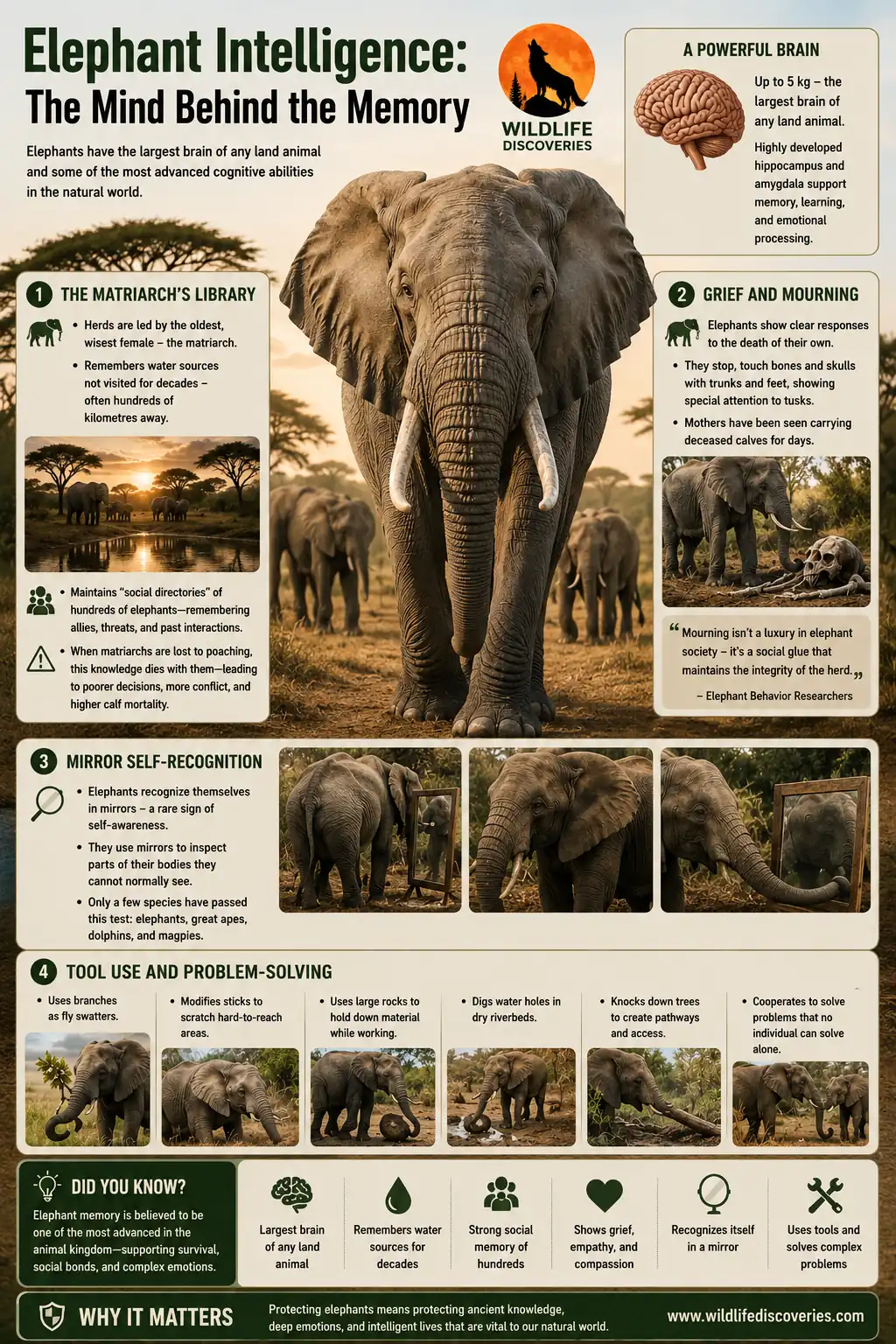
No discussion of elephants is complete without examining what may be their most remarkable attribute: their minds.
Elephants possess the largest brain of any land animal, weighing up to 5 kilograms. Critically, their brain architecture includes a highly developed hippocampus and amygdala — the structures most associated with long-term memory and emotional processing in mammals.
The Matriarch’s Library
Elephant herds are led by the matriarch — the oldest female in the group. Her knowledge is not merely social. It is encyclopaedic and life-saving.
Matriarchs can remember specific locations of water sources they have not visited in decades — a critical survival advantage during droughts when water may be hundreds of kilometres away. They maintain what researchers describe as detailed “social directories” of hundreds of other elephants, recalling which individuals are allies, which are threats, and how previous encounters with each ended. When older elephants — especially matriarchs — are killed by poachers, this accumulated knowledge dies with them. Herds without experienced matriarchs make poorer decisions, experience higher rates of human-elephant conflict, and suffer greater calf mortality.
Grief and Mourning
Elephants are among the very few non-human animals that demonstrate clear behavioural responses to the death of their own. When a herd encounters the remains of a deceased elephant, members will often stop entirely — touching the bones and skulls with their trunks and feet, showing particular attention to tusks, and sometimes remaining near the remains for extended periods. Mothers have been documented carrying deceased calves for days before setting them down.
Researchers studying elephant behaviour describe these responses as genuine mourning — indicating a concept of death, a recognition of individual identity, and an emotional depth that places elephants in a category shared by very few other species, alongside chimpanzees, dolphins, and humans.
“Mourning isn’t a luxury in elephant society — it’s a social glue that maintains the integrity of the herd,” noted researchers studying elephant limbic system architecture, which shows a proportionally large hippocampus and amygdala compared to most mammals.
Mirror Self-Recognition
In controlled experiments, elephants have demonstrated mirror self-recognition — the ability to recognise themselves in a mirror, a benchmark of self-awareness. When given access to a large mirror, elephants use it to inspect parts of their own bodies they cannot otherwise see, including the insides of their mouths and markings placed on their foreheads. This places elephants alongside great apes, bottlenose dolphins, and magpies in the small group of species that have consistently passed this test.
Tool Use and Problem-Solving
Elephants use tools. They have been observed using branches as fly swatters, modifying sticks to scratch themselves in hard-to-reach spots, and using large rocks to hold down material they are working with. They dig water holes in dry riverbeds, knock down trees to create pathways, and have been documented cooperating to solve problems that neither individual could solve alone — demonstrating advanced collaborative intelligence.
The Human-Elephant Conflict: A Crisis Without Easy Answers
Beyond poaching, one of the most complex threats facing elephants in 2026 is the expanding conflict between elephants and human communities.
As human populations grow and agricultural land expands, elephant habitats are increasingly fragmented. Elephants that once moved freely across connected landscapes now find their routes blocked by farms, roads, and settlements. Forced into closer proximity to human communities, they raid crops — sometimes destroying an entire season’s harvest in a single night. Farmers, facing economic ruin, retaliate.
The consequences are tragic on both sides. Elephants are killed. Humans are sometimes killed or injured by elephants defending themselves or their young. Communities develop deep hostility toward conservation efforts that appear to prioritise elephants over human livelihoods.
Effective long-term solutions require addressing both sides of this equation: creating wildlife corridors that allow elephants to move through landscapes without entering farmland, and compensating communities financially when crop losses occur. Some programmes have had success with non-lethal deterrents — beehive fences (elephants are deterred by the sound and sting of bees), chilli barriers, and early-warning systems that alert farmers when elephants are approaching.
Over 60% of Asia’s remaining wild elephants live in India, where this coexistence challenge is most acute and where innovative solutions are being developed — including community-managed elephant monitoring programmes in states like Karnataka and Tamil Nadu.
Conservation Progress: What Is Working
The picture is not entirely bleak. World Elephant Day reflects not just the crisis but also the real conservation progress that concerted action has achieved.
China’s ivory ban — implemented in December 2017 — was a landmark moment. China was historically the world’s largest consumer of ivory, and the closure of its legal domestic ivory market sent a powerful signal. Studies suggest that demand for ivory in China has declined significantly since the ban, though illegal trading continues.
Elephant sanctuaries and rehabilitation centres across Africa and Asia provide critical care for orphaned elephants, injured individuals, and those confiscated from the illegal trade. Organisations like the David Sheldrick Wildlife Trust in Kenya have raised and reintegrated hundreds of orphaned elephants into wild populations since their founding.
Transboundary conservation areas — large, cross-border protected zones that allow elephant populations to move freely across national boundaries — have helped stabilise populations in southern Africa, where the KAZA (Kavango–Zambezi) Transfrontier Conservation Area protects the largest elephant population on Earth across five countries.
How to Observe World Elephant Day 2026
Refuse ivory. Whether antique or modern, every piece of ivory represents a dead elephant. Refusing to purchase, display, or gift ivory products removes economic incentive from the most destructive force in elephant history.
Support credible sanctuaries. The David Sheldrick Wildlife Trust, Save the Elephants, the Elephant Crisis Fund, and the Wildlife Conservation Society all work directly on elephant conservation through anti-poaching, habitat protection, and community outreach.
Share accurate information. Use #WorldElephantDay on August 12 to amplify factual content about elephants — their intelligence, their ecological role, and the concrete steps that are making a difference.
Support habitat protection. Many of the organisations above work on securing and expanding protected land. Legislative advocacy for stronger protection of remaining elephant habitat — in Africa, India, and Southeast Asia — is among the highest-impact actions individuals can take.
Frequently Asked Questions About World Elephant Day
When is World Elephant Day 2026? World Elephant Day 2026 falls on Wednesday, August 12, 2026. It is observed every year on August 12.
Who founded World Elephant Day? World Elephant Day was co-founded in 2012 by Canadian filmmaker Patricia Sims and the Elephant Reintroduction Foundation of Thailand, with support from over 100 elephant conservation organisations worldwide.
How many elephants are left in the world? As of 2026 estimates, approximately 400,000 to 415,000 African elephants remain in the wild, alongside 40,000 to 50,000 Asian elephants. African forest elephants are critically endangered and have declined by more than 86% over the past three decades.
Why are elephants endangered? The primary threats are ivory poaching, habitat loss and fragmentation, and human-elephant conflict. Climate change is increasingly compounding all three threats by altering vegetation and water availability across elephant ranges.
How many elephants are killed each day? An estimated 100 African elephants are killed by poachers every day, primarily for their ivory tusks. This figure means that the equivalent of the entire elephant population of a small national park can be lost within weeks.
How long is an elephant pregnant? Elephants have the longest gestation period of any land mammal — approximately 22 months (nearly two full years). This, combined with the fact that females typically produce only one calf every four to six years, means elephant populations cannot recover quickly from losses.
Are elephants intelligent? Elephants are among the most cognitively complex animals on Earth. They demonstrate long-term memory, tool use, mirror self-recognition, grief responses to the death of other elephants, and sophisticated cooperative problem-solving. Matriarchs store and transmit critical knowledge about migration routes, water sources, and social relationships across generations.
What is an elephant’s trunk capable of? An elephant’s trunk contains approximately 150,000 individual muscles, giving it extraordinary versatility and precision. Elephants use their trunks to breathe, drink, smell (their sense of smell is reportedly one of the strongest of any animal), pick up objects as small as a single berry, and as a communication and social bonding tool.
Conclusion
World Elephant Day 2026 is a reminder that the crisis facing elephants is not abstract or distant. It is unfolding at a rate of approximately 100 animals per day — animals that, as this article has described, grieve their dead, remember the locations of water sources visited decades ago, reshape entire landscapes, and raise their young with a level of care and social sophistication that mirrors our own.
The question is not whether elephants deserve protection. The science of what they are and what they do for the ecosystems they inhabit makes that answer unambiguous.
The question is whether action comes fast enough to matter.
Every ivory product refused, every donation made, every accurate fact shared on August 12 is a small part of a much larger answer.
Also read on WildlifeDiscoveries.com: Shoebill Stork — The Living Dinosaur Bird of African Swamps
Sources: World Elephant Day Foundation; IUCN Red List; WWF; David Sheldrick Wildlife Trust; Elephanatics Foundation; National Today; Impactful Ninja; World Animal Foundation