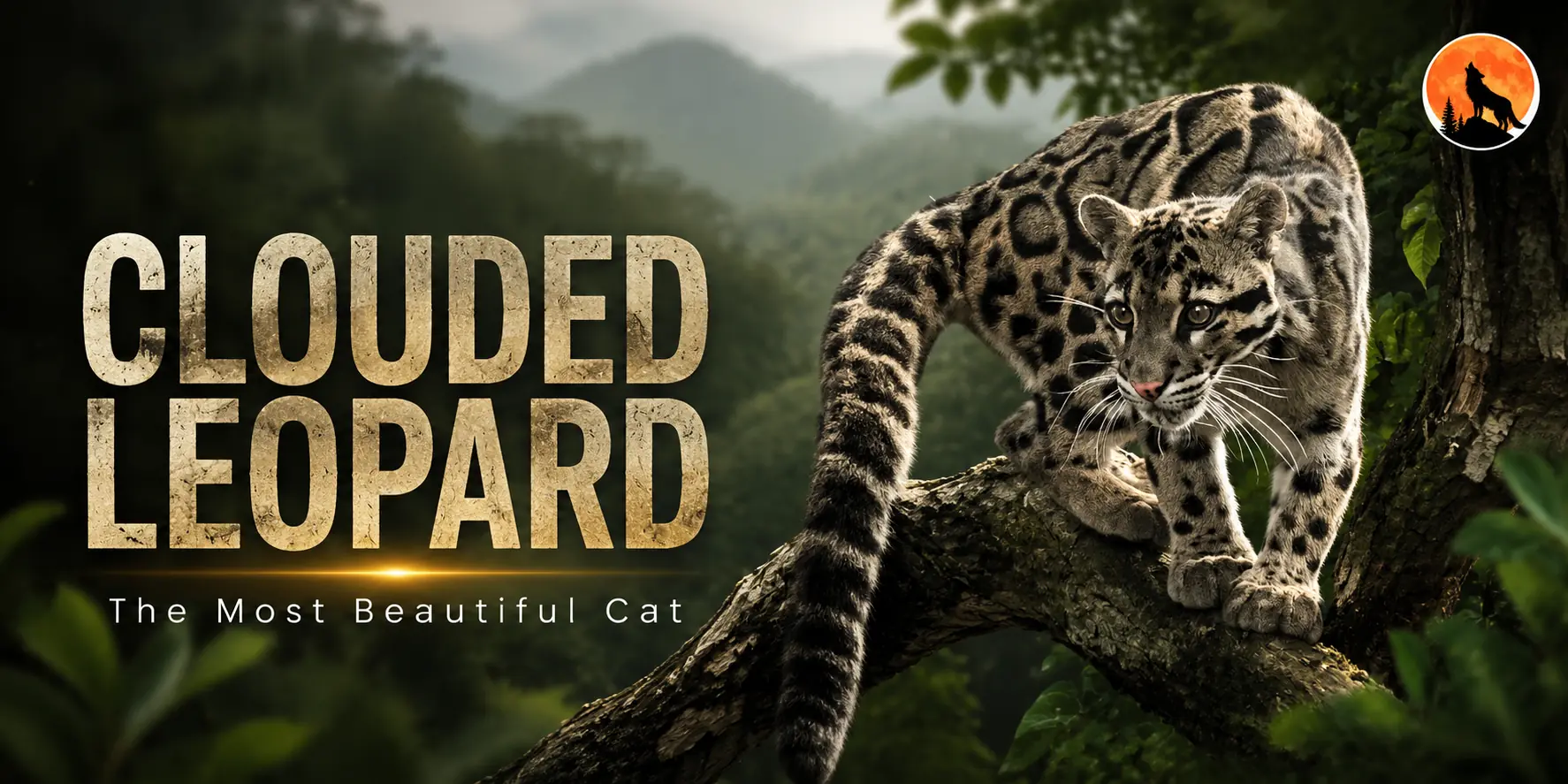
Among Asia’s wild cats, the Clouded leopard is especially beautiful and mysterious. Its name comes from the large, dark-edged markings on its coat that look like clouds. These patterns help it blend into forest shadows, making it difficult for both prey and people to notice.
Scientifically called Neofelis nebulosa, the mainland Clouded leopard is not a true leopard. True leopards belong to the genus Panthera, while this cat belongs to Neofelis. A related but separate species, the Sunda clouded leopard (Neofelis diardi), is found mainly on Borneo and Sumatra.
Long canine teeth, broad paws, flexible ankles and a very long tail make it an exceptional climber. Its secretive behaviour still leaves many questions unanswered. The mainland species is listed as Vulnerable on the IUCN Red List, with a decreasing population trend.
Quick Facts
| Category | Details |
|---|---|
| Scientific name | Neofelis nebulosa |
| Family | Felidae |
| Weight | About 16–23 kg |
| Body length | About 69–108 cm |
| Tail length | About 61–91 cm |
| Diet | Carnivorous |
| Main habitat | Tropical and subtropical forests |
| Activity | Mainly nocturnal or crepuscular |
| Status | Vulnerable |
| Main threats | Forest loss, poaching and illegal trade |
What is a Clouded Leopard?
The Clouded leopard is a medium-sized cat of South and Southeast Asia. Its strong body, short legs and broad paws suit dense forests and trees. This predator is an important part of the forest ecosystem. By hunting birds, rodents, primates and small hoofed animals, it helps regulate prey populations and supports natural ecological balance.
Meaning Behind Its Name
The name refers to the cloud-shaped patches covering its back and sides. Each patch has a dark border and lighter centre. This pattern breaks up the animal’s outline and provides natural camouflage among leaves, branches and changing forest light.
Scientific Classification
| Level | Classification |
| Kingdom | Animalia |
| Class | Mammalia |
| Order | Carnivora |
| Family | Felidae |
| Subfamily | Pantherinae |
| Genus | Neofelis |
| Species | Neofelis nebulosa |
Physical Features and Unique Adaptations
An adult Clouded leopard usually weighs 16–23 kilograms. It has a muscular body, rounded ears, short legs, a long tail and a tawny-to-grey coat. Black spots appear on its head and legs, while dark stripes may run along the neck and back. The exact arrangement of these markings differs between individuals.
The Clouded leopard coat provides camouflage in broken forest light. Its beauty has also attracted illegal hunters and traffickers. The markings help the animal remain hidden while resting, stalking prey or moving through thick vegetation. They break up the visible outline of its body, making it difficult to identify from a distance.
Long Canine Teeth and Powerful Jaws
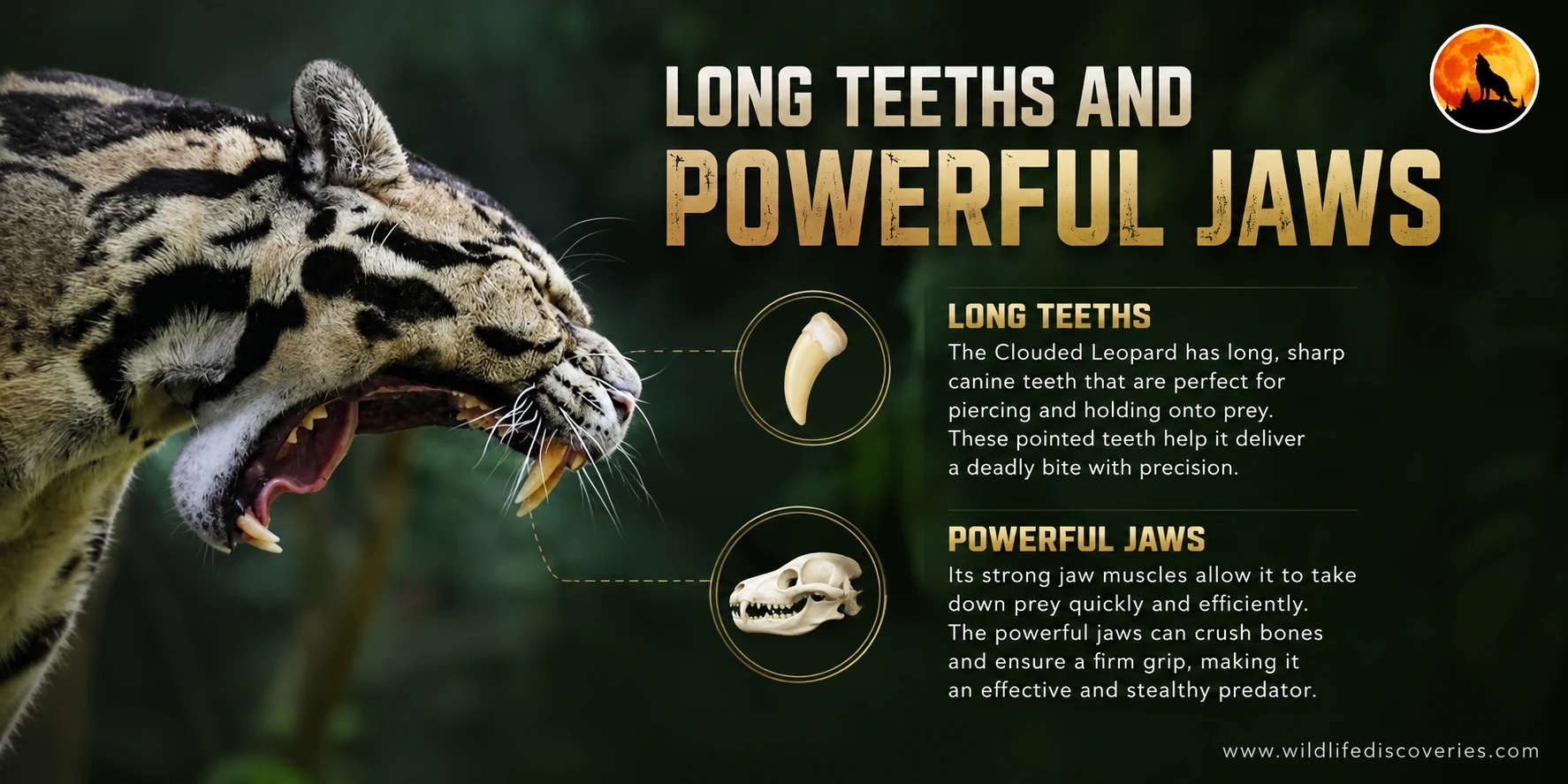
This species has exceptionally long canine teeth in proportion to its skull. Because of this, it is sometimes compared with extinct sabre-toothed cats. Its wide-opening jaws and strong muscles help it grip active forest prey.
The animal is not a surviving sabre-toothed cat, but its unusually long canines make it physically different from most living wild cats.
Flexible Ankles and Strong Claws
Its hind ankles can rotate, allowing the cat to climb down tree trunks headfirst. Broad paws, sharp claws and strong legs provide grip and control. It can even hang from a branch using its hind feet. These adaptations allow the animal to move safely on branches that would be difficult for many other land predators to use.
The long tail acts as a balancing pole on narrow branches. Large paws and specialised ankle bones support climbing, descending and moving beneath branches. Smithsonian sources describe the species as highly adapted to arboreal life. However, being an excellent climber does not mean that it remains in trees all the time. It also travels, rests and hunts on the forest floor.
Habitat and Geographical Distribution
The Clouded leopard has a fragmented range from the Himalayan region through Northeast India, southern China and mainland Southeast Asia. Rare sightings make its exact distribution difficult to measure. Countries within its recognised range include Nepal, Bhutan, India, Bangladesh, Myanmar, China, Thailand, Laos, Cambodia, Vietnam and Malaysia.
Preferred Forest Habitats
The species may occupy:
- Tropical evergreen forests
- Subtropical and mountain forests
- Secondary or logged forests
- Dry woodlands
- Mangrove forests
- Peat-swamp forests
It can survive in some disturbed areas, but it still needs tree cover, prey, resting places and safe routes between habitats. Forest quality is therefore important even when some trees remain standing.
Importance of Forest Corridors
Roads, farms, plantations, mining and settlements divide forests into isolated patches. Corridors reconnect these areas, helping animals find food, territory and mates. Without connectivity, small populations may experience reduced genetic diversity and a greater risk of local animal extinction. Forest corridors are therefore essential for the long-term survival of wide-ranging wildlife.
Behaviour, Diet and Hunting Skills
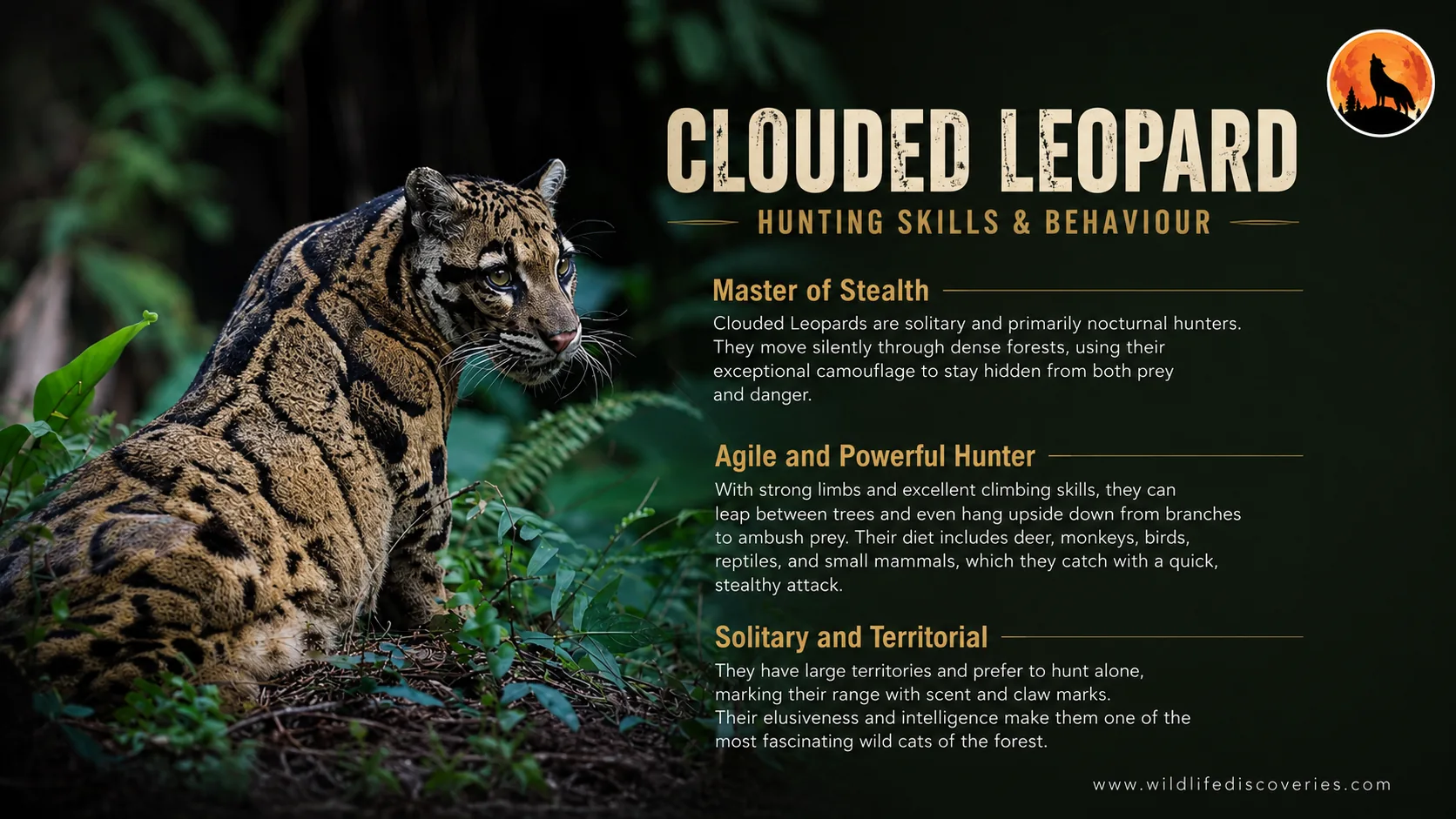
The Clouded leopard generally lives alone. Adults meet mainly to breed, and mothers raise cubs. Camera traps and genetic evidence often replace direct observation. Its secretive nature makes it one of the least understood wild cats in Asia. Scientists continue to study its territory size, movement patterns and interactions with other predators.
Nocturnal Behaviour and Daily Activities
It is mainly active at night, dawn or dusk, although prey and human disturbance may alter its routine. It rests in dense cover or trees. In forests with less human activity, individuals may also move during the daytime. Their routine is influenced by temperature, prey availability and the presence of people.
What Do Clouded Leopards Eat?
Its diet may include:
- Monkeys, macaques and gibbons
- Slow lorises
- Squirrels and rodents
- Birds
- Small deer
- Young wild pigs
- Other small and medium-sized animals
Diet remains uncertain because feeding events are rarely observed. Available prey may also differ considerably between regions.
Hunting Techniques and Prey Selection
The predator relies on stealth rather than a long chase. It approaches through cover and attacks suddenly. Its camouflage hides its body shape, while sharp claws, powerful limbs and long canine teeth help secure prey.
Hunting may occur on the ground or around trees. The animal’s ability to move in both environments allows it to target terrestrial as well as tree-dwelling prey.
Communication and Territorial Behaviour
Communication includes scent marking, urine spraying, scratching and vocal sounds such as growls, hisses and meows. These signals help individuals identify territory, avoid conflict and locate potential mates. Scratched trees and scent marks may remain after the animal has left, allowing individuals to communicate without meeting directly.
Reproduction, Cubs and Life Cycle
The Clouded leopard reaches maturity at around two years. Wild breeding is poorly known, while managed pairs require careful introduction. Males and females normally live separately. They come together during breeding before the female returns to a protected area to give birth.
Gestation Period and Litter Size
Pregnancy lasts about 85 to 93 days. A female may produce one to five cubs, although two or three are more common. She gives birth in a protected den and raises the young without help from the male. The den protects vulnerable newborns from weather, predators and disturbance.
Development of Clouded Leopard Cubs
Newborn cubs are blind and dependent. Their eyes usually open after 10 to 14 days, teeth appear at around three weeks, and they begin leaving the nest at about five weeks. Weaning generally occurs at 90 to 100 days. As their bodies become stronger, cubs begin exploring their surroundings and practising important movements.
Maternal Care and Independence
The mother protects and teaches her cubs. Through chasing, climbing, wrestling and pouncing, they develop balance, strength and hunting skills.
Young cats may remain with their mother for approximately one and a half to two years. During this period, they gradually learn how to find prey, recognise danger and survive independently.
Lifespan in the Wild and Captivity
Wild lifespan is uncertain, while managed animals may live into their teenage years. Breeding programmes must respect animal rights and welfare but cannot replace habitat protection. Responsible programmes can support research and genetic diversity. However, the ultimate goal must remain the protection of healthy populations in natural forests.
Threats and Conservation of Clouded Leopards
The mainland Clouded leopard and the Sunda species are both Vulnerable. Exact numbers remain uncertain because they occur at low densities and are difficult to survey. A Vulnerable classification means the species faces a high risk of extinction in the wild unless major threats are controlled.
Farming, plantations, logging, roads, mines and settlements remove shelter, prey and links between breeding populations. The struggle of this species shows why earth a unique planet must be protected as an interconnected living system. Damaging forests affects wildlife, water cycles, climate regulation and nearby communities.
Poaching and Illegal Wildlife Trade
It is hunted for skin, teeth, bones and meat. Patrols, border checks, penalties and lower consumer demand are all necessary.
Wildlife trafficking often operates across national borders, making international cooperation essential. Online trade and unregulated markets can also increase demand for illegal animal products.
Human-Wildlife Conflict
When prey declines, predators may approach livestock and face retaliation. Secure shelters, compensation and responsible land planning can reduce conflict. Local communities should receive practical support because conservation cannot succeed when people living near forests carry all the financial risks.
Conservation Programmes and Protection Efforts
Successful wildlife conservation requires several connected measures:
- Protect and restore large forest landscapes.
- Maintain corridors between habitat patches.
- Strengthen anti-poaching teams.
- Protect natural prey from excessive hunting.
- Expand camera-trap and genetic research.
- Include local communities in decisions.
- Improve cooperation between range countries.
- Support responsible conservation breeding.
- Reduce demand for illegal wildlife products.
Protecting this predator also safeguards many species sharing the same habitat. It can therefore act as an umbrella species for wider forest protection.
How People Can Help Protect Clouded Leopards?
People can reject wildlife products, report trafficking, support trusted groups and choose responsibly produced goods. Education should promote respect rather than harmful wildlife interactions.
Saving this cat is not only about preserving a beautiful species. It supports healthy forests, strengthens animal rights and lowers the danger of animal extinction. Protecting wildlife also protects water, clean air, climate stability and human well-being.
Key Takeaways
- It is a separate Asian wild cat, not a true leopard.
- Mainland and Sunda clouded leopards are different species.
- Cloud-shaped markings provide effective forest camouflage.
- Long canine teeth, flexible ankles and a long tail are major adaptations.
- The species is an excellent climber but also hunts on the ground.
- Its prey includes primates, birds, rodents, deer and wild pigs.
- Forest loss, poaching and illegal trade are major threats.
- Connected forests are essential for long-term survival.
- Research, law enforcement and community participation must work together.
Frequently Asked Questions (FAQs)?
1. Is It a True Leopard?
No. It belongs to the genus Neofelis, while the common leopard belongs to Panthera. It is a distinct wild cat with unique teeth, body structure and climbing adaptations.
2. Why Is It Compared With Sabre-Toothed Cats?
It has exceptionally long canine teeth in proportion to its skull. It is not a true sabre-toothed cat, but this feature creates a noticeable resemblance.
3. Can It Climb Down a Tree Headfirst?
Yes. Rotating ankles, broad paws and strong claws allow it to descend headfirst, hang from branches and move confidently in trees.
4. What Is the Difference Between Mainland and Sunda Clouded Leopards?
The mainland species, Neofelis nebulosa, lives across mainland Asia. The Sunda species, Neofelis diardi, occurs mainly on Borneo and Sumatra and differs genetically and visually.
5. Why Is the Species Vulnerable?
Its main threats are deforestation, fragmented habitat, declining prey, poaching and illegal wildlife trade. Protecting connected forests and involving local communities are essential for its future.