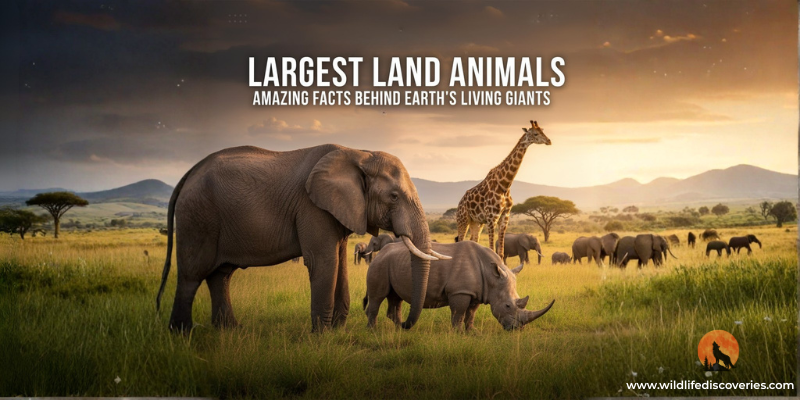
Earth’s largest mammals continue to captivate us with their magnificent presence and incredible size. When considering the giants among animals on land, the African bush elephant stands out as the largest mammal walking on land today. These remarkable creatures weigh up to 6 tons (13,200 lb) on average, making them the heaviest land animals in existence. Indeed, it is this majestic animal that holds the title of the largest living land animal in the world.
The biggest animal on land ever recorded turned out to be an exceptionally large male African elephant shot in Angola in 1974. This remarkable specimen stretched 10.67 meters from trunk to tail and reached a projected shoulder height of 3.96 meters, making it one of the tallest animals ever measured. Scientists estimated its weight between 10.4 to 12.25 tons, approaching the maximum weight for land mammals. While impressive, the blue whale dwarfs these land giants and claims the title of the largest animal in the world. These marine mammals can weigh up to 190 tons and stretch around 30 meters in length, making them the longest animal known to exist.
In this piece, we’ll discover the fascinating world of the largest land animals and explore some intriguing animal facts. We’ll delve into everything from scientists’ measurement techniques to the challenges these magnificent creatures face in today’s ever-changing world.
The Science Behind Measuring the Largest Land Animals
Measuring the largest mammals involves scientific challenges way beyond the reach and influence of simple tape measurements. Scientists need sophisticated methods to figure out the true size of these magnificent creatures, both living and extinct.
Why weight and height matter
The size of largest land mammals serves more than record-keeping purposes. Weight emerges as the most important factor when scientists assess animal performance, health status, and reproductive efficiency. Zookeepers learn about an animal’s well-being through weight monitoring. A monkey’s weight loss might point to food competition issues, while an overweight armadillo could benefit from activities that encourage movement.
Height measurements become vital for certain species like giraffes, which are among the tallest animals on Earth. The tallest zoo specimens reach between 18 to 20 feet above ground. Accurate measurements help veterinarians determine the right medication dosages to avoid under or overdosing largest land animals.
Weight helps establish market values for livestock and determines proper feed quantities from a business standpoint. Wildlife conservationists use these measurements as baselines. They track population health over time, and declining numbers could signal environmental threats that need quick action.
Challenges in measuring wild animals
Getting accurate measurements of the biggest land mammal in the world and other large species creates many obstacles. A WWF scientist points out, “In conservation we rarely have the opportunity to find each animal in a population”. Researchers often depend on indirect signs like snow tracks or tree scratches.
Largest land animals need specialized weighing equipment. Zoos use 10-foot long, 5-foot wide steel scales built into protective chutes for elephants—today’s largest living land animals. The core team focuses on training, as keeper Debbie Flinkman explains: “We ask him to stand on a scale (politely) and reward him with his favorite food“.
Scientists develop mathematical models based on repeated site visits to estimate wild population numbers. Modern approaches include environmental DNA (eDNA) collection. Genetic material from snow tracks can identify individual animals and reveal their recent meals, which provides valuable data with minimal disruption.
Animal weights change constantly with feeding, watering, urination, and other bodily functions. This adds another complex layer to measurement accuracy, especially when trying to determine the heaviest land animal in a given species.
Extinct vs. extant species: what counts?
Finding the size of the largest animal ever creates extra scientific hurdles. Many extinct species leave only fragmentary fossils, so their sizes remain estimates. Body mass calculations become speculative since soft tissues rarely turn into fossils.
Scientists use several methods to reconstruct extinct giants:
| Method | Description | Limitations |
| Allometric scaling | Applies mathematical relationships from modern animals to fossil measurements | Assumes similar proportions between species |
| Proxy taxon scaling | Scales a complete specimen up/down based on proportional fragments | May distort dimensions if body plans differ |
| Volumetric modeling | Creates 3D models based on skeletal remains | Relies on assumptions about soft tissue distribution |
Scientists compare critical metrics like functional lengths of dorsal vertebral centra to determine relative size between species. In spite of that, size estimates often need revision, sometimes dropping to half their original proposed value.
Comparing extinct and living species raises questions about what truly counts as the largest land mammal. Weight estimates for prehistoric animals like Bruhathkayosaurus and Palaeoloxodon namadicus continue to evolve as measurement techniques improve and new fossil evidence surfaces.
Top 5 Largest Land Animals Alive Today
The sheer size of Earth’s largest mammals never fails to amaze us. These gentle giants roam our planet’s landscapes, and here’s a closer look at the top five living behemoths, including some of the heaviest land animals in existence. But before we dive in, let’s first understand what is mammals? — warm-blooded vertebrates that have hair, give birth to live young (in most cases), and feed them with milk produced by the mother.
1. African Bush Elephant
The African bush elephant (Loxodonta africana) stands as the biggest animal in the world on land. Male elephants weigh between 5.2-6.9 tons on average, while females weigh much less. The record holder was a massive bull shot in Angola in 1974. It measured 3.96 meters at the shoulder and weighed an estimated 10.4 tons, making it one of the heaviest land animals ever recorded.

These giants need plenty of food to maintain their massive size. An adult eats about 150 kg of vegetation and drinks 230 liters of water each day. Their large ears do more than help them hear – they help cool their bodies in Africa’s hot climate.
Adult males prefer to live alone or with other bachelors, while females stick together in family groups with a matriarch. These largest land mammals continue to face threats from habitat loss and poaching, despite their impressive size.
2. Asian Elephant
The Asian elephant (Elephas maximus) ranks second among the largest animals on land. Male adults typically weigh about 4 tons, and females reach around 2.7 tons. The biggest Asian elephant on record was taken down by the Maharajah of Susang in Assam, India, back in 1924. It weighed roughly 7 tons.

Males stand 2.75 meters tall at the shoulder while females reach 2.40 meters. These majestic creatures live in various ecosystems throughout South and Southeast Asia. Their appetite matches their size – some produce up to 220 pounds of dung daily as they wander across territories spanning 125 square miles.
Male Asian elephants usually grow tusks, unlike their female counterparts. This makes them easy targets for ivory poachers, contributing to their status as an endangered species.
3. White Rhinoceros
The white rhinoceros (Ceratotherium simum) takes third place among today’s largest mammals. Males stretch 3.7-4 meters in length and reach 170-186 cm at the shoulder. Bulls weigh substantially more than females, averaging 2,000-2,300 kg compared to the females’ 1,600-1,700 kg.

These massive creatures sport wide, square-shaped mouths perfect for grazing. They come in two types: the southern white rhino and the critically endangered northern white rhino. The biggest confirmed specimens hit 3,600 kg, though some claim to have seen 4,500 kg giants.
Only elephants outweigh the white rhinoceros among today’s living land animals, solidifying its place among the heaviest land animals.
4. Hippopotamus
The common hippopotamus (Hippopotamus amphibius) ranks fourth among largest animals on land, though it spends lots of time in water. Bulls typically hit 1,480 kg, while cows average about 1,365 kg. The biggest males can reach 2,660 kg.
These semi-aquatic mammals stretch 2.90 to 5.05 meters long and stand 1.30 to 1.65 meters at the shoulder. Native to sub-Saharan Africa, hippos eat only plants but rank among Africa’s most dangerous animals due to their aggressive nature.
A captive hippo in Germany set the modern record at roughly 4,500 kg (9,900 pounds), showing just how big these animals can grow.
5. Giraffe
The giraffe rounds out our list of the five largest mammals on land today. These tallest animals reach 4.3-5.7 meters in height, making them the longest animal on land in terms of vertical reach. Males weigh around 1,192 kg while females hit 828 kg.
Their remarkable height lets them eat leaves other plant-eaters can’t reach. Each giraffe shows off its own unique pattern of dark spots surrounded by lighter fur, which helps them blend into their savanna homes.
The giraffe population has dropped to about 97,500 wild individuals as of 2016, despite their impressive size.
Comparison Table: Weight, Height, and Habitat
| Rank | Animal | Average Weight (Males) | Maximum Recorded | Shoulder Height | Primary Habitat |
| 1 | African Bush Elephant | 5.2-6.9 tons | 10.4 tons [141] | 3.04-3.36 m | Sub-Saharan Africa |
| 2 | Asian Elephant | 4 tons | 7 tons [101] | 2.75 m | South/Southeast Asia |
| 3 | White Rhinoceros | 2-2.3 tons | 3.6 tons | 170-186 cm | African grasslands |
| 4 | Hippopotamus | 1.48 tons | 4.5 tons | 1.3-1.65 m | Sub-Saharan Africa |
| 5 | Giraffe | 1.192 tons | 2 tons | 4.3-5.7 m (total) | African savannas |
The Largest Land Animal Ever Recorded
Paleontologists sometimes find evidence of prehistoric animals that make today’s largest mammals look small. These giant fossils challenge everything we know about how big animals can get.
Bruhathkayosaurus: the dinosaur contender
Bruhathkayosaurus, a colossal titanosaur from Late Cretaceous India, might be the largest animal ever to walk on land. Scientists first thought it was a theropod, but later studies showed it was actually a sauropod dinosaur. The fragments they found suggest this giant stretched up to 45 meters long. Its weight estimates range from 110-170 tons, and some scientists think it might have been even heavier.
The story takes a sad turn. The original fossils reportedly fell apart during a monsoon, leaving behind just descriptions and drawings. That’s why Bruhathkayosaurus remains one of the most debated candidates for the biggest animal in the world that ever walked on land. The current record-holder, Patagotitan mayorum, is no match for it at 70 tons.
Palaeoloxodon namadicus: the giant elephant
Palaeoloxodon namadicus stands out as what might be the largest land mammal that ever lived. This straight-tusked elephant roamed Earth during the Pleistocene epoch. The remains suggest it stood 5.5 meters at the shoulder and reached 8 meters in total height. Scientists estimate it weighed an impressive 22 tons, making it one of the heaviest land animals in prehistoric times.
This massive elephant’s story began in Africa during the Pliocene before it spread into Asia. The creature’s most striking feature was a unique parieto-occipital crest on its skull. It thrived from about 4 million years ago until it vanished around 20,000 years ago.
How scientists estimate size from fossils
Scientists face quite a challenge when they try to figure out how big these largest land animals really were. Most giant species left behind incomplete remains, so experts use several math-based approaches:
- Allometric scaling: They use math patterns from modern animals to understand fossil measurements
- Volumetric modeling: They create 3D models based on skeletal remains
Experts look closely at specific bone measurements, especially leg bones that associate strongly with body mass. They also compare backbone sizes between species to work out relative size.
Scientists have developed more sophisticated math methods over the last several years. They now use hundreds of measurements from complete skeletons to find the best size predictors. As measurement techniques get better, size estimates often need updates, particularly when determining the maximum weight of prehistoric giants.
How These Giants Shape Their Ecosystems
Largest mammals leave their mark on ecosystems in ways that go way beyond their physical presence. These giants reshape their surroundings and help countless other species thrive.
Seed dispersal and vegetation control
Largest land animals work as nature’s gardeners. Elephants, maybe the biggest animal in the world on land, spread seeds far and wide through their dung. Research shows that forest elephants play a crucial role – their absence throws off vegetation patterns and lets plant diseases run wild. Large herbivores also keep forests from taking over grasslands. This became clear in North America when mammoth extinction led to big changes in the landscape. Some plants with large fruits can’t survive without these mega-sized animals. Asian elephants have turned out to be key players in spreading seeds throughout tropical rainforests.
Waterhole creation and landscape impact
These largest mammals do something amazing – they create water sources that sustain life. Elephant-dug waterholes become lifelines during dry seasons and support entire ecosystems. These oases help zebras, antelopes, buffaloes, predators, birds, insects, frogs, and reptiles survive. Wild horses in North American deserts dig wells too. These wells increase water availability and help riverside trees grow better.
Predator-prey dynamics
Largest animal species shape how predators and prey interact in food webs. Large carnivores usually hunt prey that weighs between half to twice their own weight. This is a big deal as it means that megaherbivores weighing over 1000 kg—like the biggest animals in the world—don’t face much threat from predators. This size advantage shapes how entire ecosystems work.
Threats Facing the Largest Land Mammals
The largest mammals face serious threats to their survival today. These magnificent creatures once ruled their territories unchallenged. Now they struggle to survive against human activities that have cut their numbers worldwide.
Poaching and illegal wildlife trade
The illegal wildlife trade affects about 4,000 animal and plant species around the globe. The largest land mammal species face a poaching crisis. African savannah elephant numbers dropped by 30% between 2007 and 2014 because of ivory poaching. South Africa saw rhino poaching jump from 13 cases in 2007 to 1,004 in 2013. This illegal business ranks as the world’s fourth biggest trafficking industry, worth USD 7-23 billion each year.
Habitat loss and fragmentation
The largest animals need big territories that are disappearing faster. By 2050, farming expansion could destroy the homes of nearly 90% of land animals. The biggest animals in the world face special challenges since habitat loss threatens 60% of large mammals. These giants must live in smaller areas where they fight for resources, which leads to stress and more conflicts with humans.
Climate change and food scarcity
Climate change makes life harder for the largest land animals. These giants cannot adapt quickly through micro-evolution or by moving to new areas, unlike smaller species. Scientists predict that 45% of land species might die out by 2050 if they cannot move freely. Weather pattern changes also disrupt their migration paths and food sources.
Conservation efforts and global initiatives
Hope exists for the largest mammal species through protection efforts. The Global Wildlife Program fights illegal wildlife trade by improving law enforcement and policy frameworks. Plans to bring back large mammals could restore their presence across 8.5 million square kilometers by focusing on 20 key species. Success stories shine through – the Indian Rhino bounced back from just 40 animals in the 1960s to more than 4,000 today.
Many of these largest land animals are now listed as endangered species on the IUCN Red List, which categorizes them based on their conservation status. Some species, like the African forest elephant, are critically endangered, while others, such as the African bush elephant, are listed as vulnerable. Other largest land animals like the moose, elk, and polar bear range from least concern to near threatened, depending on their population trends and habitat conditions.
Conclusion
Animals on land have fascinated humans throughout history and played significant roles in shaping our planet’s ecosystems. The mighty African bush elephant weighs up to 6 tons while the towering giraffe reaches heights of 5.7 meters. These magnificent creatures showcase nature’s engineering at its finest. Modern giants are nowhere near a match for their prehistoric ancestors like Bruhathkayosaurus and Palaeoloxodon namadicus, which may have been the largest animal ever to walk on land.
Researchers continue to develop sophisticated techniques to measure and study the largest mammals accurately. These measurements determine dimensions of both living and extinct species. Of course, this work goes beyond mere curiosity and gives us great insights into animal health, conservation status, and ecological significance.
The biggest land animals face unprecedented challenges today. Many species experience alarming population declines due to poaching, habitat fragmentation, and climate change. Their remarkable traits – size and specialized adaptations – make them vulnerable to environmental changes especially.
Conservation efforts worldwide give hope to these magnificent creatures. Population recovery becomes possible through dedicated protection and habitat preservation, though challenges remain ahead.
These living giants serve as ecosystem engineers through seed dispersal, vegetation control, and waterhole creation. The biggest animals’ ecological importance cannot be overstated. Countless plant and animal species depend on their presence, and without these megafauna, entire ecosystems would fundamentally change.
Protecting these remarkable creatures requires global cooperation and innovative conservation strategies. These magnificent animals represent biological wonders and our connection to Earth’s evolutionary history. The largest land animals deserve our respect and protection – not just for their impressive size but for their irreplaceable role in maintaining our natural world’s delicate balance.
Key Takeaways
Discover the fascinating world of Earth’s largest land animals and their critical role in maintaining ecosystem balance.
• African bush elephants reign as the largest living land animals, weighing up to 6 tons, with the biggest recorded specimen reaching 10.4 tons in 1974.
• These giants function as ecosystem engineers, dispersing seeds across vast distances, creating vital waterholes, and preventing forests from overrunning grasslands.
• Prehistoric giants like Bruhathkayosaurus potentially reached 45 meters in length and 170 tons, dwarfing today’s largest land mammals.
• Modern megafauna face unprecedented threats from poaching, habitat loss, and climate change, with elephant populations declining 30% between 2007-2014.
• Conservation success stories like the Indian Rhino recovery from 40 to over 4,000 individuals prove that dedicated protection efforts can restore populations.
The survival of these magnificent creatures depends on global cooperation and innovative conservation strategies, as their loss would fundamentally alter entire ecosystems and affect countless species that depend on their presence.
FAQs
Q1. What is currently the largest land animal on Earth? The African bush elephant is the largest living land animal, with males weighing between 5.2-6.9 tons on average. The largest recorded specimen was an enormous bull shot in Angola in 1974, weighing an estimated 10.4 tons.
Q2. How do scientists measure the size of largest land animals? Scientists use specialized equipment like large steel scales for weighing and employ various techniques for measuring height and length. For wild animals, they often rely on indirect indicators and mathematical models based on repeated observations.
Q3. What was the largest land animals to ever exist? While it’s difficult to determine with certainty, some contenders for the largest animal ever to walk on land include the Bruhathkayosaurus (a titanosaur dinosaur) and Palaeoloxodon namadicus (a prehistoric elephant). Estimates suggest these creatures could have weighed up to 170 tons and 22 tons respectively.
Q4. How do largest land animals impact their ecosystems? Largest land animals play crucial roles in their ecosystems. They disperse seeds over vast distances, control vegetation growth, create waterholes that benefit numerous species, and influence predator-prey dynamics due to their size.
Q5. What are the main threats facing the largest land mammals today? The biggest threats to largest land mammals include poaching and illegal wildlife trade, habitat loss and fragmentation, climate change leading to food scarcity, and human-wildlife conflict. These factors have led to significant population declines in many species, with several now listed as endangered on the IUCN Red List.