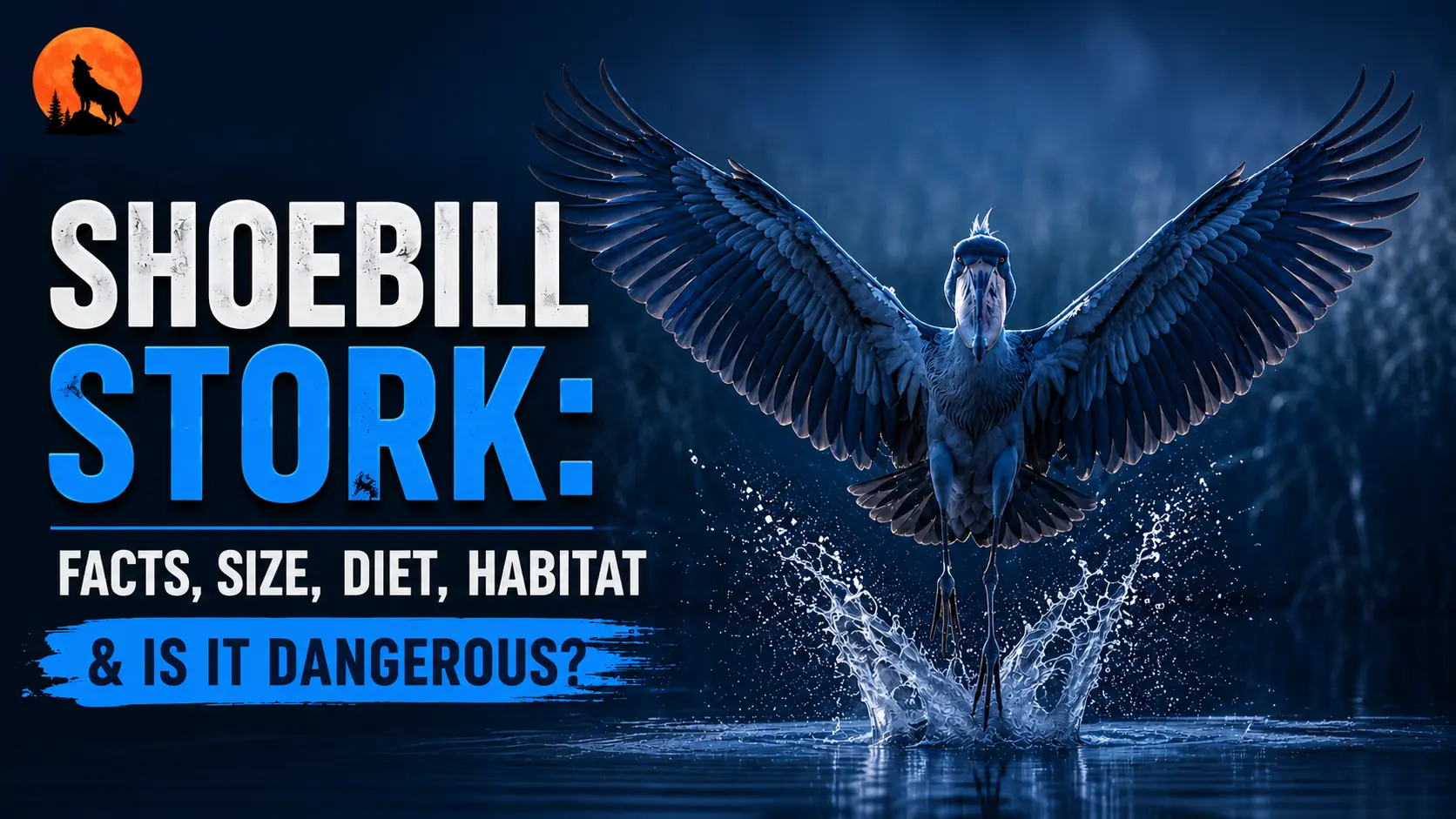
Imagine standing face-to-face with a 5-foot-tall bird that hasn’t changed much since the age of dinosaurs — a bird that can stand motionless for hours, decapitate a baby crocodile with one snap, and stare you down without blinking.
That bird is real. It’s called the shoebill stork, and it might be the most extraordinary bird alive today.
What Is a Shoebill Stork?
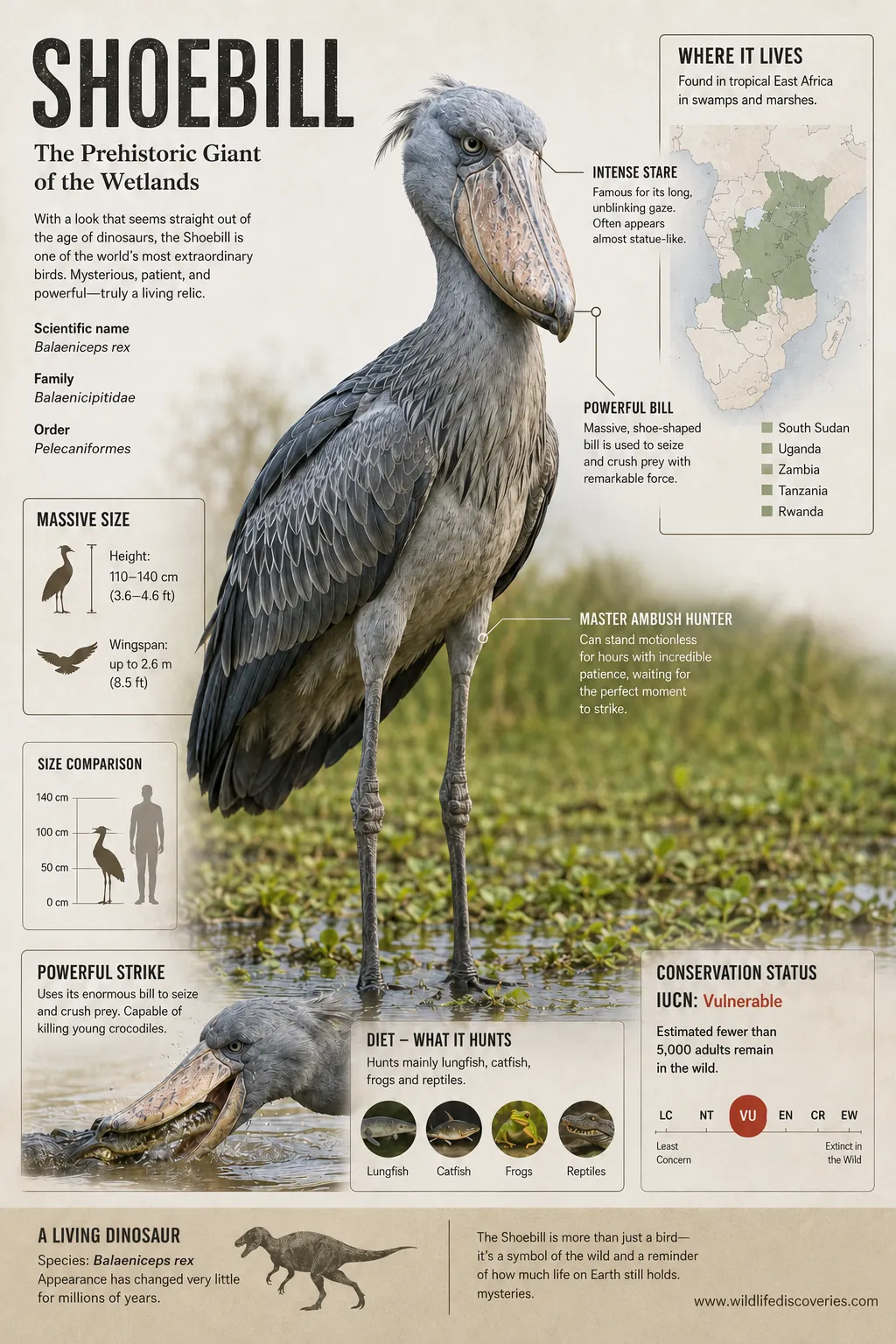
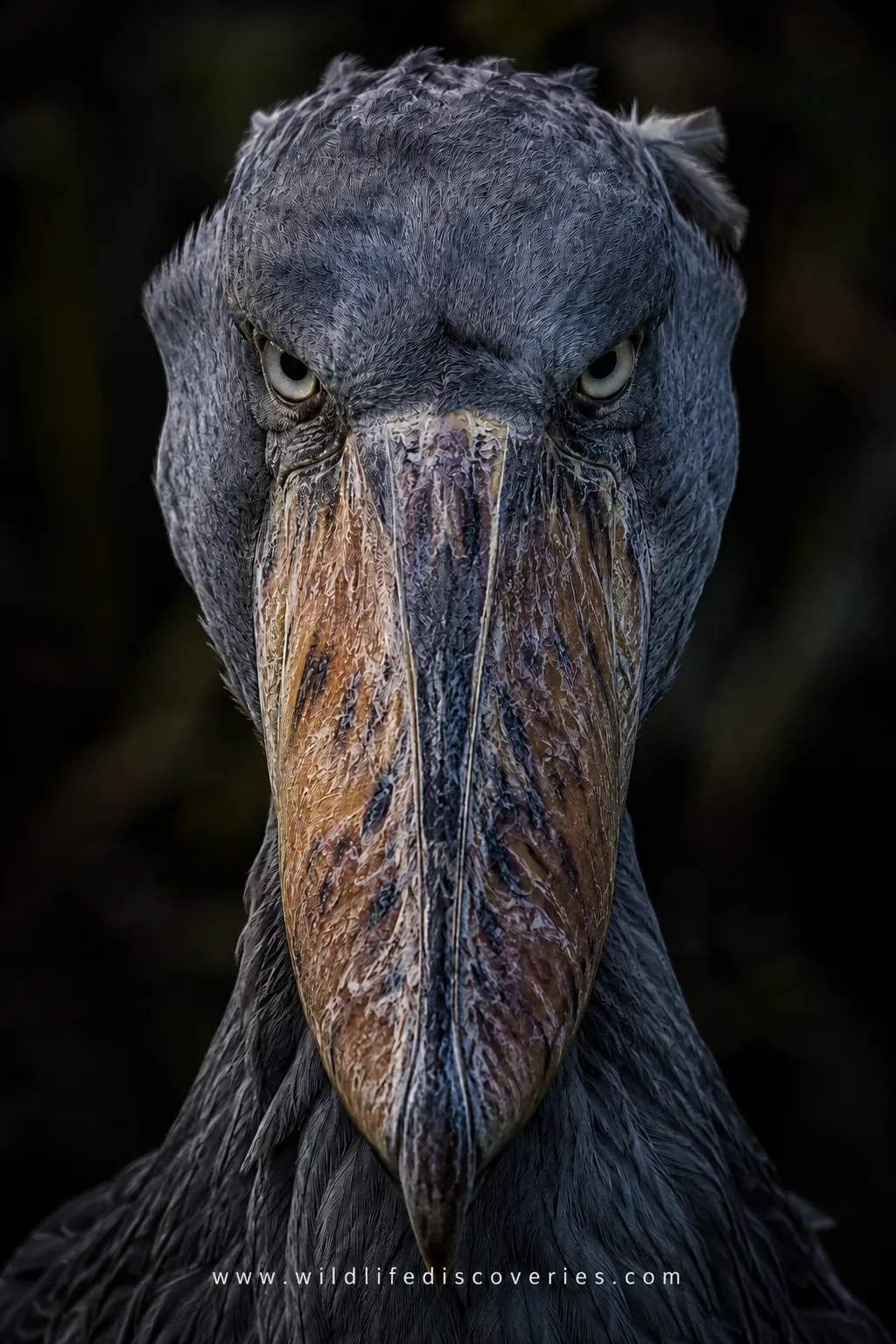
The shoebill stork (Balaeniceps rex) is one of Africa’s most prehistoric-looking birds. With piercing yellow eyes, a bill the size of a man’s shoe, and the kind of unblinking stare that makes people deeply uncomfortable, this bird looks like it walked directly out of the Cretaceous period.
Despite its name, the shoebill is not actually a stork. DNA research revealed it belongs to the order Pelecaniformes making pelicans and herons its closest living relatives. It is the only living member of its family, Balaenicipitidae, placing it in a biological category entirely its own.
Found only in the remote freshwater swamps of East and Central Africa, it is one of the most sought-after wildlife sightings on the continent rare, elusive, and utterly unforgettable.
Key Facts at a Glance
| Feature | Detail |
|---|---|
| Scientific Name | Balaeniceps rex (“whale-headed king”) |
| Height | 4–5 feet (1.2–1.5 m) |
| Weight | 9–15 lbs (4–7 kg) |
| Wingspan | 7.5–8.5 feet (2.3–2.6 m) |
| Lifespan | ~35 years wild / ~50 years captivity |
| Diet | Lungfish, catfish, baby crocodiles |
| Habitat | Freshwater swamps, East & Central Africa |
| IUCN Status | Vulnerable — only 5,000–8,000 left (3,300–5,300 mature individuals) |
| Flight Speed | 35–48 km/h |
| Closest Relatives | Pelicans and herons (NOT true storks) |
How Big Is a Shoebill Stork? (Size & Weight)
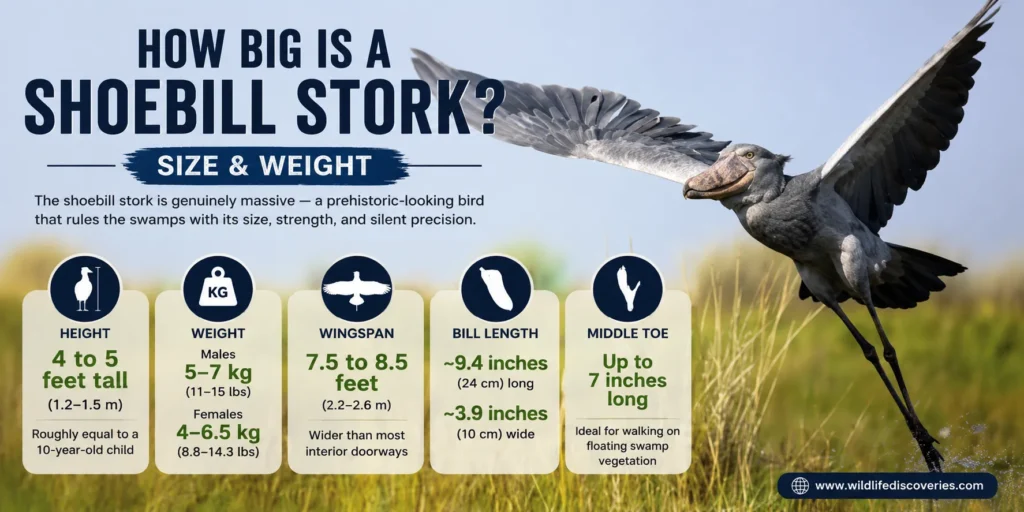
The shoebill stork is genuinely massive. Here’s a precise breakdown:
- Height: 4 to 5 feet tall (1.2–1.5 m) — roughly equal to a 10-year-old child
- Weight: Males 5–7 kg (11–15 lbs); females slightly smaller at 4–6.5 kg
- Wingspan: 7.5 to 8.5 feet (2.3–2.6 m) — wider than most interior doorways
- Bill length: ~9.4 inches (24 cm) long, ~3.9 inches (10 cm) wide
- Middle toe: Up to 7 inches long — ideal for walking on floating swamp vegetation
Its bill is the third longest of any bird species on Earth, after pelicans and large storks. The upper mandible curves into a razor-sharp downward hook, designed not just to grip prey but to kill it instantly.
How Tall Is a Shoebill Stork?
A fully grown adult shoebill stands between 4 and 5 feet tall (1.2–1.5 meters). Males are typically slightly taller than females.
Most of that height comes from their long, dark grey legs built strong enough to carry the bird steadily across unstable, floating mats of aquatic vegetation. This is an ability most large birds simply don’t have.
When a shoebill looks at you, it looks at you at eye level. That’s not a metaphor.
What Do Shoebill Storks Eat?
Shoebill storks are specialized carnivores, and their diet is more impressive than most people expect.
Primary prey:
- Lungfish — their absolute favourite; a primitive, air-breathing fish that must surface regularly, making it a perfect ambush target
- Catfish and tilapia
- Water snakes and monitor lizards
- Frogs, turtles, and molluscs
- Baby crocodiles — yes, genuinely
Their hunting method is extraordinary. A shoebill will stand completely motionless in shallow water for hours, waiting. When prey surfaces, it launches forward with explosive speed — collapsing its entire body weight onto the target and pinning it with its massive bill.
Before swallowing large fish, it often decapitates them using the bill’s sharp hooked tip. This prevents fins and claws from injuring the bird’s throat during swallowing.
Wildlife researchers studying shoebill behavior have noted that the bird’s hunting strike is one of the most efficient ambush attacks in the avian world — combining hours of stillness with explosive, lethal precision.
Did you know? A shoebill’s bill operates like biological scissors — the sharp edges can cut through thick fish bones and crocodile skin with a single snap.
Can Shoebill Storks Fly?
Yes but they rarely do, and they prefer not to. With a wingspan stretching up to 8.5 feet, shoebills are fully capable of powered flight, reaching speeds of 35 to 48 km/h. However, they have one of the slowest wingbeat rates of any large flying bird — approximately 150 beats per minute, which is slow for a bird of its size and wingspan and use thermal air currents to soar when necessary.
In practice, shoebills are highly sedentary. They establish a territory in their swamp and stay there, walking slowly through shallow water rather than flying between locations. Flight typically only occurs when they need to move between wetland areas or escape a genuine threat.
When they do fly, their slow, deliberate wingbeats and hunched posture give them an almost prehistoric silhouette against the African sky.
Shoebill Stork Breeding & Nesting Behavior
The shoebill stork breeds once a year, typically during the dry season between April and June, when falling water levels make prey more concentrated and easier to catch — a critical advantage when raising chicks.
Pairs are monogamous during the breeding season, though they do not mate for life. Courtship is understated: the two birds stand close together, clatter their bills, and bow repeatedly — a ritual that looks almost ceremonial.
Nesting
Shoebills build large, flat nests directly on floating vegetation or firm ground near water. The nest can reach up to 8 feet (2.5 m) in diameter — wide enough to land a small aircraft. Both parents participate in construction, gathering papyrus stems and aquatic grasses.
The female lays 1 to 3 eggs, which both parents incubate for approximately 30 days. During the hottest part of the day, parents carry water in their bills and pour it over the eggs to prevent overheating — a behavior called “egg wetting” that is rare among birds.
Chick Survival
Only one chick typically survives to adulthood. The oldest, strongest chick monopolizes food and attention, and younger siblings rarely make it past the first few weeks. This is not neglect — shoebill parents are attentive — but resources in the wild are finite.
Chicks fledge at around 95 days and become fully independent at roughly 3 to 4 months. Juveniles have a softer, browner plumage compared to the steel-grey adults and take several years to reach full size.
Conservation note: With only 1–2 chicks surviving per breeding pair per year, population recovery is extremely slow — making habitat protection especially critical.
Are Shoebill Storks Dangerous? The Honest Answer
Short answer: No, not to humans — but they could be if provoked.
This is one of the most searched questions about this bird, and the honest answer is more nuanced than most articles admit.
Shoebill storks are not aggressive toward humans by nature. They are solitary, quiet birds that generally avoid contact. In the wild, most shoebills will simply stand still and stare when approached — using their intense, unblinking gaze to intimidate rather than attack.
According to wildlife researchers, there are no documented cases of a shoebill killing a human being. Injuries have occurred in captive settings where handlers made errors during feeding, but unprovoked attacks in the wild are essentially unheard of.
However, their physical capabilities are formidable:
- Their bill can exert enough force to break bones and has been documented crushing fish skulls and crocodile skulls instantly
- They are territorial during nesting season and may charge if they feel their eggs are threatened
- Captive individuals — particularly juveniles — can strike handlers who approach without caution
The famous “Sushi,” a shoebill at Uganda Wildlife Education Centre, has a well-known ritual: visitors must bow before approaching him, and he bows back. This has become one of Uganda’s most viral wildlife moments.
For a full analysis of what this bird is truly capable of, read: Can a Shoebill Stork Kill You? Are They Dangerous?
How Does the Shoebill Compare to the World’s Truly Dangerous Birds?
| Bird | Danger Level | Documented Human Fatalities | Weapon |
|---|---|---|---|
| Cassowary | High | Yes (1926, 2019) | 5-inch dagger claws |
| Ostrich | Medium | Yes (rare) | Powerful kick, claws |
| Emu | Low-Medium | None confirmed | Kick, claws |
| Shoebill Stork | Very Low | None | Bill strike |
| Mute Swan | Very Low | Extremely rare | Wing strike, bill |
The shoebill sits at the bottom of this list. Compared to the cassowary — officially considered the world’s most dangerous bird — the shoebill is docile. The cassowary is roughly 150 pounds with 5-inch claws and has killed at least two people, while no shoebill has ever killed a human.
Where Do Shoebill Storks Live?
Shoebill storks are native to a narrow band of East and Central Africa, inhabiting freshwater swamps, papyrus marshes, and shallow wetlands.
Countries where they are found:
- Uganda (largest and most reliable population)
- South Sudan
- Democratic Republic of Congo
- Zambia
- Tanzania and Kenya (smaller populations)
- Ethiopia, Rwanda, Botswana
They have highly specific habitat requirements: shallow water with dense papyrus or floating vegetation, where they can walk, hide, and hunt. Deep water is useless to them they need to stand.
Best Places to See a Shoebill Stork in the Wild
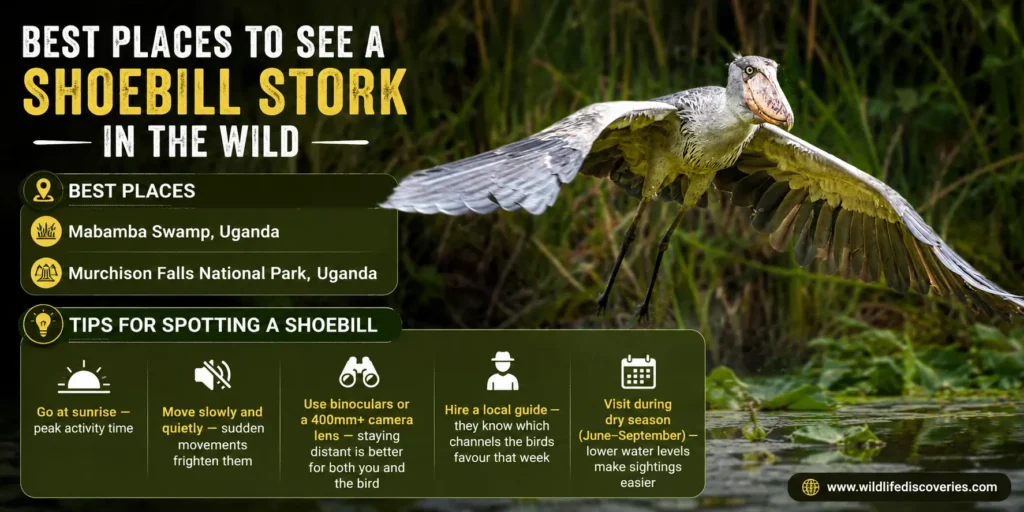
Mabamba Swamp, Uganda is widely considered the single best location on Earth to see a wild shoebill. Success rates here are exceptionally high, often exceeding 80 percent. The swamp sits just one hour from Entebbe International Airport making it a realistic day trip.
Murchison Falls National Park, Uganda offers boat safaris along the Nile Delta where shoebills hunt along the banks. Shoebills are most active in the early morning, so visits at sunrise give the best chance to see them hunting and moving through the water.
Tips for spotting a shoebill:
- Go at sunrise — peak activity time
- Move slowly and quietly — sudden movements frighten them
- Use binoculars or a 400mm+ camera lens — staying distant is better for both you and the bird
- Hire a local guide — they know which channels the birds favour that week
- Visit during dry season (June–September) — lower water levels make sightings easier
Full location guide: Where Do Shoebill Storks Live? Habitat & Location Guide
Shoebill Stork Conservation Status
The shoebill stork is listed as Vulnerable on the IUCN Red List. There are only about 5,000–8,000 shoebills left in the wild a critically small number for a species of this size and ecological importance.
Why is the shoebill endangered?
- Habitat destruction — freshwater swamps are being drained for agriculture and cattle grazing at an accelerating rate
- Illegal capture — shoebills are sold into the exotic pet trade, fetching high prices in private collections
- Human disturbance — fishermen and farming activities disturb nesting sites
- Climate change — shifting rainfall patterns are altering wetland ecosystems across Central Africa
Recovery is slow: females lay only 2–3 eggs per breeding season, and both parents must guard the nest continuously against predators and heat. Chick survival rates are low.
The good news: eco-tourism in Uganda has created genuine economic incentives to protect shoebill habitat. Local communities that run guided canoe tours benefit directly from the bird’s survival — a model that wildlife conservationists point to as one of Africa’s more successful community-driven conservation stories.
Learn more: Shoebill Stork Conservation: Is It Endangered?
Broader context: Why Is Wildlife Conservation Important? | What Can We Do to Protect Endangered Animals?
12 Incredible Shoebill Stork Facts
- Its scientific name Balaeniceps rex translates to “whale-headed king”
- It can stand completely motionless for hours while hunting — a patience no human photographer can match
- It was only scientifically described in the 1850s — remarkably recent for a bird this large
- Its call sounds like a machine gun — a loud, rapid bill-clattering used for communication
- Baby chicks hatch with a temporary blue-grey bill that turns grey-yellow as they mature
- It is strictly solitary — adults only tolerate each other during breeding season
- Uganda’s famous “Sushi” the shoebill greets visitors who bow — and bows back
- It has one of the slowest wingbeat rates of any large flying bird
- The shoebill’s eye colour changes from grey-blue in juveniles to striking yellow in adults
- They regulate body temperature by flapping their wings like a fan — called “gular fluttering”
- A shoebill can go days without eating after a large lungfish meal
- Despite weighing up to 7 kg, they can walk on floating papyrus mats without sinking — thanks to their enormous, spread-out feet
Frequently Asked Questions
Is a shoebill stork actually a stork?
No. Despite the name, the shoebill belongs to the order Pelecaniformes — making it more closely related to pelicans and herons. It was reclassified after DNA analysis revealed it was genetically distinct from true storks.
How tall is a shoebill stork compared to a human?
A fully grown shoebill stands 4–5 feet (1.2–1.5 m) tall — roughly the height of an average 10-year-old. When one looks at you, it is looking you directly in the eye.
Can a shoebill stork kill a human?
No shoebill has ever been documented killing a human. Their bill is powerful enough to break bones, but they are not aggressive toward people unless directly threatened or cornered. In the wild, the risk to humans is essentially zero.
What is special about a shoebill stork’s bill?
It is the third longest bill of any bird — around 24 cm long with a razor-sharp hooked tip. The shoebill uses it to catch, decapitate, and swallow large prey including lungfish, water snakes, and baby crocodiles.
How many shoebill storks are left in the wild?
The IUCN estimates 5,000–8,000 individuals remain. Numbers are declining due to habitat loss, illegal capture, and human disturbance near nesting sites.
Where is the best place in the world to see a shoebill stork?
Mabamba Swamp in Uganda, located one hour from Entebbe International Airport. Success rates for sightings exceed 80%, making it the most reliable location globally.
Do shoebill storks eat crocodiles?
They eat baby crocodiles — young individuals small enough to fit in their bill. Adult crocodiles are not prey. This behaviour highlights the shoebill’s position as an apex predator within its wetland ecosystem.
Sources: IUCN Red List (Balaeniceps rex assessment), Animal Diversity Web – University of Michigan, Uganda Wildlife Authority, Follow Alice Wildlife Guide (2026)