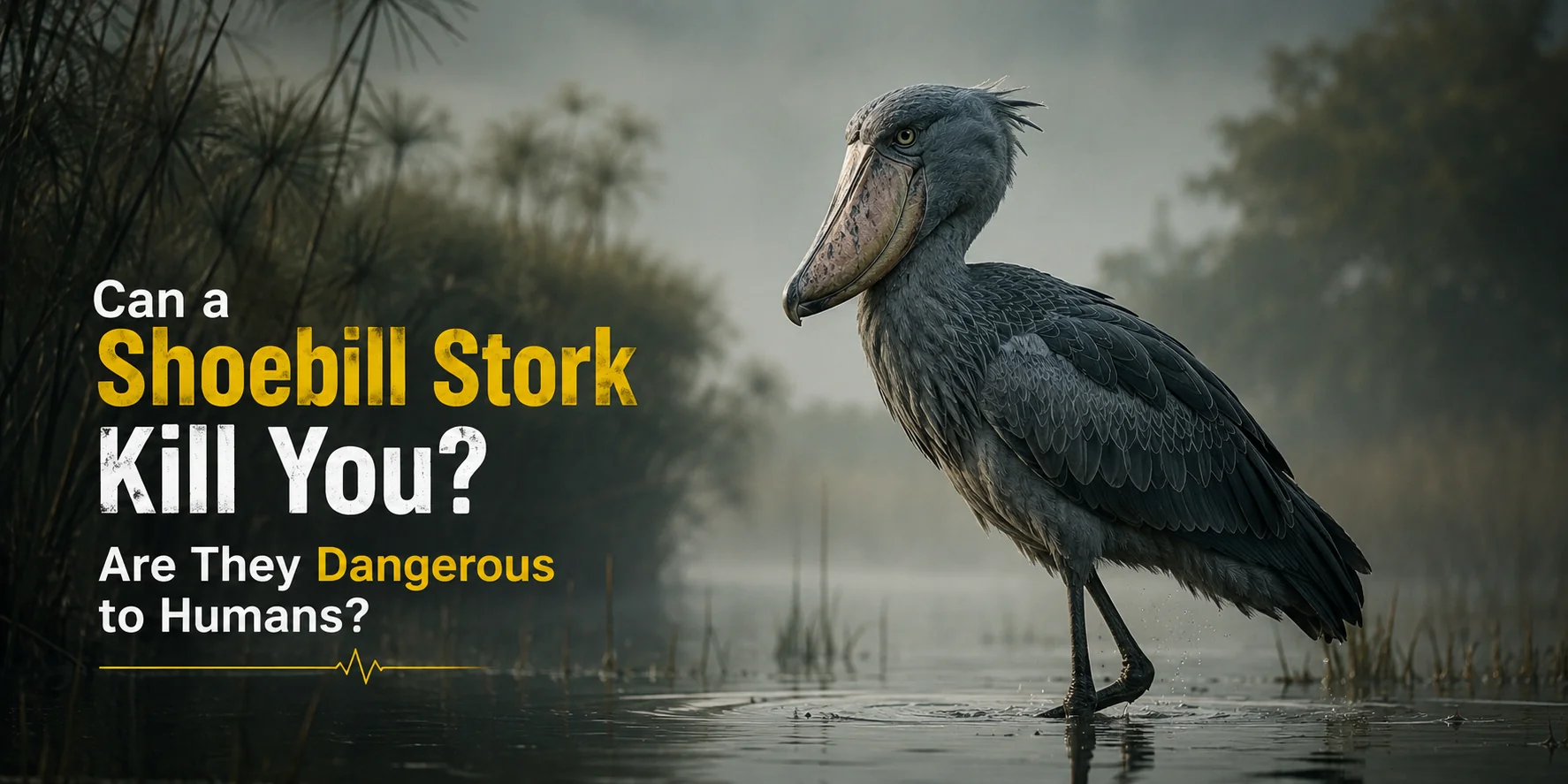
Can a Shoebill Stork Kill You?
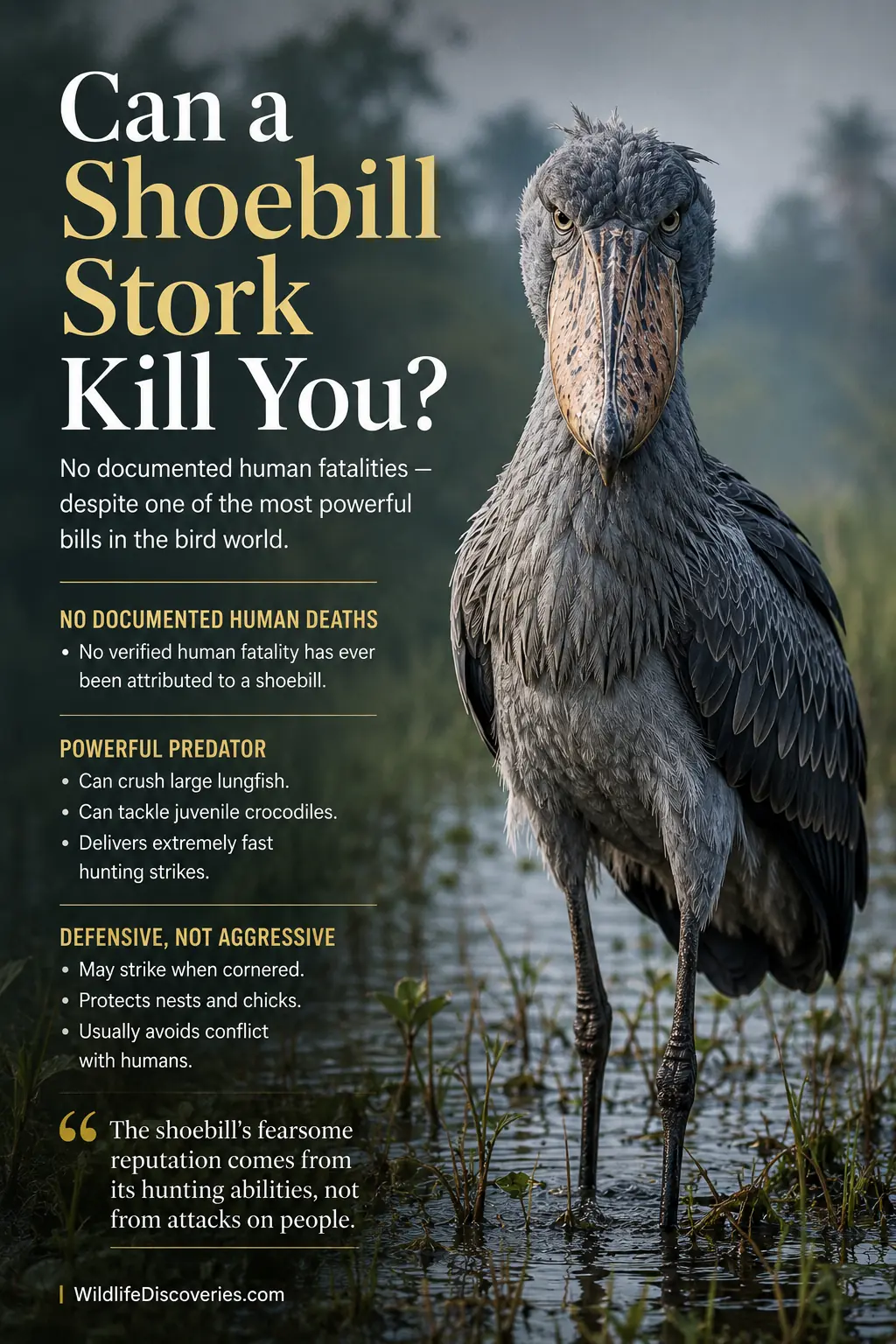
No — a shoebill stork has never killed a human being. But that answer deserves a lot more detail.
Because while no shoebill has ever caused a human fatality, this bird is a 5-foot apex predator with a beak powerful enough to decapitate a baby crocodile in a single snap. Zookeepers wear thick protective gloves around them. Researchers have sustained serious injuries from defensive strikes. And in the wild, they are completely fearless — they have been documented standing their ground against charging crocodiles and large antelopes without flinching.
So the question isn’t really can a shoebill stork kill you. The real question is: what is this bird actually capable of — and under what circumstances does it become dangerous?
That’s exactly what this guide breaks down.
Quick Answer: Danger Level at a Glance
| Scenario | Danger Level | Notes |
|---|---|---|
| Wild shoebill, no approach | 🟢 None | They ignore humans unless disturbed |
| Approaching in the wild | 🟡 Low | May charge if near nest; retreats first |
| Cornered or threatened | 🟠 Moderate | Will strike defensively; injuries possible |
| Captive feeding (handler) | 🔴 High | Multiple documented injuries in zoos |
| Nesting season disturbance | 🟠 Moderate | Highly territorial; may attack |
| Child or small person | 🟠 Moderate | Eye-level contact; more intimidating |
The Shoebill’s Physical Capabilities: What It Can Actually Do
Before answering the danger question, you need to understand what you’re dealing with.
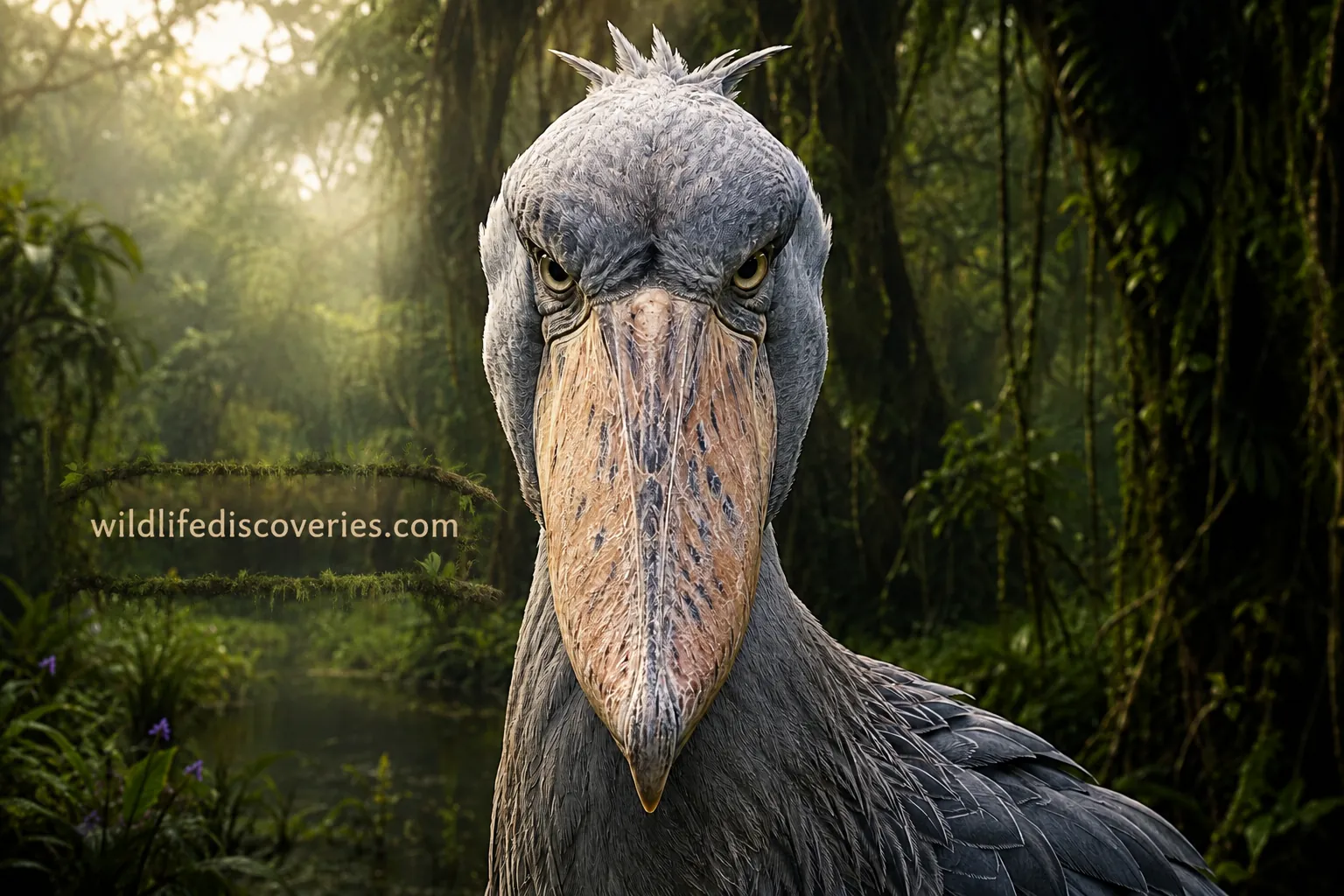
The shoebill stork (Balaeniceps rex) stands up to 5 feet tall and weighs up to 7 kg (15 lbs). That alone makes it one of the largest birds on Earth. But its most dangerous feature isn’t its size — it’s its bill.
The Bill: Nature’s Most Underrated Weapon
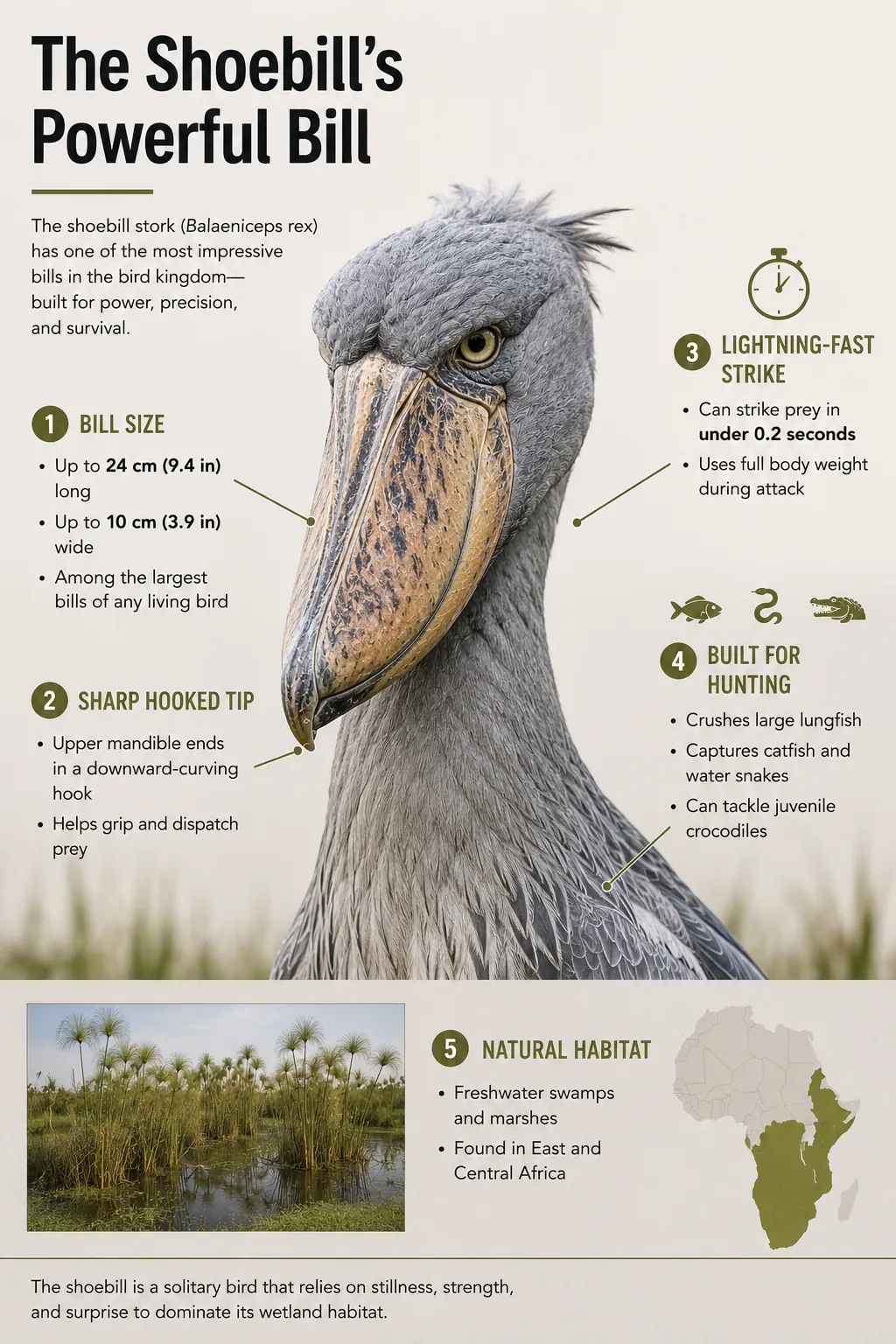
The shoebill’s bill measures up to 24 cm (9.4 inches) long and 10 cm (3.9 inches) wide — making it the third longest bill of any living bird, and the widest in circumference of any bird alive today. The upper mandible ends in a downward-curving razor-sharp hook, designed for one purpose: killing prey instantly.
What makes it genuinely alarming is the striking speed. When a shoebill hunts, it lunges from a standing position and makes contact with prey in under 0.2 seconds — faster than most animals can register a threat. The entire body weight of the bird drives the strike forward.
The bill’s edges function like biological scissors — sharp enough to slice through thick fish bones, tough crocodile skin, and the skulls of large lungfish in a single motion.
Key fact: The shoebill routinely decapitates fish before swallowing them to prevent fins and bones from injuring its throat. That same bill, applied to a human hand or arm, would cause severe lacerations at minimum.
Strength That Scientists Struggle to Quantify
Precise bite force data for the shoebill is not available — the bird’s beak operates more like a slicing instrument than a crushing jaw, making standard PSI measurements difficult to apply. What researchers have documented is this: the shoebill can crush the skulls of large lungfish (which grow up to 6 feet long), pin struggling monitor lizards, and dismember juvenile crocodiles — all with a single strike.
For comparison, the beak pressure generated by large herons — close relatives of the shoebill — has been measured at several hundred PSI. The shoebill, being significantly larger and more powerfully built, is believed to exceed this substantially, though no peer-reviewed measurement exists.
Has a Shoebill Stork Ever Attacked a Human?
Yes — but exclusively in captive settings, and never fatally.
Incidents have occurred where handlers were injured during feeding or enclosure cleaning. One notable case in a European zoo involved a keeper sustaining a fractured finger after misjudging the bird’s reaction time. In 2019, a shoebill at San Diego Zoo Safari Park made headlines after a confrontation with a keeper was captured on video — the bird lunged aggressively and had to be redirected. No serious injuries were reported in that case.
Wildlife researchers note that shoebills are fearless when it comes to confrontation, and will engage fully when the need to attack arises — whether against another shoebill, another bird species, or larger animals such as crocodiles, antelopes, or monitor lizards.
In the wild, however, unprovoked attacks on humans are essentially unheard of. Despite various scenarios where they might pose a threat, attacks on humans by shoebills are exceedingly rare, and there are no documented cases of a shoebill killing a person.
The pattern is consistent: wild shoebills tolerate human presence when approached calmly and respectfully. The danger increases sharply in captive settings, during nesting season, or when a bird feels cornered.
When Could a Shoebill Stork Be Dangerous?
There are specific scenarios where a shoebill could pose a genuine threat to humans. Here they are in order of likelihood:
1. Near a Nest During Breeding Season
This is the highest-risk scenario. Shoebill storks are intensely territorial around their nests and will charge intruders — human or animal — that come too close. They lay only 2–3 eggs per season, and both parents guard the nest ferociously. A charging shoebill is not bluffing. Wildlife researchers who have studied nesting sites consistently warn that getting within 10–15 meters of an active nest is genuinely dangerous.
2. Captive Individuals During Feeding
Zookeepers handling shoebills wear thick gloves and maintain strict protocols to avoid injury. Juvenile shoebills raised in captivity are particularly unpredictable — they lack the social conditioning that wild birds develop and may strike without the warning signals that experienced handlers watch for.
3. If Cornered or Directly Threatened
If a shoebill feels cornered or threatened, it may react defensively. This reaction is rare, as the bird’s first instinct is usually to fly or walk away. However, a shoebill could use its powerful beak to defend itself if necessary — the beak is strong enough to break bones or inflict serious injuries.
4. Juvenile Birds in Captivity
Juvenile shoebills, especially those raised in captivity, might not yet fully understand boundaries. Their natural instincts to grab or peck could inadvertently cause injury if they interact with humans too closely.
What About in the Wild? The “Sushi” Effect
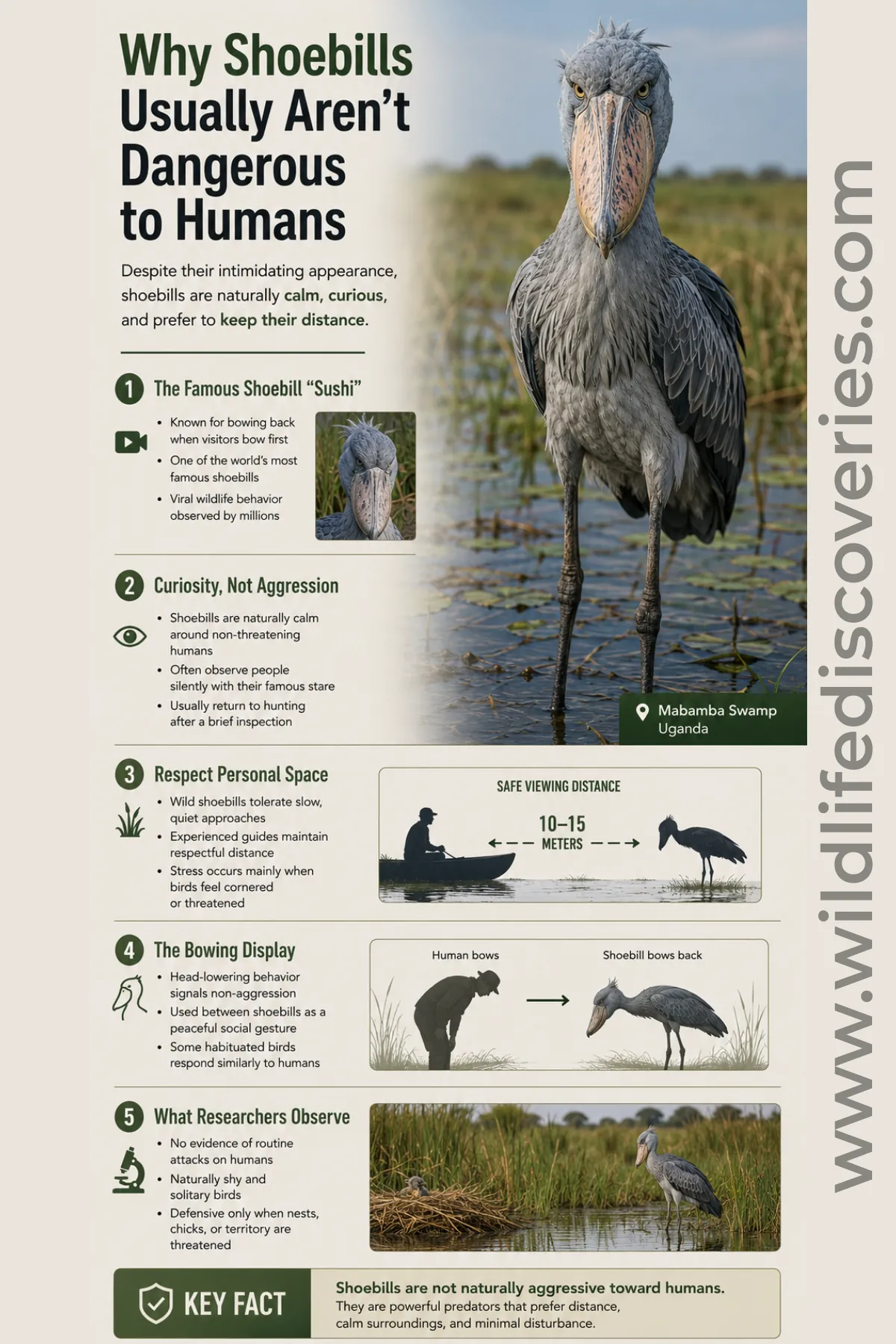
If you’ve spent any time on wildlife social media, you’ve likely seen the famous “Sushi” — the shoebill at Uganda Wildlife Education Centre who bows to visitors who bow to him first. The video has tens of millions of views.
What Sushi demonstrates perfectly is the shoebill’s default disposition toward humans in non-threatening situations: curiosity, not aggression.
Wild shoebills encountered during properly guided canoe safaris in Uganda’s Mabamba Swamp behave similarly. Experienced guides report that birds will allow boats to come within 10–15 meters without showing stress, as long as movements are slow and the approach is calm. The birds often simply stare — that famous unblinking gaze — before returning to hunting.
The “bowing ritual” observed with Sushi and other habituated shoebills is believed to be a form of appeasement display — the same head-lowering behaviour they use with other shoebills to signal non-aggression. When humans bow and the bird bows back, it appears to be responding to a recognized social signal.
This tells us something important: the shoebill is not instinctively aggressive toward humans. It is simply a large, powerful predator with a very low threshold for defending its personal space.
Shoebill vs. The World’s Actually Dangerous Birds
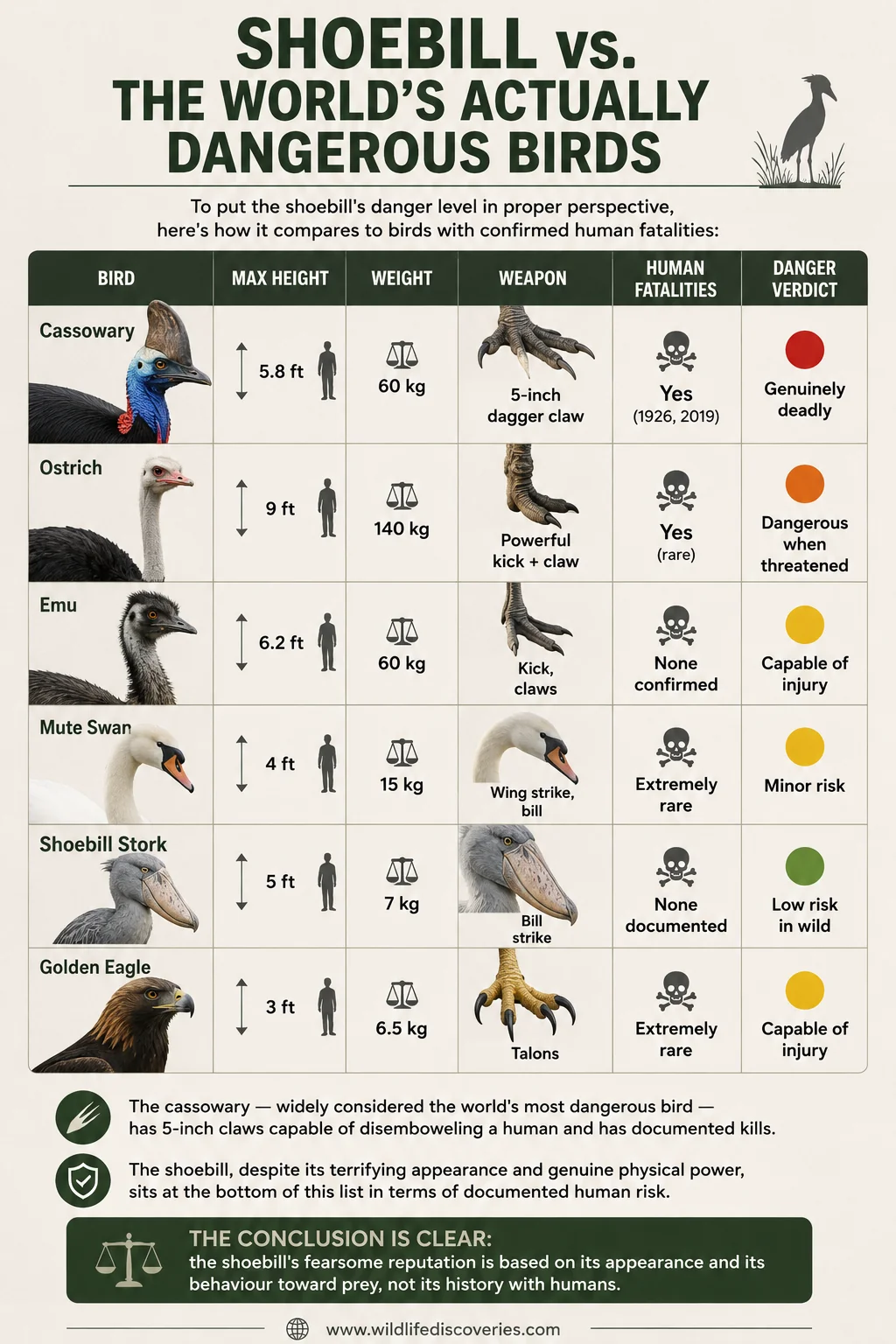
To put the shoebill’s danger level in proper perspective, here’s how it compares to birds with confirmed human fatalities:
| Bird | Max Height | Weight | Weapon | Human Fatalities | Danger Verdict |
|---|---|---|---|---|---|
| Cassowary | 5.8 ft | 60 kg | 5-inch dagger claw | Yes (1926, 2019) | 🔴 Genuinely deadly |
| Ostrich | 9 ft | 140 kg | Powerful kick + claw | Yes (rare) | 🟠 Dangerous when threatened |
| Emu | 6.2 ft | 60 kg | Kick, claws | None confirmed | 🟡 Capable of injury |
| Mute Swan | 4 ft | 15 kg | Wing strike, bill | Extremely rare | 🟡 Minor risk |
| Shoebill Stork | 5 ft | 7 kg | Bill strike | None documented | 🟢 Low risk in wild |
| Golden Eagle | 3 ft | 6.5 kg | Talons | Extremely rare | 🟡 Capable of injury |
The cassowary — widely considered the world’s most dangerous bird — has 5-inch claws capable of disemboweling a human and has documented kills. The shoebill, despite its terrifying appearance and genuine physical power, sits at the bottom of this list in terms of documented human risk.
The conclusion is clear: the shoebill’s fearsome reputation is based on its appearance and its behaviour toward prey, not its history with humans.
Can You Keep a Shoebill Stork as a Pet?
No — and attempting to do so is both dangerous and illegal.
Shoebill storks are protected by international law under CITES Appendix II, have highly specialized dietary needs, and require vast, swampy habitats to thrive. Captive birds are typically housed only in large zoological institutions with the expertise and permits to care for them.
Many countries within their natural habitat have laws prohibiting the capture, possession, or trade of these birds. The penalties for illegally possessing a shoebill stork vary by jurisdiction but can include hefty fines, imprisonment, and confiscation of the bird.
Beyond legality, the practical challenges make private ownership impossible:
- Diet: They require live or freshly killed large fish — primarily African lungfish — daily. A single adult can consume up to 500g of fish per day.
- Space: They need vast wetland environments. A standard enclosure, even a large one, causes severe stress, leading to feather plucking, pacing, and shortened lifespan.
- Behaviour: The shoebill has never been domesticated. Its solitary nature, ambush hunting instincts, low breeding success, and need for large wetlands and live prey make domestication completely impractical.
- Danger to owner: A stressed captive shoebill is unpredictable. Its bill can fracture bones. There is no safe way for a private individual to manage this.
If you’re fascinated by shoebills — and who isn’t — the answer is to visit them in the wild. Uganda’s Mabamba Swamp offers some of the most reliable shoebill sightings on Earth, with success rates above 80%.
How to Safely Observe a Shoebill Stork in the Wild
If you’re planning a wildlife trip to see one of these extraordinary birds, follow these guidelines to stay safe and avoid disturbing them:
Before you go:
- Book with a licensed, experienced guide — solo observation in shoebill swamps is not advisable
- Choose Mabamba Swamp (Uganda) for the highest success rate, or Murchison Falls National Park for boat-based sightings
During observation:
- Move slowly and silently at all times — sudden movement triggers defensive behaviour
- Stay in your canoe or boat — do not wade into the water near a shoebill
- Maintain a minimum distance of 10–15 meters from any wild shoebill
- Never approach a nest — nesting birds are highly aggressive
- Do not make direct sustained eye contact — to the bird, this reads as a challenge
- If a shoebill lowers its head and flares its wings slightly, back away immediately — this is a warning display
For photographers:
- Use a 400mm+ lens — you can get excellent shots at safe distances
- Early morning (6–8 AM) is peak activity; birds are more alert and less tolerant mid-day
- Patience is everything — a shoebill can stand still for 40 minutes; so should you
For complete habitat and location details, read: Where Do Shoebill Storks Live? Habitat & Location Guide
The Verdict: Should You Be Afraid of a Shoebill Stork?
No — but you should respect it enormously.
The shoebill stork is not a bird that hunts humans or poses any natural threat to people who observe it responsibly. It is a solitary, patient, and largely unbothered predator that has coexisted with human communities in Central Africa for thousands of years without a single documented fatality.
What it is, without question, is one of the most powerful birds alive. Its bill can deliver bone-breaking strikes. Its hunting speed is faster than human reflex. In captivity, it has injured experienced keepers. And near its nest, it will charge without hesitation.
The appropriate response to a shoebill stork is not fear — it is the same quiet awe you’d give any apex predator in its environment. Observe from a respectful distance, follow your guide’s instructions, and let the bird do what it does best: stand perfectly still and wait.
Because few things in the natural world are as extraordinary as watching one of Earth’s last prehistoric birds hunt in absolute, unblinking silence.
Learn more about this remarkable species: Shoebill Stork: Facts, Size, Diet, Habitat & Complete Guide
Help protect birds like the shoebill: Why Is Wildlife Conservation Important | What Can We Do to Protect Endangered Animals.
Frequently Asked Questions
Can a shoebill stork kill a human?
No shoebill stork has ever been documented killing a human being. While physically capable of serious injury — their bill can fracture bones and deliver high-speed strikes — they are not aggressive toward humans by nature. In the wild, the risk to people is essentially zero.
Are shoebill storks dangerous?
In the wild, they pose very little danger to humans who observe them respectfully. The risk increases significantly in captive settings, near active nests, or if a bird is cornered. Zookeepers treat them as potentially dangerous animals and use protective equipment when handling them.
Has a shoebill stork ever attacked a human?
Yes — in captive settings. Incidents include a zoo keeper sustaining a fractured finger in a European zoo, and a filmed confrontation at San Diego Zoo Safari Park in 2019. Wild attacks on humans are essentially unrecorded.
How powerful is a shoebill stork’s beak?
Extremely powerful. The bill strikes at speeds under 0.2 seconds, can decapitate large fish and juvenile crocodiles, and has sharp edges that function like biological scissors. The bill length of up to 24 cm and width of 10 cm make it the widest bill in circumference of any living bird.
What should I do if I encounter a shoebill stork in the wild?
Stay calm, move slowly, maintain at least 10–15 meters distance, stay in your boat if on water, and never approach a nest. If the bird lowers its head and flares its wings, back away — that is a warning display. Most wild shoebills will simply stare and return to hunting.
Is a shoebill stork more dangerous than a cassowary?
No. The cassowary is widely considered the world’s most dangerous bird and has documented human fatalities. The shoebill, despite its fearsome appearance, has no recorded human kills and is docile in the wild compared to the cassowary.
Why does the shoebill stork bow?
The bowing behaviour is an appeasement display — the same signal shoebills use with each other to communicate non-aggression. Habituated birds like “Sushi” at Uganda Wildlife Education Centre appear to respond to human bowing as a recognized friendly signal, and bow in return.
Sources: IUCN Red List (Balaeniceps rex), BirdFact (Are Shoebills Dangerous, 2022), A-Z Animals (Shoebill Stork Facts), CITES Appendix II listing, Uganda Wildlife Education Centre





very good love it keep going
thank you ashish
very informative blog
thank you pranay