Are Bald Eagles Endangered? Current Status and Conservation Success
Most Recognised Birds of Prey in the World

Bald eagles are among the most recognised birds of prey in the world. With their white heads, dark brown bodies, powerful yellow beaks and impressive wingspans, these birds represent strength, freedom and courage. They are also the national bird of the United States. However, their history raises an important question: are bald eagles endangered today?
The direct answer is no. Bald eagles are no longer classified as endangered or threatened under the United States Endangered Species Act. They were officially removed from the federal list of threatened and endangered species in 2007 after decades of conservation work and population recovery. However, this does not mean they are completely free from danger or legal protection.
Today, the bald eagle is viewed as one of the greatest wildlife recovery stories in modern history. Its comeback demonstrates how environmental laws, scientific research, habitat protection and public awareness can save vulnerable species. It also explains why wildlife conservation remains important even after an animal’s population begins to recover.
Why Did Bald Eagles Become Endangered?
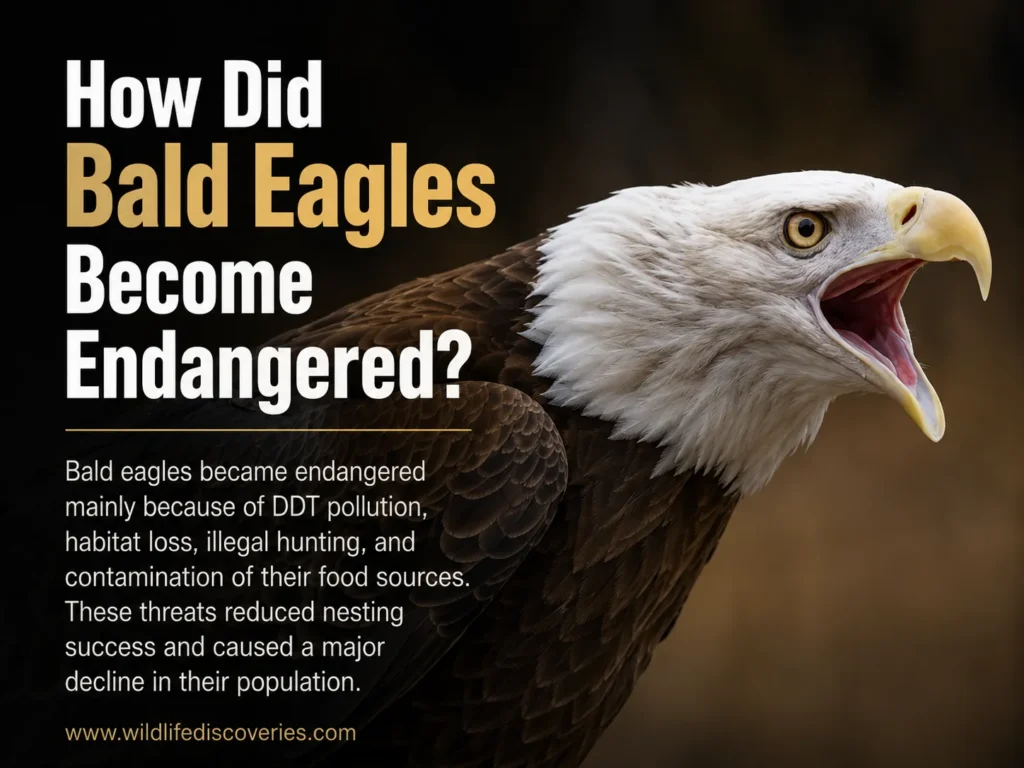
To understand are bald eagles endangered, it is necessary to look at the events that caused their earlier decline. Bald eagles were once common across North America, particularly near rivers, lakes, coastlines, wetlands and other areas with abundant fish.
During the nineteenth and twentieth centuries, their numbers began falling rapidly. Several human-created threats affected their ability to survive and reproduce.
Widespread Use of DDT
One of the most damaging factors was DDT, a synthetic pesticide widely used during the twentieth century. The chemical entered water bodies and accumulated in fish. Bald eagles then consumed contaminated fish, allowing harmful chemicals to build up inside their bodies.
DDT and its breakdown products interfered with calcium production, causing female eagles to lay unusually thin eggs. These fragile eggs frequently cracked during incubation, greatly reducing reproductive success.
The Environmental Protection Agency cancelled most uses of DDT in the United States in 1972. In the following years, bald eagle and other bird-of-prey populations gradually recovered, providing strong evidence that DDT had been a major cause of their decline.
Habitat Destruction
Bald eagles require suitable nesting trees, relatively undisturbed breeding areas and reliable food sources. The clearing of forests and trees, expansion of cities, construction near waterways and destruction of wetlands removed many of their traditional nesting and feeding sites.
Large, mature trees are especially important because bald eagle nests can be enormous and may be reused for many years. When these trees are cut down, breeding pairs may struggle to find safe alternatives.
Illegal Hunting and Shooting
Bald eagles were historically shot because some people mistakenly believed they posed a serious threat to livestock, game animals or commercial fisheries. Others killed them for feathers, trophies or sport.
These actions reduced adult populations and disrupted breeding pairs. Since bald eagles usually produce only a small number of young each year, the loss of mature adults can significantly affect a local population.
Contaminated Food Sources
Pollution does not always kill bald eagles immediately. Toxic substances may move through the food chain and slowly affect their health, behaviour and reproductive ability.
Because bald eagles often feed on fish and carrion, they are vulnerable to contaminants present in water, prey animals and animal remains. Their position as an apex predator makes them valuable indicators of environmental health.
How Serious Was the Decline?
Therefore, those wondering are bald eagles endangered should understand that this concern comes from a genuine historical crisis, and without strong environmental action, the species might never have achieved its remarkable recovery.
How Bald Eagles Made a Remarkable Recovery?
The recovery of the bald eagle did not happen because of one action alone. It resulted from several coordinated efforts involving environmental agencies, scientists, conservation organisations, lawmakers and local communities.
Ban on DDT
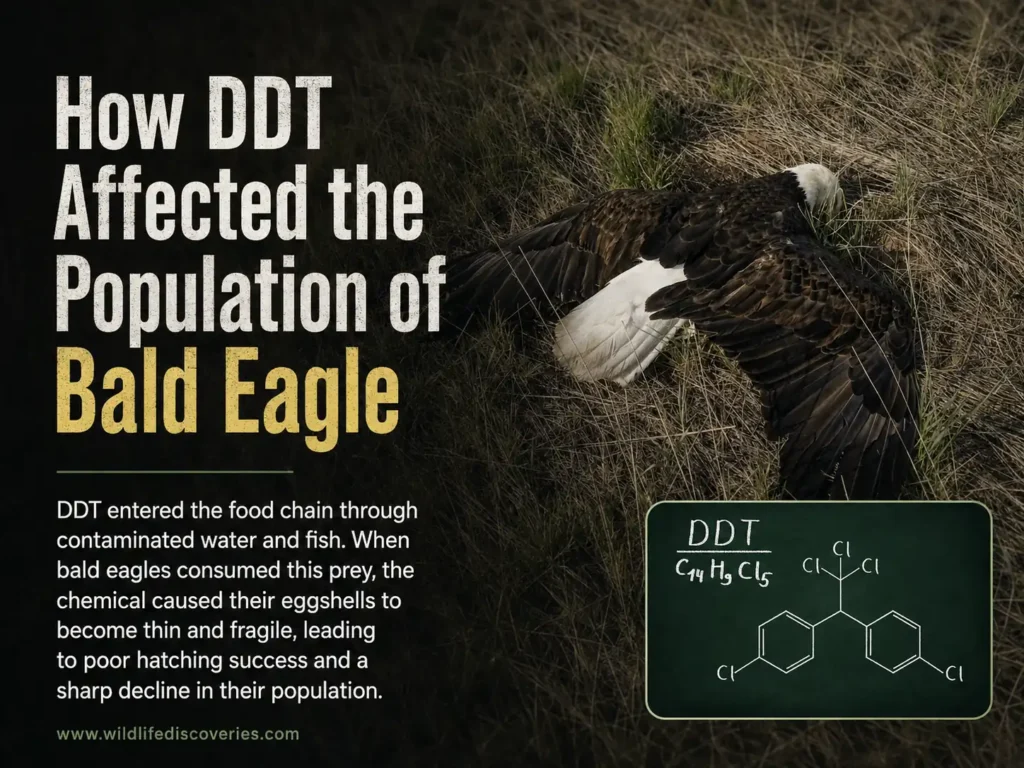
The 1972 restriction on most uses of DDT was a turning point. As the amount of contamination in the environment gradually declined, bald eagle eggshells became stronger and more chicks survived.
The DDT ban did not produce an immediate recovery, as persistent chemicals remained in ecosystems for years. Nevertheless, breeding success improved over time, allowing populations to expand into areas where bald eagles had disappeared.
Protection Under the Endangered Species Act
The Endangered Species Act of 1973 provided a stronger legal framework for protecting vulnerable species and their habitats. Bald eagles received protection that supported recovery planning, habitat management, monitoring and enforcement against harmful activities.
This legislation helped answer the question to “are bald eagles endangered” at a time when the answer was genuinely alarming. It also created a structured process through which the species could eventually recover.
Nest and Habitat Protection
Wildlife authorities identified important nesting, feeding and wintering areas. Restrictions and guidelines were introduced to reduce disturbances near active nests.
Protecting waterways, wetlands and mature trees helped ensure that bald eagles had access to both food and secure nesting locations. This demonstrates why protecting forests and trees is closely connected to the survival of birds, mammals and countless other organisms.
Captive Breeding and Reintroduction
In some areas, conservationists used captive breeding, relocation and reintroduction programmes to rebuild local populations. Young eagles were carefully raised and released into suitable habitats.
Artificial nesting platforms were also installed where natural nesting sites were limited. These measures helped establish new breeding populations and increased the species’ geographic distribution.
Public Awareness and Community Participation
Public attitudes towards birds of prey also improved. Educational campaigns helped people understand the ecological importance of bald eagles and the consequences of shooting, poisoning or disturbing them.
The recovery supports the principles of animal rights and responsible human behaviour. Wild animals should not be harmed simply because they are misunderstood or considered inconvenient.
It also connects with animal welfare, which encourages people to reduce unnecessary suffering and prevent harmful interactions with wildlife.
Are Bald Eagles Still Protected by Law?
The answer to are bald eagles endangered is no at the US federal level, but bald eagles remain strongly protected by law. Removal from the endangered species list did not remove every legal safeguard.
Bald and Golden Eagle Protection Act
The Bald and Golden Eagle Protection Act prohibits unauthorised activities involving bald eagles and golden eagles. It protects living and dead birds as well as their parts, feathers, eggs and nests.
Under this law, people generally cannot:
- Kill, capture, shoot or poison a bald eagle.
- Possess an eagle or its body parts without authorisation.
- Collect eagle feathers, eggs or nests.
- Sell, purchase, barter, import or export protected eagle items.
- Disturb eagles in a way that interferes with breeding, feeding or sheltering.
- Remove or destroy a nest without an appropriate permit.
Eagle nests are protected even when they are not actively being used. They cannot legally be removed, destroyed, moved or obstructed without official permission.
Migratory Bird Treaty Act
Bald eagles also receive protection under the Migratory Bird Treaty Act. This law protects many native migratory birds from unauthorised capture, killing, possession and trade.
State and local regulations may provide additional safeguards. Protection can therefore vary depending on the location and activity involved.
Current Threats Facing Bald Eagles
Although the population has increased greatly, bald eagles still face several dangers. Their recovery should not create a false sense of permanent security.
Habitat Loss and Human Development
Residential construction, industrial development, logging and recreational activity can reduce nesting habitat. Development near rivers and lakes may also increase noise and human presence around feeding areas.
Responsible land-use planning is therefore an essential part of wildlife conservation.
Lead Poisoning
Bald eagles may consume fragments of lead ammunition when feeding on animals or remains left by hunters. Even a small amount of lead can damage the nervous and digestive systems.
Using non-lead ammunition and disposing of animal remains responsibly can reduce this risk.
Collisions and Electrocution
Bald eagles may collide with vehicles while feeding on roadkill. They can also strike power lines, communication structures, buildings or energy infrastructure.
Poorly designed electrical equipment may cause electrocution when an eagle touches two energised components at the same time.
Water Pollution
Because fish form a major part of the bald eagle’s diet, polluted rivers, lakes and coastlines can expose the birds to harmful chemicals.
Healthy aquatic ecosystems support healthy eagle populations. Controlling industrial waste, agricultural runoff, plastic pollution and toxic substances benefits both wildlife and people.
Human Disturbance
Repeated human activity close to a nest can cause adult eagles to temporarily leave their eggs or chicks, which is why people asking “are bald eagles endangered” should also understand that severe or prolonged disturbance may contribute to nest failure.
People should observe bald eagles from a respectful distance and follow official guidance near nesting areas. This is a practical way to take care of animals without attempting to touch, feed or interfere with them.
Bald Eagle Population and Future Conservation
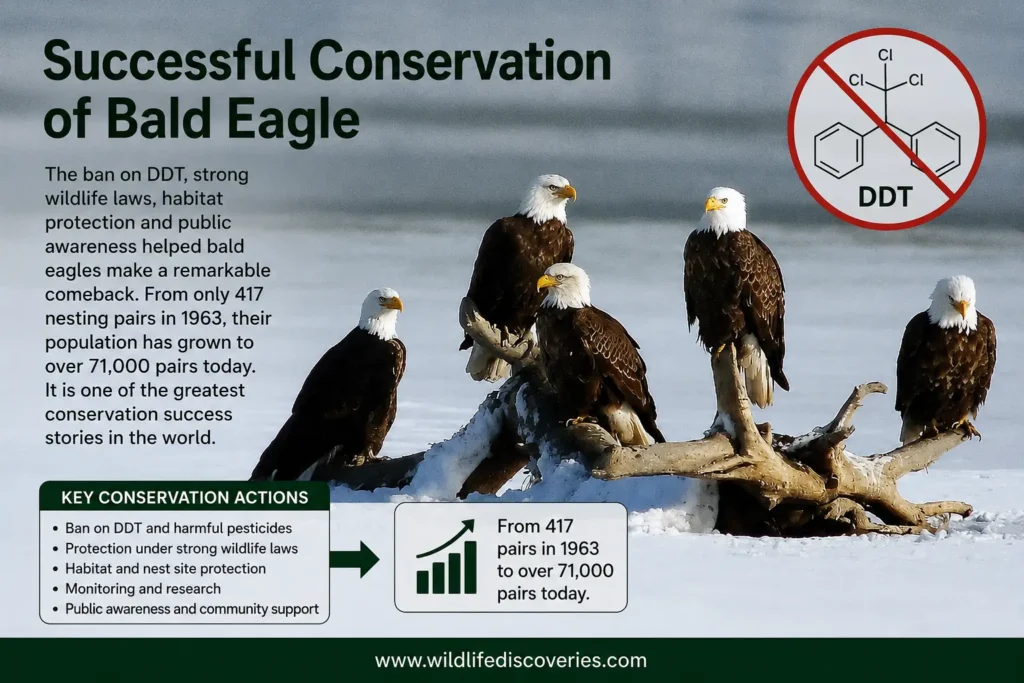
The latest nationwide estimate published by the U.S. Fish and Wildlife Service reported approximately 316,700 individual bald eagles and 71,400 nesting pairs in the lower 48 states. The estimate showed that the population had quadrupled compared with the previous set of data collected in 2009.
This is an extraordinary improvement from the 417 known nesting pairs recorded in 1963. However, population growth does not mean monitoring should stop.
How Can People Help Bald Eagles?
Individuals can support bald eagle conservation by:
- Protecting mature trees and natural nesting habitats.
- Keeping rivers, lakes and wetlands free from pollution.
- Avoiding unnecessary activity near nests.
- Driving carefully in areas where eagles feed on roadkill.
- Reporting injured or dead eagles to authorised wildlife agencies.
- Never collecting feathers, eggs or nest material.
- Supporting responsible environmental organisations.
- Learning about endangered animals and the threats affecting them.
- Encouraging authorities and landowners to preserve natural habitats.
- Following wildlife laws and official viewing guidelines.
People interested in eagle biology may also explore how long do bald eagles live. Bald eagles can live for decades in the wild, meaning the safety of mature adults is particularly important for long-term breeding success. The U.S. Fish and Wildlife Service notes that they may live for around 30 years in the wild and longer in captivity.
Can Bald Eagles Become Endangered Again?
Yes, it is possible. Any recovered species could decline again if major threats return or new threats become severe.
A future decline could be caused by:
- Large-scale habitat destruction.
- New toxic chemicals entering food chains.
- Reduced availability of fish and other prey.
- Weak enforcement of wildlife laws.
- Increased illegal killing or poisoning.
- Widespread disease.
- Major environmental and climatic changes.
This is why the question are bald eagles endangered must be reviewed through continued research rather than answered once and forgotten.
Key Takeaways
- Bald eagles are not currently classified as endangered or threatened under the US Endangered Species Act.
- They were officially removed from the federal endangered and threatened species list in 2007.
- Habitat destruction, illegal shooting and DDT contamination caused their historical decline.
- Only 417 known nesting pairs were recorded in the lower 48 states in 1963.
- The latest published nationwide estimate reported 316,700 bald eagles and 71,400 nesting pairs in the lower 48 states.
- Bald eagles remain protected under major federal wildlife laws.
- Their nests, eggs, feathers and body parts are legally protected.
- Habitat loss, lead poisoning, pollution, collisions and disturbance remain significant concerns.
- Continued conservation is necessary to prevent another population decline.
- The bald eagle’s recovery shows how collective environmental action can save vulnerable wildlife.
Frequently Asked Questions (FAQs)?
1. Are bald eagles endangered in 2026?
No. Bald eagles are not federally classified as endangered or threatened in the United States. They were removed from the Endangered Species Act list in 2007 after their population recovered. They nevertheless remain protected under other federal laws.
2. Why were bald eagles endangered in the past?
Their decline was caused mainly by habitat destruction, illegal shooting and contamination from DDT. DDT accumulated in the food chain and caused eggshell thinning, which reduced the number of chicks that successfully hatched.
3. How many bald eagles are there?
The most current nationwide estimate published by the U.S. Fish and Wildlife Service reported approximately 316,700 individual bald eagles, including around 71,400 nesting pairs, in the lower 48 states.
4. Is it legal to keep a bald eagle feather?
For most people, possessing a bald eagle feather without legal authorisation is prohibited, and although many wonder “are bald eagles endangered” the species and its parts—including feathers, eggs and nests—remain protected under federal law. Anyone who finds a feather should not assume that it is legal to keep it.
5. What should people do if they see a bald eagle nest?
People asking “are bald eagles endangered” should remember to maintain a safe distance from nests, avoid loud activity and never attempt to touch, move or inspect them. Disturbing or removing a bald eagle nest without authorisation may violate federal law, so any concerns should be reported to the relevant wildlife authority.


that was very informative loved reading it
It was so amazing to read and know about this beautiful bird. Loved it!!