International Whale Shark Day 2026: Date, History, Facts
International Whale Shark Day 2026: Date, History, Facts & How to Celebrate the Ocean's Gentle Giant

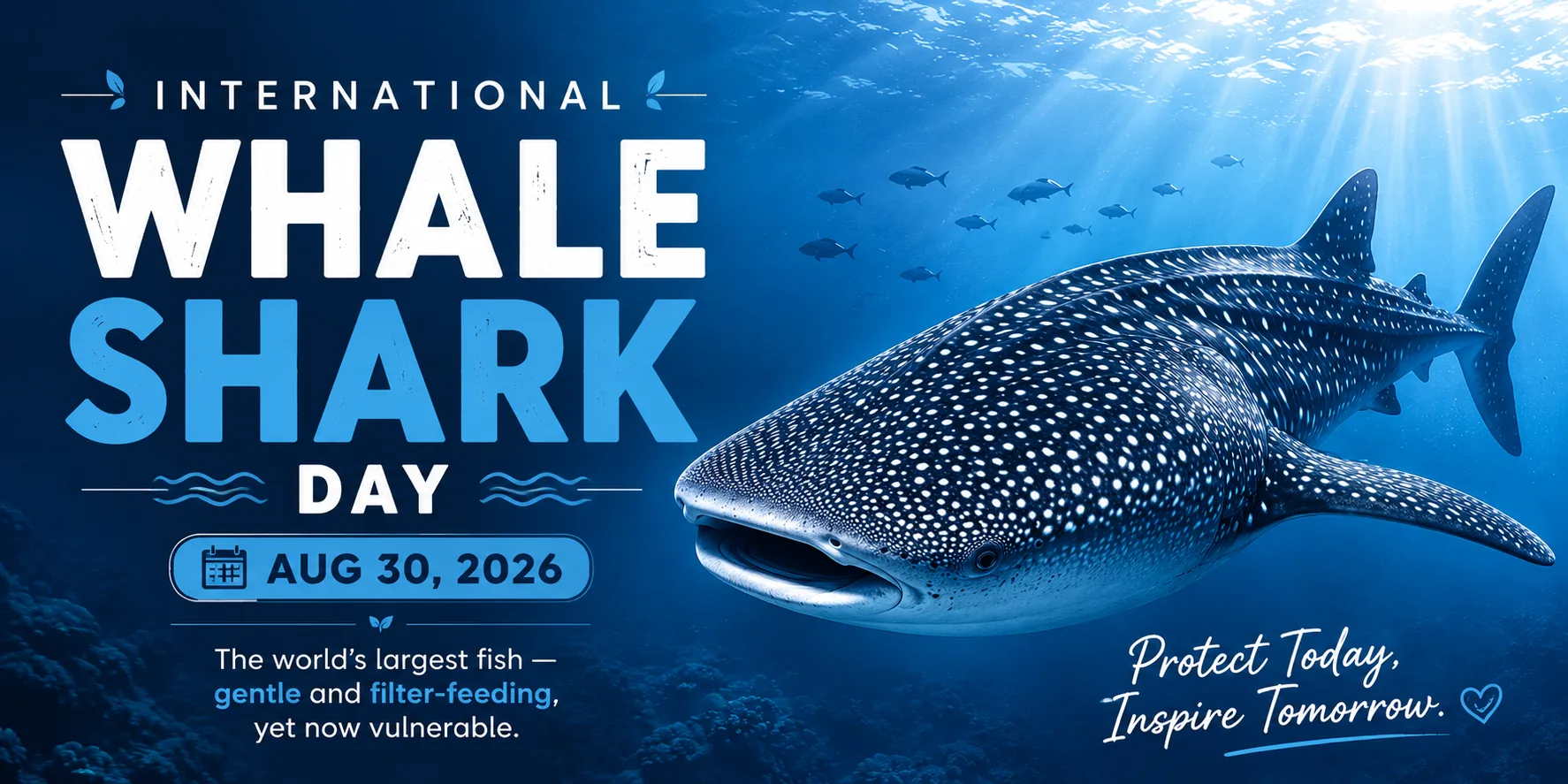
Every year on August 30, ocean lovers, marine biologists, aquariums, and conservation groups around the world come together to observe International Whale Shark Day. It’s a day built around one simple goal: getting more people to fall in love with the largest fish in the sea before it’s too late to save it.
If you’ve ever typed “when is International Whale Shark Day” into a search bar, or wondered why an entire day is dedicated to a single species of shark, this guide covers everything — the origin story, the science, the numbers researchers have spent decades collecting, and practical ways you can mark the occasion yourself.
When Is International Whale Shark Day?
International Whale Shark Day falls on August 30 every year, without exception. It’s a fixed-date observance, not a “third Saturday of the month” kind of holiday, which makes it easy to plan around. So International Whale Shark Day 2026 lands on Sunday, August 30, 2026 — and if you’re reading this in a different year, the date stays the same; only the day of the week changes.
You may also see the occasion written simply as Whale Shark Day, National Whale Shark Day, or even World Whale Shark Day in different countries. These are, in practice, the same celebration — a global rather than a single-nation observance — just referred to slightly differently depending on the source, the region, or the organization promoting it.
The History Behind International Whale Shark Day
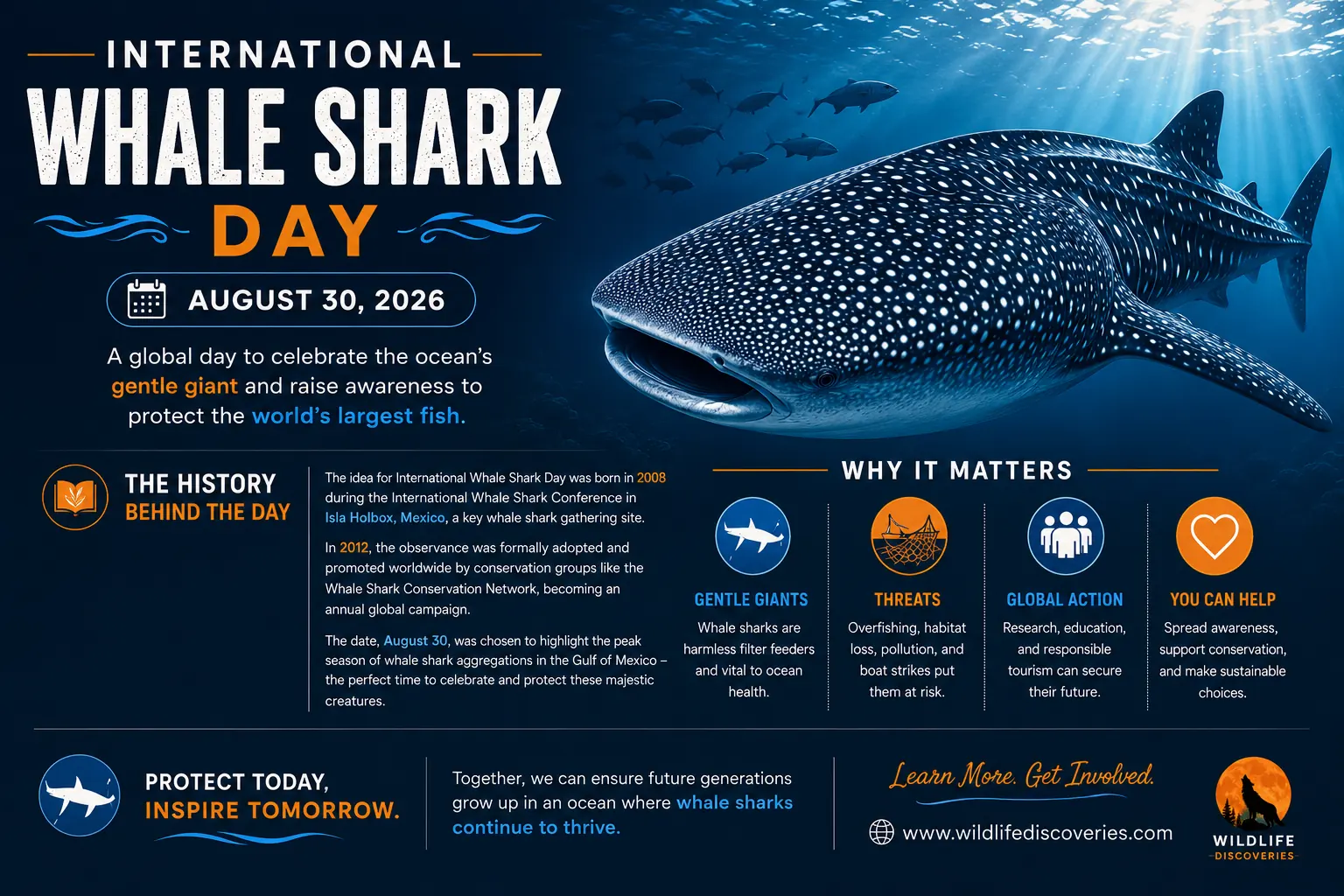
The story most widely cited traces back to 2008, at the International Whale Shark Conference held in Isla Holbox, Mexico — a small island off the Yucatán Peninsula that happens to sit near one of the largest seasonal gatherings of whale sharks on the planet. More than 40 marine biologists, shark researchers, and ocean conservationists attended, and out of that meeting came a shared decision: the world needed a dedicated day to spotlight whale sharks and the mounting threats to their survival.
You’ll also find some calendars and conservation pages dating the formal creation of the observance to 2012, sometimes crediting groups like the Whale Shark Conservation Network for popularizing it as an annual awareness campaign. The discrepancy isn’t really a contradiction — the Isla Holbox meeting planted the idea, and it took a few more years for the day to be formally adopted, promoted, and repeated annually until it became the internationally recognized event it is today.
What’s consistent across every source is the date itself: August 30, chosen specifically because it falls during the peak whale shark aggregation season in the Gulf of Mexico, when hundreds of these animals gather to feed near the surface — making it the perfect symbolic moment to talk about them.
Since then, International Whale Shark Day has grown from a niche marine-biology observance into a genuinely global campaign, backed by aquariums, universities, dive operators, and NGOs that use the day to publish new research, run public talks, and launch fundraising drives for whale shark protection.
Why International Whale Shark Day Matters
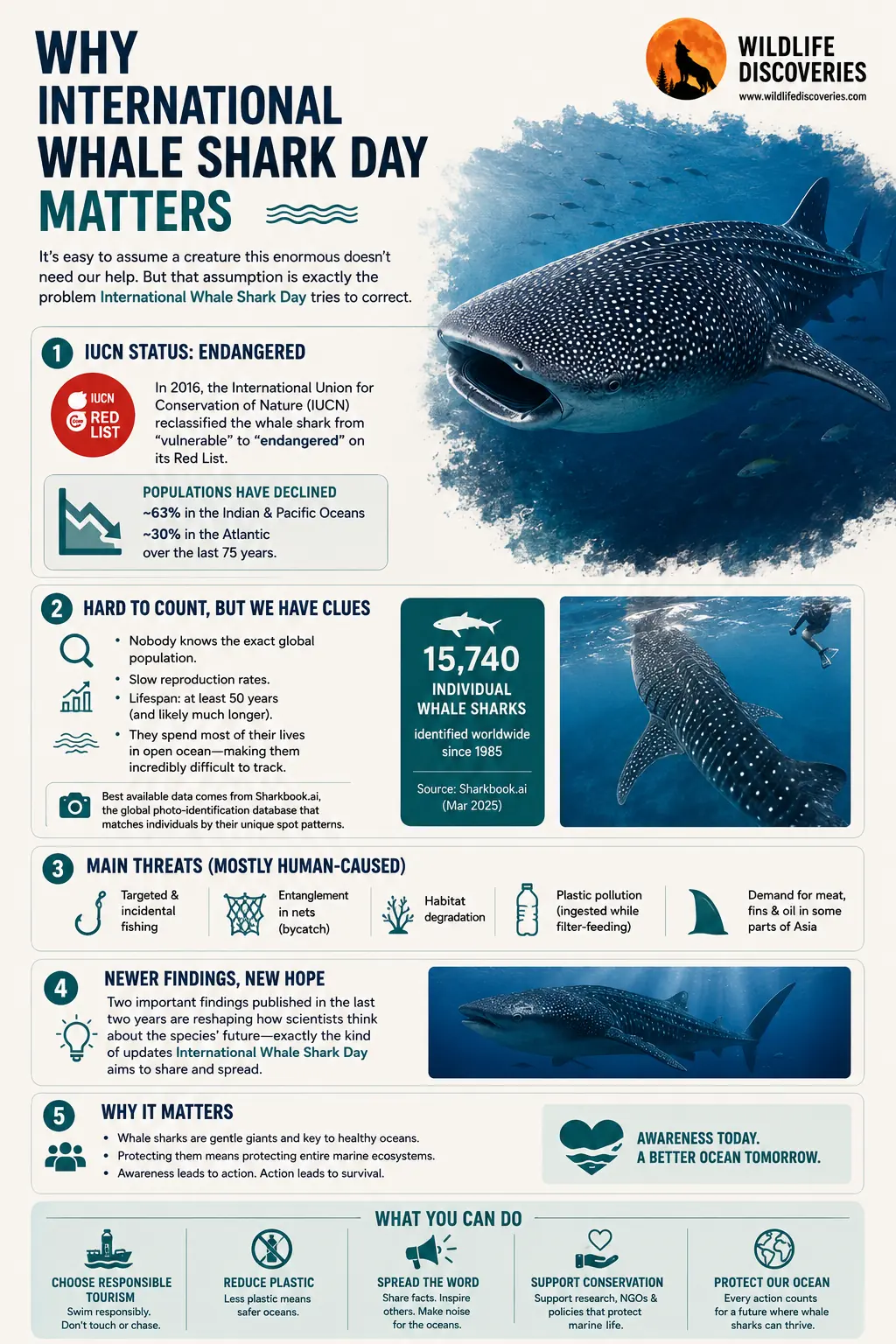
It’s easy to assume a creature this enormous doesn’t need our help. But that assumption is exactly the problem International Whale Shark Day tries to correct. In 2016, the International Union for Conservation of Nature (IUCN) reclassified the whale shark from “vulnerable” to “endangered” on its Red List — a formal acknowledgment that global populations have fallen sharply, with declines estimated at around 63% in the Indian and Pacific Oceans and over 30% in the Atlantic over the last 75 years.
Nobody knows the exact global population of whale sharks; slow reproduction rates, a lifespan that recent radiocarbon dating confirms can reach at least 50 years (and plausibly much longer), and the sheer difficulty of tracking an animal that spends most of its life in open ocean make an accurate census nearly impossible. The best available figure comes from Sharkbook.ai, the global photo-identification database researchers use to match individual whale sharks by their unique spot patterns: as of March 2025, 15,740 individual whale sharks had been identified worldwide since 1985 — not a full population estimate, but the clearest catalogue of known individuals science currently has.
What researchers do know is that the traditional threats are almost entirely human-caused: targeted and incidental fishing, entanglement in nets meant for other species (bycatch), habitat degradation, and plastic pollution that whale sharks accidentally ingest while filter-feeding. In parts of Asia, whale shark meat, fins, and oil have also historically been in demand, adding direct hunting pressure on top of everything else. But two newer findings, both published in the last two years, have reframed how scientists think about the species’ future — and both are exactly the kind of updates International Whale Shark Day is meant to spread.
The Shipping Collision Crisis
As oceans warm, whale sharks are being pushed out of their traditional equatorial range and into cooler waters — which increasingly puts them on a collision course with international shipping lanes. A 2024 study published in Nature Climate Change, which combined 15 years of satellite-tracking data from 348 whale sharks with global climate models and shipping-traffic maps, found that core whale shark habitat could shrink by more than 50% in some national waters by 2100 under a high-emissions scenario, with sharks shifting over 1,000 kilometers from their current range.
Because that shift pushes them straight into busy shipping corridors, the same study projected that whale sharks could become up to 15,000 times more likely to be struck by ships by 2100 compared with a lower-emissions future. Whale sharks are especially exposed because they filter-feed near the surface and are slightly negatively buoyant — meaning many fatal strikes likely go unrecorded, since the animal simply sinks.
The encouraging part of that same research: simulations showed that cutting vessel speed by 75% through known whale shark hotspots increased total shipping transit time by only about 5%, while rerouting ships around core habitats added a mere 0.5% to journey times — small costs for a potentially large drop in collision risk.
The High Seas Loophole
A second, decade-long tracking study — published in Frontiers in Marine Science in April 2026 and led by Konservasi Indonesia and the Elasmobranch Institute Indonesia — tagged 70 whale sharks across four Indonesian aggregation sites over ten years and traced their movements across 13 countries and territories.
The Indo-Pacific subpopulation, which makes up around 60% of the global total, turned out to spend a striking share of its life in international waters: researchers found that over 40% of adult male habitat falls within the high seas, far beyond any single nation’s protected areas or fishing regulations. These “Areas Beyond National Jurisdiction” function as migration corridors and feeding zones linked to seamounts and ocean eddies — and because no country is responsible for policing them, whale sharks passing through are left almost entirely unprotected from industrial fishing fleets and cargo traffic.
International Whale Shark Day exists to interrupt this trajectory — not through legislation directly, but through visibility. Awareness drives funding, funding drives research like the two studies above, and research drives the policy changes (marine protected areas, shipping-lane adjustments, and international high-seas agreements) that actually move the needle for the species.
Meet the Whale Shark: Rhincodon typus
Before diving into the day itself, it helps to actually understand the animal being celebrated — and the whale shark is genuinely one of the strangest, most misunderstood creatures in the ocean.
It’s a shark, not a whale. Despite the name and the scale, the whale shark (Rhincodon typus) is a cartilaginous fish, closely related to other sharks, not a marine mammal. The name comes purely from its size and its whale-like feeding style, and this exact confusion is one of the reasons International Whale Shark Day exists — to clear up what this animal actually is.
It’s the largest fish alive today. Confirmed lengths regularly reach 40 feet (about 12 meters), with the largest verified individual measured at roughly 62 feet (18.8 meters); some researchers believe even larger animals may exist but haven’t been formally documented. Adults can weigh over 20 tons — roughly the same as a loaded school bus.
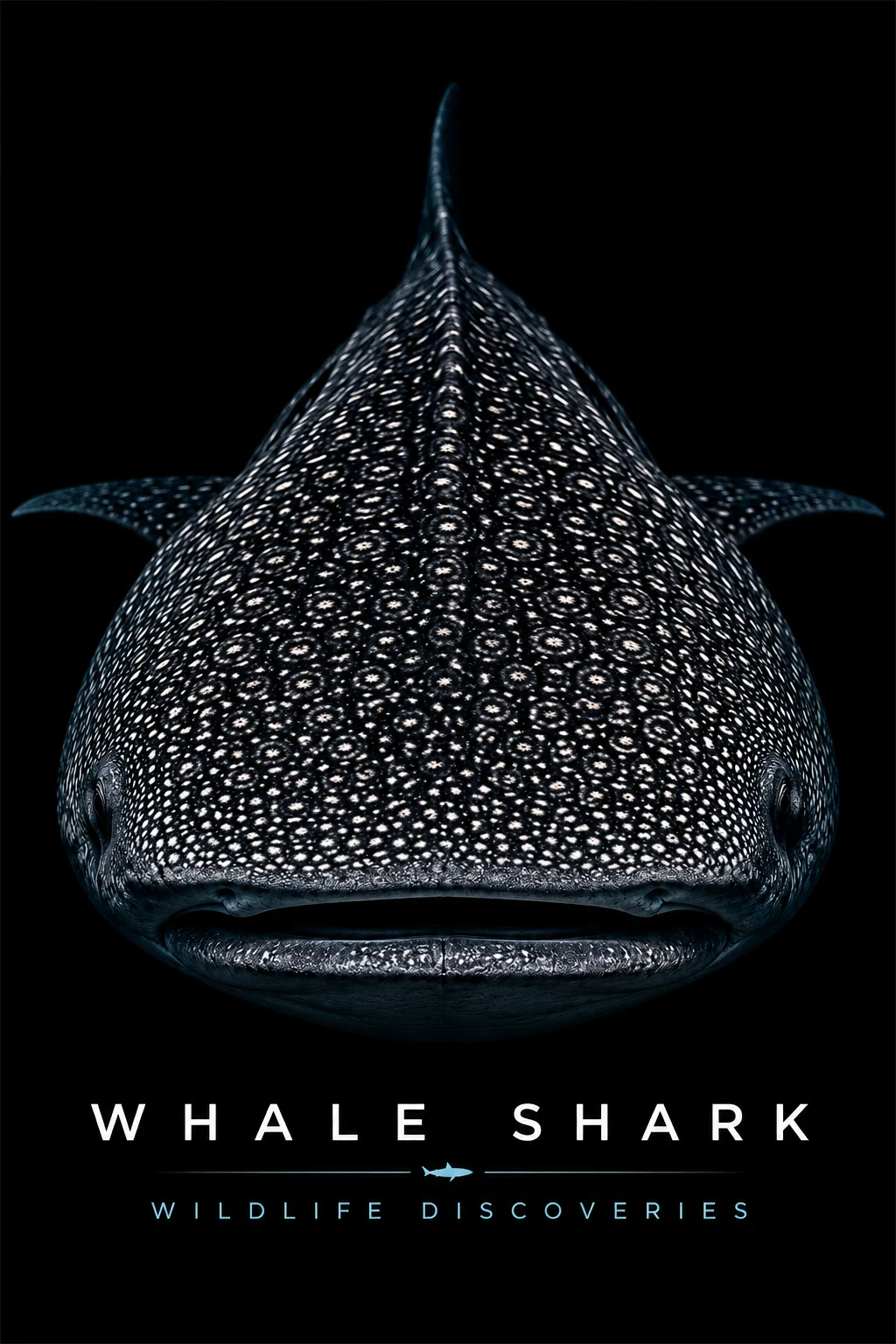
Its skin is a fingerprint. Each whale shark has a completely unique pattern of pale yellow spots and stripes across a dark grey-blue back. Researchers use photo-identification databases to track individual sharks over decades using this pattern alone, the same way investigators use human fingerprints.
Its true lifespan was only confirmed recently. For years, “70 to 100 years” was the standard guess, based on modeling and growth-ring counts in vertebrae — some studies even suggested up to 130 years. In 2020, scientists finally got hard proof using an unusual method: Cold War-era nuclear bomb tests temporarily doubled atmospheric carbon-14 levels, and that spike got absorbed into whale shark vertebrae just like it did into everything else in the ocean. By measuring that radiocarbon signature, researchers confirmed one stranded shark was at least 50 years old when it died — the first hard-verified age for the species — while acknowledging the largest individuals could plausibly live a century or more.
It’s older than most people realize — but not as ancient as some blogs claim. You’ll often see whale sharks described as “240 million years old,” but that number actually refers to sharks as a broad group, not this species. The fossil record tells a more precise story: early relatives in the genus Palaeorhincodon appear in rock layers from the Late Paleocene to Early Eocene, roughly 56 million years ago, and the modern genus Rhincodon — the whale shark as we’d recognize it today — shows up in the fossil record by the late Oligocene, around 28 million years ago, with some of the earliest specimens found in South Carolina’s Chandler Bridge Formation.
Either way, whale sharks were swimming the oceans long before humans existed. It just wasn’t until 1828, when British military surgeon Andrew Smith described a specimen harpooned in Table Bay, South Africa, that science formally caught up with them. Before the 1980s, fewer than 350 confirmed sightings existed in scientific records — this is a species we’ve only really begun to understand in the last few decades.
It’s harmless to humans. Whale sharks have roughly 300 rows of teeth lining their jaws, each tooth less than 6 millimeters long — but these teeth are vestigial and play no role in feeding at all. Instead, they rely entirely on filter-feeding through 20 specialized gill pads. (You’ll see this species credited with anywhere from 3,000 to 27,000 total teeth across different sources — researchers haven’t settled on one precise count, since the rows themselves are the consistently documented feature, not a total tally.)
How Much Do Whale Sharks Eat in a Day?
This is one of the most common questions people search alongside International Whale Shark Day, and the honest answer is: it depends heavily on the shark’s size and what food source is available.
A detailed study of whale sharks off the Yucatán Peninsula found that a six-meter juvenile shark spends roughly 7.5 hours a day actively feeding, filtering about 600 cubic meters of water per hour and extracting close to 21 kilograms (46 pounds) of plankton daily. Other estimates for young or medium-sized whale sharks land in a similar range — around 45 pounds of plankton per day under normal feeding conditions.
But that number can spike dramatically depending on the food source. At Isla Mujeres in Mexico, where hundreds of whale sharks gather seasonally to feed on tuna eggs, a medium-sized shark can consume around 142.5 kilograms of tuna eggs in a single day, adding up to roughly 43,000 kilocalories — for scale, that’s the caloric equivalent of about 8 kilograms of chocolate. Larger adults, which can weigh over 20 tons, are estimated to need several hundred pounds of food per day just to sustain their size.
Whale sharks pull this off through a feeding mechanism unlike almost anything else in the ocean: a mouth that can stretch more than four feet wide, gill openings lined with filtering pads that work something like a colander, and the ability to gulp roughly 10,000 gallons of seawater an hour while cruising slowly forward. Their diet is mostly plankton, krill, small crustaceans, fish eggs, and the occasional small schooling fish like anchovies or sardines — never anything resembling the large prey their size might suggest.
How Far Do Whale Sharks Travel in a Day?
Whale sharks are among the most well-traveled animals in the ocean, migrating enormous distances in search of seasonal plankton blooms, warmer water, and possibly mates.
Satellite tracking has produced some remarkable numbers, and the honest answer depends on what kind of movement you’re measuring. On a routine day around a feeding or aggregation site, whale sharks tend to cover more modest ground — a long-term photo-ID study at Donsol in the Philippines put typical daily movement at around 24 to 28 kilometers (roughly 15 to 17 miles).
But when a whale shark shifts into full migratory mode, that pace picks up considerably: large females have been recorded covering an average of 67 kilometers (about 42 miles) in a single day while on long migratory routes. In one of the most famous tracking studies ever conducted, a female whale shark named “Anne” was tagged near Panama’s Coiba Island in 2011 and tracked for 841 days as she swam more than 20,142 kilometers (over 12,500 miles) — crossing the entire Pacific Ocean from the eastern Pacific near Central America to the Mariana Trench near Japan and the Philippines. That’s roughly halfway around the planet, and it remains the longest migration ever recorded for the species.
Regional tracking studies tell a similar story on a smaller scale: whale sharks tagged off Mozambique’s coast traveled an average of 738 kilometers over about a month, moving at roughly 28 kilometers per day, with some individuals covering over 2,700 kilometers before their tags stopped transmitting. Despite these vast distances, whale sharks aren’t fast swimmers — they typically cruise at only about 5 kilometers per hour, relying on time and endurance rather than speed to cover so much ocean.
The interactive tracker below retraces Anne’s full 20,142 km Pacific crossing and overlays it against major commercial shipping corridors — a visual of exactly why the ship-strike research above matters so much, and exactly the kind of data International Whale Shark Day 2026 campaigns are built around.
Where Whale Sharks Live
Whale sharks inhabit warm, tropical, and subtropical waters across nearly the entire globe — with the notable exception of the Mediterranean Sea. Scientists generally split the global population into two major subgroups: an Indo-Pacific subpopulation, which holds roughly three-quarters of all whale sharks, and a smaller Atlantic subpopulation. They’re typically found near the surface, preferring water temperatures above 70°F (21°C), though they’re also capable of diving to extraordinary depths — tracked individuals have been recorded diving beyond 1,900 meters (over 6,000 feet).
Some of the best-known whale shark hotspots — many of which host their own local events tied to International Whale Shark Day — include:
- Isla Holbox and Isla Mujeres, Mexico — the birthplace of the observance and one of the largest seasonal aggregations on Earth
- Ningaloo Reef, Australia — famous for a reliable spring aggregation tied to coral spawning
- Oslob and Donsol, Philippines — popular (and controversial, due to tourism practices) year-round viewing sites
- South Ari Atoll, Maldives — one of the few places whale sharks can be seen almost year-round
- The northern Gulf of Mexico, particularly near Louisiana’s Ewing Bank, a key feeding and aggregation site tracked extensively by NOAA
How to Celebrate International Whale Shark Day
You don’t need to be a marine biologist or live near the ocean to take part. Here’s how people typically mark National Whale Shark Day and International Whale Shark Day each August 30:
- Learn and share. Post a fact, photo, or short video about whale sharks on social media — even a simple “Happy International Whale Shark Day” caption paired with real information helps push awareness further than most people expect.
- Support the scientists. Organizations like the Marine Megafauna Foundation and the Elasmobranch Institute Indonesia rely on public funding to deploy satellite tags — the exact telemetry data behind the shipping-lane and high-seas findings covered above, and the evidence that eventually convinces governments to reroute vessels or protect habitat.
- Choose responsible tourism. If you ever get the chance to swim with whale sharks in hotspots like Mexico, the Philippines, or Australia, pick operators that follow strict no-touch, no-feeding, respectful-distance policies — irresponsible tourism practices can stress the animals and disrupt natural feeding behavior.
- Reduce single-use plastic. Since whale sharks feed by blindly filtering huge volumes of surface water, they’re especially vulnerable to ingesting microplastics and larger debris. Small everyday choices genuinely add up at the population level.
- Speak up. Share facts on social media using tags like #WhaleSharkDay or #InternationalWhaleSharkDay. Awareness drives funding, and funding drives the policy changes that protect the species long after August 30 has passed.
- Visit an aquarium event. Many aquariums run special International Whale Shark Day programming, talks, and fundraisers around August 30 — a good way to get kids interested in ocean conservation.
Frequently Asked Questions
When is International Whale Shark Day?
August 30, every year, without fail.
Is Whale Shark Day the same as National Whale Shark Day?
Yes — “International Whale Shark Day,” “World Whale Shark Day,” and “National Whale Shark Day” all refer to the same August 30 observance; the naming just varies by source or region.
Are whale sharks actually endangered?
Yes. The IUCN reclassified whale sharks from vulnerable to endangered in 2016, citing population declines driven mainly by fishing, bycatch, and habitat pressure. More recent research adds a growing concern: climate-driven habitat shifts that could push whale sharks into busy shipping lanes, sharply raising ship-strike risk by 2100.
Are whale sharks dangerous to humans?
No. Despite their size, whale sharks are filter feeders with no interest in — or ability to — prey on humans. They’re widely considered one of the gentlest large animals in the ocean.
Final Thoughts
International Whale Shark Day isn’t really about one 24-hour window on the calendar — it’s a yearly checkpoint for a species that’s easy to overlook precisely because it’s so enormous, so slow-moving, and so rarely seen up close. Every August 30, the goal is the same: turn curiosity about the world’s biggest fish into real support for keeping it around for the next 260 million years.